


QDM- Effect of breeding related stress
 12-25-2009 | 02:05 PM
#21
Nontypical Buck
Joined: Apr 2008
Posts: 3,879
Likes: 0

Alright bluebird. Since you love disagreeing with me, why don't you provide me with your explanation concerning the three examples I provided. I put forth my theory, you pulled out bits and pieces to argue definitions, while claiming that some of the FACTS I put forth are negligible.
Now you tell me, why did the dominant buck I've watched for three years have such lower antler growth rate than his subordinate counterpart. Also, why did the same scenario play out at MSU under Ozaga? Please enlighten me.
Now you tell me, why did the dominant buck I've watched for three years have such lower antler growth rate than his subordinate counterpart. Also, why did the same scenario play out at MSU under Ozaga? Please enlighten me.
Dr. Randy DeYoung’s article in the October 2005 issue of Quality Whitetails explained this concept and documented through research that breeding is done by bucks of all age classes, irrespective of the herd’s age structure. Yearlings and 2½-year-olds even get in on the action on the King Ranch in Texas, where more than 50 percent of the bucks are 3½ years of age or older. Randy’s research also showed bucks that successfully breed do not sire many fawns. The most prolific buck in their studies only sired six fawns in a single year, and on one study site successful bucks averaged less than three fawns per year over an 11-year period. Anna Bess Sorin found similar results in a Michigan deer herd where 17 bucks sired 67 fawns for an average of 3.9 fawns per buck. Individual bucks sired anywhere from one to nine fawns in her study.
Dominant bucks don’t monopolize the breeding, and they don’t even sire all of the fawns from each doe they breed. Black bear biologists have known for years that a litter of cubs could easily have more than one father, but multiple paternity in whitetails is relatively new information. Randy and his colleagues were the first to report on this. Their study of captive deer revealed multiple paternity occurred in about 24 percent of compound litters. Approximately one in four sets of twins or triplets had two fathers! This means does are breeding with multiple bucks, which further clarifies that individual whitetail bucks do not monopolize breeding.
Dominant bucks don’t monopolize the breeding, and they don’t even sire all of the fawns from each doe they breed. Black bear biologists have known for years that a litter of cubs could easily have more than one father, but multiple paternity in whitetails is relatively new information. Randy and his colleagues were the first to report on this. Their study of captive deer revealed multiple paternity occurred in about 24 percent of compound litters. Approximately one in four sets of twins or triplets had two fathers! This means does are breeding with multiple bucks, which further clarifies that individual whitetail bucks do not monopolize breeding.
 12-25-2009 | 02:24 PM
#22
Nontypical Buck
Joined: Apr 2003
Posts: 1,313
Likes: 0
From: York, PA.
I didn't know that by "in mature" you meant "immature". You're assuming a lot of things here, and you may not be trying to be rude, but when you make false claims (that I don't know what I'm talking about, and I just read it in a mag.) attempting to undermine my credibility and belittle my knowledge I do take offense (not that big of a deal though, I'll get over it ). I never read anything I've claimed in this post from a magaizine. Instead, I've heard it first hand from multiple nationally recognized managers, researchers, biologists, and authors. As I mentioned, the 10 to 1 ratio I was claiming was a hypothetical situation. As far as it being impossible to reach a ratio greater than 3 to 1, what ratio are we talking about, adult sex ratio, or antlered to antlerless ratio?
One distiction I have failed to clarify is that of rutting behavior, and breeding related stress. While they're not mutually exclusive, that are distinct entities. There are a LOT of different rutting behaviors (fighting, breeding, chasing, etc.). To think that all of these activies contribute the same amount of breeding stress as the other is logically flawed. I feel it is possible to increase certain rutting behaviors, while still decreasing the overall impact of breeding related stress.
I will elaborate on the third example in my original post to clarify my stance. Again, keep in mind this is hypotheical; I simply want to demonstrate my views conceptually. My buddy witnessed 44 deer in one field one night: 43 doe, 1 yearling buck. Because all does will not get bred, this herd is in for a lengthy, drawn out rut. Keep in mind that the lone buck is absorbing all the stress (breeding, chasing, etc.) from that extended rut. Now lets say we took the same herd, instead this time theres 43 doe and 43 bucks. In this scenario we expect to see a decrease in the lenth of the rut because there is an increased likelihood all does will be bred on their 1st cycle. We would obviously expect to see more fighting, because there is increased competition for breeding rights. We also expect to see a decrease in the number of does bread by an individual buck (there's more bucks around to breed, so each has to breed a lesser number of does).
What I'm getting at is that your hypothesizing as to which breeding activities have a greater impact of their level of stress. You say fighting, I say length of rut. It's impossible to pull out what factors have what effect. IMO I would take the herd with the even buck/doe ratio, because the stress will get absorbed by a larger number of bucks. Each buck has to breed a lesser number of does, and will be active for a much shorted period of time. A rigorous 2 week rut allows them to get back to nutrition and recoupng their bodies faster than a 1.5 month rut that prevents them from physically recovering for at least another month.
). I never read anything I've claimed in this post from a magaizine. Instead, I've heard it first hand from multiple nationally recognized managers, researchers, biologists, and authors. As I mentioned, the 10 to 1 ratio I was claiming was a hypothetical situation. As far as it being impossible to reach a ratio greater than 3 to 1, what ratio are we talking about, adult sex ratio, or antlered to antlerless ratio? One distiction I have failed to clarify is that of rutting behavior, and breeding related stress. While they're not mutually exclusive, that are distinct entities. There are a LOT of different rutting behaviors (fighting, breeding, chasing, etc.). To think that all of these activies contribute the same amount of breeding stress as the other is logically flawed. I feel it is possible to increase certain rutting behaviors, while still decreasing the overall impact of breeding related stress.
I will elaborate on the third example in my original post to clarify my stance. Again, keep in mind this is hypotheical; I simply want to demonstrate my views conceptually. My buddy witnessed 44 deer in one field one night: 43 doe, 1 yearling buck. Because all does will not get bred, this herd is in for a lengthy, drawn out rut. Keep in mind that the lone buck is absorbing all the stress (breeding, chasing, etc.) from that extended rut. Now lets say we took the same herd, instead this time theres 43 doe and 43 bucks. In this scenario we expect to see a decrease in the lenth of the rut because there is an increased likelihood all does will be bred on their 1st cycle. We would obviously expect to see more fighting, because there is increased competition for breeding rights. We also expect to see a decrease in the number of does bread by an individual buck (there's more bucks around to breed, so each has to breed a lesser number of does).
What I'm getting at is that your hypothesizing as to which breeding activities have a greater impact of their level of stress. You say fighting, I say length of rut. It's impossible to pull out what factors have what effect. IMO I would take the herd with the even buck/doe ratio, because the stress will get absorbed by a larger number of bucks. Each buck has to breed a lesser number of does, and will be active for a much shorted period of time. A rigorous 2 week rut allows them to get back to nutrition and recoupng their bodies faster than a 1.5 month rut that prevents them from physically recovering for at least another month.
10 years ago I thought the same way you currently do (nothing wrong with that) But what we have seen with our own eye's over the last 10 years contradicts much of what I have learned from talking with biologists, and studying about breeding behavior.
when we started out our goal was to improve the health of the herd including to get our bucks thru the breeding season in as good of shape as possible and also get our entire deer herd thru the winter in as good of shape as possible. To acheive this we have havested as many doe's as possible prior to the rut as we can, shoot as many doe's thru out the season in every age class (including female fawns) Our goals were to shorten the rut aswell as shorten the fawning season, the reason we tried to shorten the fawning season was to overwelm the huge population of yotes and bobcats that we have thus reducing the amount of fawn mortality due to prededation. Well over the years we have acheived alot of our goals from having the majority of our buck population in the 3.5 year old age class and older aswell as acheive a perfect buck to doe ratio and also to bring our deer population in regards to deer per square mile in line with the habitat to insure that we have a healthy habitat for all species. (the area of SE. OH. my property is located in is what I would consider bigwoods with very little AG crops) so having a healthy habitat is crucial for our bucks to reach their true genetic potential. But to my amazement the 2 goals we havent acheived is to shorten the breeding period and the fawning period, The main reasons we have not acheived these goals had nothing to do with buck to doe ratio's or having older age classes of bucks present, it is because doe's will come into estrous from Oct. thru Jan. regardless of the buck to doe ratio and the presence of a natural breeding ecology. When you have a healthy herd and a healthy habitat the majority of our doe fawns come into estrous anywhere from Late Nov. thru late Jan. it all depends when the particular doe fawn reaches a body weight of 76-80lbs.
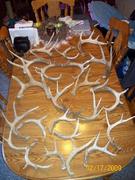
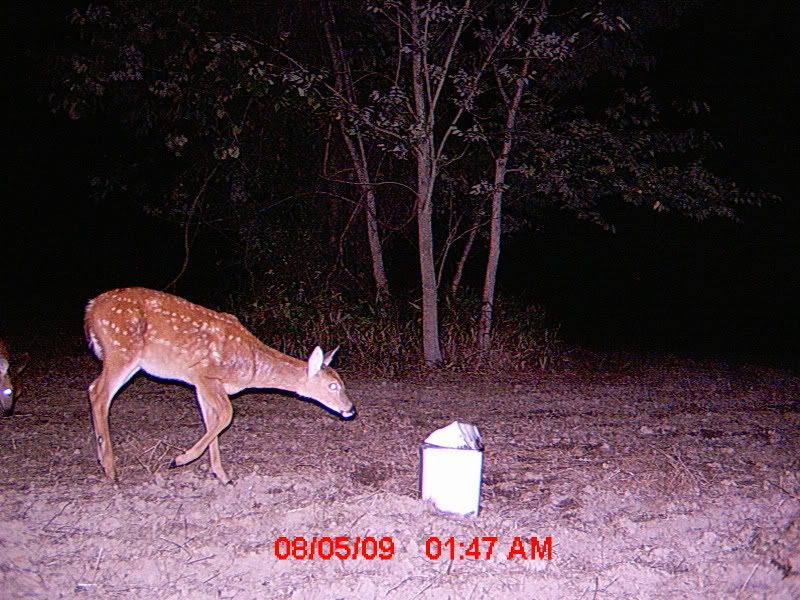
This fact is the reason as of why we have been unable to shorten our breeding season and fawning season aswell as the reason why our bucks of every age class are searching, fighting, rubbing, scraping and chasing from Oct. thru Jan. And trust me when I tell you that the presence of older age classes of bucks does nothing to deter our 1.5 and 2.5 year old bucks from trying to pass on their genes, (as seen in the pics above) their urge to breed is no different than the in mature bucks I grew up hunting here in PA.
As far as it being impossible to have a buck to doe ratio of over 1:3, I was talking about antlered male deer to female deer and just to let you know we have never had a buck to doe ratio here in PA. higher than 1:2 even prior to AR., Now according to DR. Valirous Geist (the leading biologist in regards to wild Ungulites in the world) he states that in a natural unhunted herd you will have a buck to doe ratio of 1:1.3. So our out of wack buck to doe ratio of 1:2 here in PA. prior to AR. wasnt that much different than a natural or "" perfect "" buck to doe ratio of 1:3. Pike
Last edited by J Pike; 12-25-2009 at 02:33 PM.
12-25-2009 | 04:10 PM
#23
Fork Horn
Joined: Nov 2007
Posts: 106
Likes: 0
From:

 12-25-2009 | 04:45 PM
#24
Thread Starter
Typical Buck
Joined: May 2005
Posts: 657
Likes: 0
From: SE PA
I notice from your signature that you are always subordinate to a "dominant buck" in your various positions. I'm wondering if your own testosterone is depressed as a result and, if, as a consequence, you devote your energy to building your body and not to chasing "does."
12-25-2009 | 04:54 PM
#25
Thread Starter
Typical Buck
Joined: May 2005
Posts: 657
Likes: 0
From: SE PA
You're 100% wrong, and once again it goes back to you cutting down ARs every chance you get, even when they have nothing to do with the conversation at hand. I went to a 2hr Kroll seminar this summer in which he specifically talked about the once a spike always a spike montra. They found that these "inferior" bucks ALWAYS caught up in antler growth by maturity (4.5). As I stated in my first post, the dominant buck was a perfect 8pt at 3.5, and returned as a 7pt at maturity. Even if what you said was true, it would not explain why this buck lost a point at maturity, and peaked at 4.5, when his subordinate counterpart added points from 3-4, and added inches from 4-5. So again I ask, do you have a plausible explanation as to why this happened.
12-25-2009 | 05:06 PM
#26
Nontypical Buck
Joined: Apr 2008
Posts: 3,879
Likes: 0
You're 100% wrong, and once again it goes back to you cutting down ARs every chance you get, even when they have nothing to do with the conversation at hand. I went to a 2hr Kroll seminar this summer in which he specifically talked about the once a spike always a spike montra. They found that these "inferior" bucks ALWAYS caught up in antler growth by maturity (4.5).
Even if what you said was true, it would not explain why this buck lost a point at maturity, and peaked at 4.5, when his subordinate counterpart added points from 3-4, and added inches from 4-5. So again I ask, do you have a plausible explanation as to why this happened.
12-25-2009 | 07:04 PM
#27
Thread Starter
Typical Buck
Joined: May 2005
Posts: 657
Likes: 0
From: SE PA
Point taken. I still don't feel that Krolls findings explain a buck regressing in antler points from 3-4. As you noted, however, very small sample size.
Last edited by glew22; 12-25-2009 at 07:32 PM.
12-25-2009 | 09:22 PM
#28
Nontypical Buck
Joined: Nov 2008
Posts: 1,712
Likes: 0
From: Poconos, PA
Well since i was the hunter who took the 4.5 year old buck in the example glew gave i felt obligated to post on the thread. i do not have much to offer due to only dealing with small samples and not wanting to draw any conclusions before further research and observations. But i was curious how the buck to doe ratio can never be higher than 1:3 because from my observations in the last 6 years in my area the buck to doe ratio seems to be at least 1:6. I am sure in restricted areas the buck to doe ratio can be higher than the one you supplied, cant it pike?
12-26-2009 | 04:03 AM
#29
Nontypical Buck
Joined: Apr 2008
Posts: 3,879
Likes: 0
Here is the answer.
Adult Sex Ratios
By: Kip Adams
Hunters often ask about the sex ratio of the deer herd where they hunt and then compare that ratio to herds in other areas or states. There are a lot of misunderstandings regarding sex ratios and this article will help clarify some misconceptions. First, what is a sex ratio, what animals are used to determine it and when is it measured? The sex ratio is a number describing the number of adult females for each adult male in a population. The number includes deer 1.5 years and older (all deer except fawns) and describes the population immediately preceding the hunting season. When comparing ratios, make sure you are referring to pre-hunt adult sex ratios. These are the ratios biologists most often refer to, and they should not be confused with observed or post-hunt ratios as the latter are nearly always heavily skewed towards females.
I often hear hunters, outdoor writers, and even biologists refer to 10:1 or 15:1 doe:buck ratios. These cannot be pre-hunt adult ratios because as long as the deer herd is reproducing and recruiting fawns, the ratio cannot become more skewed than about 5 does per buck. The biological maximum is about 5:1 because even in the absence of female harvest, 15-20% of adult females in the population will die each year from old age, vehicles, disease, predators, etc. Also, about 50% of fawns born each year are male, thus the sex ratio gets an annual correction when fawns are recruited. This concept is easier to understand with an example.
Let’s say a hypothetical population contains 120 adult deer (fawns not included).
Pre-hunt population = 100 does and 20 bucks (this is a 5:1 ratio)
During the hunting season let’s say hunters kill 90% (18) of the bucks and 0% (0) of the does.
Hunting mortality 0 does and 18 bucks
Post-hunt population = 100 does and 2 bucks (50:1, heavily skewed after the hunt)
Natural mortality gets added next. Since there are very few bucks left in the population, very few will die from other causes. We’ll say 1 of the 2 remaining bucks dies. However, 15-20% of the does will die from natural causes. We’ll be conservative and use 15% (15 does).
Natural mortality 15 does and 1 buck
Remaining population = 85 does and 1 buck (85:1, the ratio is still heavily skewed)
For simplicity, we’ll say each doe recruits one fawn. This isn’t the number of fawns born but the number that survive to about six months of age. It’s important to realize this is a liberal recruitment rate as the national average is slightly less than one fawn per doe. The most reproductive herds in the country only recruit about 1.2 fawns per doe. For our example there will be 85 (about 43 buck and 42 doe) fawns. These won’t be added to the adult population until the following year but last year’s fawns get added this year. For simplicity, we’ll assume last year’s population had the same number of fawns and immigration and emigration are equal.
Recruitment 42 does and 43 bucks
Pre-hunt population = 127 does and 44 bucks (this is a 3:1 ratio)
This example is simplified but it demonstrates that pre-hunt adult sex ratios can’t become as skewed as many think. However, from a biological perspective, a 3:1 ratio is heavily skewed and reflects poor management on the deer population. This 3:1 ratio could lead to hunters observing 10 or more antlerless deer (females and fawns) per buck.
By: Kip Adams
Hunters often ask about the sex ratio of the deer herd where they hunt and then compare that ratio to herds in other areas or states. There are a lot of misunderstandings regarding sex ratios and this article will help clarify some misconceptions. First, what is a sex ratio, what animals are used to determine it and when is it measured? The sex ratio is a number describing the number of adult females for each adult male in a population. The number includes deer 1.5 years and older (all deer except fawns) and describes the population immediately preceding the hunting season. When comparing ratios, make sure you are referring to pre-hunt adult sex ratios. These are the ratios biologists most often refer to, and they should not be confused with observed or post-hunt ratios as the latter are nearly always heavily skewed towards females.
I often hear hunters, outdoor writers, and even biologists refer to 10:1 or 15:1 doe:buck ratios. These cannot be pre-hunt adult ratios because as long as the deer herd is reproducing and recruiting fawns, the ratio cannot become more skewed than about 5 does per buck. The biological maximum is about 5:1 because even in the absence of female harvest, 15-20% of adult females in the population will die each year from old age, vehicles, disease, predators, etc. Also, about 50% of fawns born each year are male, thus the sex ratio gets an annual correction when fawns are recruited. This concept is easier to understand with an example.
Let’s say a hypothetical population contains 120 adult deer (fawns not included).
Pre-hunt population = 100 does and 20 bucks (this is a 5:1 ratio)
During the hunting season let’s say hunters kill 90% (18) of the bucks and 0% (0) of the does.
Hunting mortality 0 does and 18 bucks
Post-hunt population = 100 does and 2 bucks (50:1, heavily skewed after the hunt)
Natural mortality gets added next. Since there are very few bucks left in the population, very few will die from other causes. We’ll say 1 of the 2 remaining bucks dies. However, 15-20% of the does will die from natural causes. We’ll be conservative and use 15% (15 does).
Natural mortality 15 does and 1 buck
Remaining population = 85 does and 1 buck (85:1, the ratio is still heavily skewed)
For simplicity, we’ll say each doe recruits one fawn. This isn’t the number of fawns born but the number that survive to about six months of age. It’s important to realize this is a liberal recruitment rate as the national average is slightly less than one fawn per doe. The most reproductive herds in the country only recruit about 1.2 fawns per doe. For our example there will be 85 (about 43 buck and 42 doe) fawns. These won’t be added to the adult population until the following year but last year’s fawns get added this year. For simplicity, we’ll assume last year’s population had the same number of fawns and immigration and emigration are equal.
Recruitment 42 does and 43 bucks
Pre-hunt population = 127 does and 44 bucks (this is a 3:1 ratio)
This example is simplified but it demonstrates that pre-hunt adult sex ratios can’t become as skewed as many think. However, from a biological perspective, a 3:1 ratio is heavily skewed and reflects poor management on the deer population. This 3:1 ratio could lead to hunters observing 10 or more antlerless deer (females and fawns) per buck.
12-26-2009 | 04:15 AM
#30
Nontypical Buck
Joined: Apr 2008
Posts: 3,879
Likes: 0
Unless the buck had a specific deformity , how can you be sure it is the same buck and not one of his off spring?
BTW, anomalies like that are rather common in nature and shouldn't be used to support a theory on breeding stress. As yet, I have not found a single article or study that supports your claim that breeding stress effects antler development.