Originally Posted by
glew22
I didn't know that by "in mature" you meant "immature". You're assuming a lot of things here, and you may not be trying to be rude, but when you make false claims (that I don't know what I'm talking about, and I just read it in a mag.) attempting to undermine my credibility and belittle my knowledge I do take offense (not that big of a deal though, I'll get over it

). I never read anything I've claimed in this post from a magaizine. Instead, I've heard it first hand from multiple nationally recognized managers, researchers, biologists, and authors. As I mentioned, the 10 to 1 ratio I was claiming was a hypothetical situation. As far as it being impossible to reach a ratio greater than 3 to 1, what ratio are we talking about, adult sex ratio, or antlered to antlerless ratio?
One distiction I have failed to clarify is that of rutting behavior, and breeding related stress. While they're not mutually exclusive, that are distinct entities. There are a LOT of different rutting behaviors (fighting, breeding, chasing, etc.). To think that all of these activies contribute the same amount of breeding stress as the other is logically flawed. I feel it is possible to increase certain rutting behaviors, while still decreasing the overall impact of breeding related stress.
I will elaborate on the third example in my original post to clarify my stance. Again, keep in mind this is hypotheical; I simply want to demonstrate my views conceptually. My buddy witnessed 44 deer in one field one night: 43 doe, 1 yearling buck. Because all does will not get bred, this herd is in for a lengthy, drawn out rut. Keep in mind that the lone buck is absorbing all the stress (breeding, chasing, etc.) from that extended rut. Now lets say we took the same herd, instead this time theres 43 doe and 43 bucks. In this scenario we expect to see a decrease in the lenth of the rut because there is an increased likelihood all does will be bred on their 1st cycle. We would obviously expect to see more fighting, because there is increased competition for breeding rights. We also expect to see a decrease in the number of does bread by an individual buck (there's more bucks around to breed, so each has to breed a lesser number of does).
What I'm getting at is that your hypothesizing as to which breeding activities have a greater impact of their level of stress. You say fighting, I say length of rut. It's impossible to pull out what factors have what effect. IMO I would take the herd with the even buck/doe ratio, because the stress will get absorbed by a larger number of bucks. Each buck has to breed a lesser number of does, and will be active for a much shorted period of time. A rigorous 2 week rut allows them to get back to nutrition and recoupng their bodies faster than a 1.5 month rut that prevents them from physically recovering for at least another month.
glew first I apologize if I offended you in any way, I didnt mean too. Today being Christmas and all I didnt have much time to say or put in the proper words what I was trying to say.
10 years ago I thought the same way you currently do (nothing wrong with that) But what we have seen with our own eye's over the last 10 years contradicts much of what I have learned from talking with biologists, and studying about breeding behavior.
when we started out our goal was to improve the health of the herd including to get our bucks thru the breeding season in as good of shape as possible and also get our entire deer herd thru the winter in as good of shape as possible. To acheive this we have havested as many doe's as possible prior to the rut as we can, shoot as many doe's thru out the season in every age class (including female fawns) Our goals were to shorten the rut aswell as shorten the fawning season, the reason we tried to shorten the fawning season was to overwelm the huge population of yotes and bobcats that we have thus reducing the amount of fawn mortality due to prededation. Well over the years we have acheived alot of our goals from having the majority of our buck population in the 3.5 year old age class and older aswell as acheive a perfect buck to doe ratio and also to bring our deer population in regards to deer per square mile in line with the habitat to insure that we have a healthy habitat for all species. (the area of SE. OH. my property is located in is what I would consider bigwoods with very little AG crops) so having a healthy habitat is crucial for our bucks to reach their true genetic potential. But to my amazement the 2 goals we havent acheived is to shorten the breeding period and the fawning period, The main reasons we have not acheived these goals had nothing to do with buck to doe ratio's or having older age classes of bucks present, it is because doe's will come into estrous from Oct. thru Jan. regardless of the buck to doe ratio and the presence of a natural breeding ecology. When you have a healthy herd and a healthy habitat the majority of our doe fawns come into estrous anywhere from Late Nov. thru late Jan. it all depends when the particular doe fawn reaches a body weight of 76-80lbs.
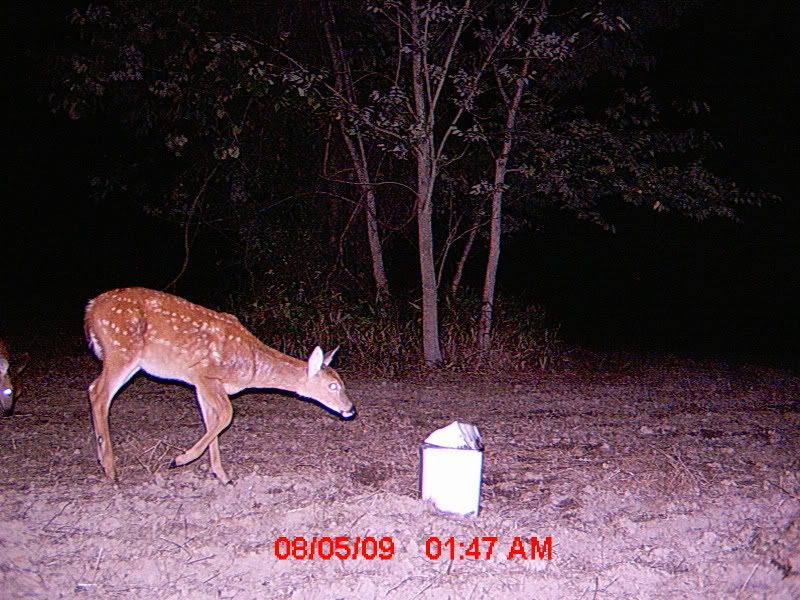
This fact is the reason as of why we have been unable to shorten our breeding season and fawning season aswell as the reason why our bucks of every age class are searching, fighting, rubbing, scraping and chasing from Oct. thru Jan. And trust me when I tell you that the presence of older age classes of bucks does nothing to deter our 1.5 and 2.5 year old bucks from trying to pass on their genes, (as seen in the pics above) their urge to breed is no different than the in mature bucks I grew up hunting here in PA.
As far as it being impossible to have a buck to doe ratio of over 1:3, I was talking about antlered male deer to female deer and just to let you know we have never had a buck to doe ratio here in PA. higher than 1:2 even prior to AR., Now according to DR. Valirous Geist (the leading biologist in regards to wild Ungulites in the world) he states that in a natural unhunted herd you will have a buck to doe ratio of 1:1.3. So our out of wack buck to doe ratio of 1:2 here in PA. prior to AR. wasnt that much different than a natural or "" perfect "" buck to doe ratio of 1:3. Pike