


QDM- Effect of breeding related stress
 12-26-2009 | 08:46 AM
#31
Nontypical Buck
Joined: Apr 2003
Posts: 1,313
Likes: 0
From: York, PA.

Hunt Kip's article that bluebird posted pretty much sums it up. Here in PA. we have never had a buck to doe ratio of higher than 1:2 even prior to AR.
By the way your buck was a tremendous PA. public land buck, congrads again! Pike
By the way your buck was a tremendous PA. public land buck, congrads again! Pike
Last edited by J Pike; 12-26-2009 at 08:49 AM.
 12-26-2009 | 12:07 PM
#32
Thread Starter
Typical Buck
Joined: May 2005
Posts: 657
Likes: 0
From: SE PA
Go back and look at the photos I included in my first post. Note the cleft lip appearance on the right side of his lower jaw (his right side). It's the same buck.
12-26-2009 | 12:20 PM
#33
Nontypical Buck
Joined: Apr 2008
Posts: 3,879
Likes: 0
So you have a buck with a deformity and you wonder why the antler growth is abnormal? Interesting.
Also, is there a reason you didn't comment about the quote I posted about the latest research on dominant breeding?
Also, is there a reason you didn't comment about the quote I posted about the latest research on dominant breeding?
12-26-2009 | 02:56 PM
#34
Nontypical Buck
Joined: Feb 2003
Posts: 1,983
Likes: 0
From: Sturgis, SD
glew, interesting observations. But, they are observations and opinion only. There is no proof for your theory, only your opinions.
You can't take two or three deer out of an entire population and make any kind meaningful observations about the herd or species as a whole. How about random chance that the racks are of a different size and the testosterone levels are lower in some deer? Without a properly designed study and statistical analysis there are no facts, no results and no conclusions that can be drawn. You are taking a dependant variable and randomly applying or discounting the variables.
Without any real data you can't really have an educated discussion about the topic. Can discuss opinion and theory, none are more right or wrong than the other. Simply no data to support any points.
You can't take two or three deer out of an entire population and make any kind meaningful observations about the herd or species as a whole. How about random chance that the racks are of a different size and the testosterone levels are lower in some deer? Without a properly designed study and statistical analysis there are no facts, no results and no conclusions that can be drawn. You are taking a dependant variable and randomly applying or discounting the variables.
Without any real data you can't really have an educated discussion about the topic. Can discuss opinion and theory, none are more right or wrong than the other. Simply no data to support any points.
12-26-2009 | 05:04 PM
#35
Spike
Joined: Nov 2008
Posts: 70
Likes: 0
From: Pa
glew i for one found this to be a very interesting read. it is a very interesting point that i had never put much thought into.
when a buck grows his antlers each year he is robbing nutrients that would typically go into his body, which instead get absorbed into shaping his rack. nutrients that a well stressed buck desperately needs are being robbed by his antler development, so perhaps his body can somehow detect that the nutrients are more suited to not be "wasted" in antler development?
i believe stress plays a VERY big roll into the overall health of animals. It would be cool to know how much extra stress a mature buck undergoes as compared to an immature buck if any at all.
as far as hunting pressure i dont buy it, a 1.5 year old buck has no more pressure in an area then a 4.5 year old, if anything i would think the younger buck would be more pressured from my personal experience, as they are not as aware of what is going on and will be bumped and disturbed more than an older buck who has been there and knows its safety spots which allowed him to survive previous hunting seasons. lets face it if 4.5 year old bucks dont go strolling around the woods like 1.5 year olds ive seen countless 1.5 year old bucks while hunting and few 4.5 year olds, not that they aren’t there just that they go nocturnal and dont slip up typically until the rut kicks in. i dont think too many people would argue that they see more young bucks then mature bucks
however once the rut comes around its a different ball game. mature bucks get up and get moving. multiple times ive witness when a doe comes into heat a mature buck will be hot at foot. and i mean hot at foot, he wont leave her side she moves, he moves, when she feeds he stands there and watches or try’s to resume chase on her. and while all this is going on other bucks will be in the area due to the scent of doe in heat but they are not trailing her, they are keeping their distance from the mature buck and laying down or feeding hoping that he will lose her and they can take up chase. does this happen all the time? im not sure but from my experience ive always witness mature bucks expelling much more energy chasing doe.
also this may not be true in all cases but it seems from my experience once again that mature bucks cover more territory in search of a doe. where immature bucks will cover less territory.
a mature buck also has to hold his title as the dominate animal, mature bucks have been known to endure great amounts of energy in fighting, energy that they dont have the luxury to loose in this crucial time of year.
im not saying a mature buck will breed every doe that comes into heat, or that they will breed more then another buck, but i dont have a hard time at all believing that they do indeed exude more energy during the rut then immature bucks which could indeed lead to a loss in antler growth in comparison to other bucks... I would say I agree with glew’s research many times a buck with the most inches of antler in an area isn’t the dominate buck…just my .02 cents
when a buck grows his antlers each year he is robbing nutrients that would typically go into his body, which instead get absorbed into shaping his rack. nutrients that a well stressed buck desperately needs are being robbed by his antler development, so perhaps his body can somehow detect that the nutrients are more suited to not be "wasted" in antler development?
i believe stress plays a VERY big roll into the overall health of animals. It would be cool to know how much extra stress a mature buck undergoes as compared to an immature buck if any at all.
as far as hunting pressure i dont buy it, a 1.5 year old buck has no more pressure in an area then a 4.5 year old, if anything i would think the younger buck would be more pressured from my personal experience, as they are not as aware of what is going on and will be bumped and disturbed more than an older buck who has been there and knows its safety spots which allowed him to survive previous hunting seasons. lets face it if 4.5 year old bucks dont go strolling around the woods like 1.5 year olds ive seen countless 1.5 year old bucks while hunting and few 4.5 year olds, not that they aren’t there just that they go nocturnal and dont slip up typically until the rut kicks in. i dont think too many people would argue that they see more young bucks then mature bucks
however once the rut comes around its a different ball game. mature bucks get up and get moving. multiple times ive witness when a doe comes into heat a mature buck will be hot at foot. and i mean hot at foot, he wont leave her side she moves, he moves, when she feeds he stands there and watches or try’s to resume chase on her. and while all this is going on other bucks will be in the area due to the scent of doe in heat but they are not trailing her, they are keeping their distance from the mature buck and laying down or feeding hoping that he will lose her and they can take up chase. does this happen all the time? im not sure but from my experience ive always witness mature bucks expelling much more energy chasing doe.
also this may not be true in all cases but it seems from my experience once again that mature bucks cover more territory in search of a doe. where immature bucks will cover less territory.
a mature buck also has to hold his title as the dominate animal, mature bucks have been known to endure great amounts of energy in fighting, energy that they dont have the luxury to loose in this crucial time of year.
im not saying a mature buck will breed every doe that comes into heat, or that they will breed more then another buck, but i dont have a hard time at all believing that they do indeed exude more energy during the rut then immature bucks which could indeed lead to a loss in antler growth in comparison to other bucks... I would say I agree with glew’s research many times a buck with the most inches of antler in an area isn’t the dominate buck…just my .02 cents
12-26-2009 | 06:16 PM
#37
Nontypical Buck
Joined: Nov 2008
Posts: 1,712
Likes: 0
From: Poconos, PA
i dont think its a big leap at all to say that. if a bucks health from breeding related stress decreases in the fall and winter they have to put all their nutrition into rebuilding their body and getting it back to full health before putting the energy and nutrients into their antler growth. also since winter is the toughest time of the year for deer in terms of finding food in many places this isnt the best time to have their bodies in bad shape. if there are no food sources available in the winter they can easily die from lack of food and nutrition, as i have seen in my area several times.
This is also where a proper buck to doe ratio comes into play, as well as a low deer density so that any deer that needs to rebuild their body has the ability to find food to do so. My area of PA is over populated with deer and the browse line in the woods is at head height. There is no browse for the deer this time of the year and with icy conditions occuring often it is hard for them to dig up the food that they need. Many people feed them corn in the winter, but when a deers natural diet is acorns and browse, corn does not do much to help them unless it is supplied year round as a supplimental food source.
Due to these factors, many deer are still recovering from the rut well into spring when antler growth is occuring. And also antler growth doesnt begin in june, it occurs as soon as their antlers fall off so it really isnt that long from the end of the rut to the beginning of antler growth. With a mast crop like we had this year in PA, deer were able to bulk up in fat which greatly helped them stay healthy through the rut and the winter. I have not seen many deer in poor physical condition this year, but i could certainly not say that in past years.
This is also where a proper buck to doe ratio comes into play, as well as a low deer density so that any deer that needs to rebuild their body has the ability to find food to do so. My area of PA is over populated with deer and the browse line in the woods is at head height. There is no browse for the deer this time of the year and with icy conditions occuring often it is hard for them to dig up the food that they need. Many people feed them corn in the winter, but when a deers natural diet is acorns and browse, corn does not do much to help them unless it is supplied year round as a supplimental food source.
Due to these factors, many deer are still recovering from the rut well into spring when antler growth is occuring. And also antler growth doesnt begin in june, it occurs as soon as their antlers fall off so it really isnt that long from the end of the rut to the beginning of antler growth. With a mast crop like we had this year in PA, deer were able to bulk up in fat which greatly helped them stay healthy through the rut and the winter. I have not seen many deer in poor physical condition this year, but i could certainly not say that in past years.
12-26-2009 | 06:51 PM
#38
Nontypical Buck
Joined: Feb 2003
Posts: 1,983
Likes: 0
From: Sturgis, SD
Then how do you explain the huge racks in Wisconsin, Minnesota, Canada, etc. States that have long hard winters. Should stand to reason that if rut stress along with winter stress is causing decreased growth of antlers then the Southern states should have the biggest deer.
12-26-2009 | 07:47 PM
#39
Nontypical Buck
Joined: Apr 2003
Posts: 1,313
Likes: 0
From: York, PA.
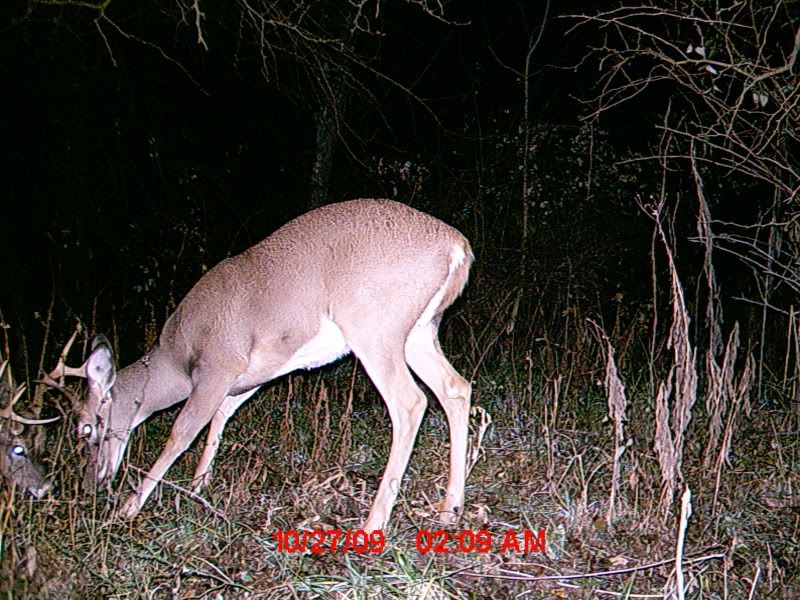
Guys I dont know what else to tell you. I have been studying breeding ecology and behavior of bucks for the last 10 years aswell as hunting a herd that has a natural breeding ecology and a perfect buck to doe ratio and our inmature bucks wear them themselves to darn near exhaustion searching, chasing and fighting all rut long. Heck in most instances when we see chasing it is usually from 1.5 year old bucks with our mature bucks no where to be found. I dont know what else say or what other pics of inmature bucks fighting or with broken racks but here is more pics of the smallest buck we have on our property fighting for over 22 minutes non stop!! The only other thing I can add is dont always believe what you read in hunting mags or at seminars etc. It wasnt too long along that the so called deer experts were claiming things like spikes will always be spikes, The moon phase affects the rut, that a doe couldnt give birth to 2 or more fawns that were sired by different bucks, that mineral supplements aid in growing larger antlers, that bucks ""RUBBED"" their velvet off, that you could have a buck to doe ratio of 1:10 and even 1:30. etc. etc. etc. Pike


Last edited by J Pike; 12-26-2009 at 07:59 PM.
12-26-2009 | 07:54 PM
#40
Thread Starter
Typical Buck
Joined: May 2005
Posts: 657
Likes: 0
From: SE PA
The reason that these deer have bigger bodies and antlers is because the further north you go the bigger their bodies get. Antlers are just an extension of the skeleton, and the rule goes with bigger bodies you see bigger antlers (look at moose/elk, etc). The underlyign reason here is that in cold climates you want small surface area relative to body mass to conserve heat, and in the south you want a lot of surface area relative to body mass to keep cool. TX deer seem to be the exception to this rule in regards to antler growth, and it's unknown why that is.
Last edited by glew22; 12-26-2009 at 07:57 PM.