
|
Originally Posted by wis_bow_huntr
(Post 3486699)
You cant use a 22 rim fire but you can use a 22Mag Centerfire. There is a little difference. The 22Mag is not a very popular load but it is sold in most sporting good stores.
|
Originally Posted by zrexpilot
(Post 3486705)
so then how does a bow and arrow kill with only 50lb KE ?
How come I can kill a cow with a .22LR with only 120 lb KE How come when someone places a bad shot on an animal with a 300 mag and 2500 lbs KE the deer is never found. I mean come on, you just blasted him with 2500 ft lbs kinetic energy why didnt he die. Why are there soldiers walking around with bullet wounds, how come that kinetic energy didnt kill them. An arrow cuts and slices which causes massive hemmoraging(sp) and blood loss,as well as deflating the lungs. Like I said,you want a hole through the heart/lungs but the massive shock waves kill and kill quickly.With a rifle, both do the job.This is why deer shot with high caliber guns drop in their tracks and deer shot with a .223 run for 100 yards leaving no blood. How do your shots to the neck kill ,even you bosted about the SHOCK(that shock is KE) as you put it. Hell,I opened up a deer I shot with a .270 once and there was NO LUNGS OR HEART,they were GONE.This was a 130 gr ppsp wicnchester.That was damage cause from massive shock. |
Federal sells two recommended for deer.....
.223 60gr Nosler Partition-Vital-Shok .223 55gr Barnes Triple Shok X bullet-Vital Shok |
lol always the guys who dont shoot a 223 sayin how a mag makes em drop lol i got a mag and they run sumtimes,and they drop too... and with my 223 they run sometimes, but they drop just as much lol
|
Originally Posted by TFOX
(Post 3487002)
Like I said,you want a hole through the heart/lungs but the massive shock waves kill and kill quickly.With a rifle, both do the job.This is why deer shot with high caliber guns drop in their tracks and deer shot with a .223 run for 100 yards leaving no blood. |
If you are confident with your shooting, no trouble's. However the .223 is a little light for most deer hunters.
|
Originally Posted by TFOX
(Post 3487002)
An arrow cuts and slices which causes massive hemmoraging(sp) and blood loss,as well as deflating the lungs.
Like I said,you want a hole through the heart/lungs but the massive shock waves kill and kill quickly.With a rifle, both do the job.This is why deer shot with high caliber guns drop in their tracks and deer shot with a .223 run for 100 yards leaving no blood. How do your shots to the neck kill ,even you bosted about the SHOCK(that shock is KE) as you put it. Hell,I opened up a deer I shot with a .270 once and there was NO LUNGS OR HEART,they were GONE.This was a 130 gr ppsp wicnchester.That was damage cause from massive shock. So why doesnt the KE or shock wave as you put it kill a deer when shot in the ass ? |
Originally Posted by zrexpilot
(Post 3487263)
So why doesnt the KE or shock wave as you put it kill a deer when shot in the ass ?
Please tell me your not serious.:confused0024: |
Originally Posted by ipscshooter
(Post 3487120)
Interesting. I've had as many deer drop in their tracks with my .243 as with my .30-06, and have had as many run 50 yards after the shot with my .30-06 as with my .243.
Good for you;) So according to your logic,a 22 outpenetrates a .223 so now it is better suited for deer. What about the damage to the shoulders,ever noticed how much more bruised they get from HIGH caliber than lower calibers.That same damage gets done to the vitals as well but I am glad you set me straight and we don't want or need ke in a rifle load.Glad to know they kill just like a bow. |
Originally Posted by TFOX
(Post 3487309)
Please tell me your not serious.:confused0024:
|
Originally Posted by zrexpilot
(Post 3487392)
just answer the question
It doesnt take a whole lot of trauma to stop a beating heart. |
[quote=ipscshooter;3484503]I thought this "theory" was pretty much discredited as a bunch of hokum...
What if you "transfer" all your energy penetrating the hide and the bone and then only get another 1/8" of penetration? The concept of "transferring all the energy" inside the game is absurd from a physics standpoint. What would you really rather have, a bullet that hits the front shoulder with 2500 ft lbs of energy, and then penetrates and hits the back shoulder with 2100 ft lbs of energy and then exits, or a bullet that hits the front shoulder with 2500 ft lbs of energy but, doesn't penetrate to the far shoulder, thus, that shoulder gets hit with 0 ft lbs? The energy transfers during the full penetration event. The first bullet will hit the front shoulder at 2500, the first lung at 2400, the heart at 2300 the second lung at 2200. The second bullet hits the front shoulder at 2500, the first lung at 1750, the heart at 1000, the second lung at 250, and then pretty much bounces harmlessly off the rear shoulder. If the bullet is slowing down to the point that it fails to penetrate, it's going to transfer less and less and less energy as it slows. The first animal's various organs are hit by a cumulative energy transfer of 11,500 ft lbs. The second gets hit by 5500.[/quote] What your saying is absurd... With two EVEN weighted bullits you could have exactly what you are saying. Im not sure what condition I would ever want this in unless I needed to shoot a tank but here we go... Keep in mind, both shots are the same, and they travel the same path... We will start with bullet 1. Bullet 1 has an initial impact of 2500#'s. It is a lead tipped bullet. Bullet 2 has the same specs as #1, except it is not meant to expand. It is meant for strictly penetration, so... its structure will stay composed at all times... Bullet 1 lodges in the opposite shoulder. Bullet 2 passes through cleanly. Upon exit, Bullet 1 left with 2000#'s of energy. Impressive on penetration yes. Which Bullet would you rather hit a deer with??? The one that leaves a bullet sized hole in the deer but only expends 500#'s as it travels through the deer, or the one that smacks it hard, expending all of its energy inside of the deer tearing the inside apart. You know which one did more damage! What you are saying above is true yes and can happen. But in equal circumstance, the bullet that is not passing through is OBVIOUSLY doing more damage:s4: |
[quote=drockw;3487483]
Originally Posted by ipscshooter
(Post 3484503)
I thought this "theory" was pretty much discredited as a bunch of hokum...
What if you "transfer" all your energy penetrating the hide and the bone and then only get another 1/8" of penetration? The concept of "transferring all the energy" inside the game is absurd from a physics standpoint. What would you really rather have, a bullet that hits the front shoulder with 2500 ft lbs of energy, and then penetrates and hits the back shoulder with 2100 ft lbs of energy and then exits, or a bullet that hits the front shoulder with 2500 ft lbs of energy but, doesn't penetrate to the far shoulder, thus, that shoulder gets hit with 0 ft lbs? The energy transfers during the full penetration event. The first bullet will hit the front shoulder at 2500, the first lung at 2400, the heart at 2300 the second lung at 2200. The second bullet hits the front shoulder at 2500, the first lung at 1750, the heart at 1000, the second lung at 250, and then pretty much bounces harmlessly off the rear shoulder. If the bullet is slowing down to the point that it fails to penetrate, it's going to transfer less and less and less energy as it slows. The first animal's various organs are hit by a cumulative energy transfer of 11,500 ft lbs. The second gets hit by 5500.[/quote] What your saying is absurd... With two EVEN weighted bullits you could have exactly what you are saying. Im not sure what condition I would ever want this in unless I needed to shoot a tank but here we go... Keep in mind, both shots are the same, and they travel the same path... We will start with bullet 1. Bullet 1 has an initial impact of 2500#'s. It is a lead tipped bullet. Bullet 2 has the same specs as #1, except it is not meant to expand. It is meant for strictly penetration, so... its structure will stay composed at all times... Bullet 1 lodges in the opposite shoulder. Bullet 2 passes through cleanly. Upon exit, Bullet 1 left with 2000#'s of energy. Impressive on penetration yes. Which Bullet would you rather hit a deer with??? The one that leaves a bullet sized hole in the deer but only expends 500#'s as it travels through the deer, or the one that smacks it hard, expending all of its energy inside of the deer tearing the inside apart. You know which one did more damage! What you are saying above is true yes and can happen. But in equal circumstance, the bullet that is not passing through is OBVIOUSLY doing more damage:s4: I might be wrong about this but isn't this what makes Full metal jacketed bullets illegal. |
Originally Posted by zrexpilot
(Post 3487392)
just answer the question
|
Thanks for turning me on to the thread; you're right -- that was worth a good laugh. :D
|
Greg / MO,
They need threads like this to blow off some steam. You know it's Fall now and I think these guys are coming into rut. That or estrus. LOL! iSnipe |
Originally Posted by TFOX
(Post 3487622)
drock handled it nicely,thanks.:patriot::happy0001:
copied and pasted. try and understand sport. The other popular contemporary misconception results from the assumption that the kinetic energy of the bullet is "transferred" to the target, thereby somehow killing it through "hydrostatic shock". I don't know where this term originated, but it is pseudoscience babble. In the first place, these are dynamic - not static - events. Moreover, "hydrostatic shock" is an oxymoron. Shock, in the technical sense, indicates a mechanical wave travelling in excess of the inherent sound speed of the material; it can't be static. This may be a flow related wave like a bow shock on the nose of a bullet in air or it may be a supersonic acoustic wave travelling through a solid after impact. In terms of bullets striking tissue, shock is never encountered. The sound speed of water (which is very close to that of soft tissue) is about 4900 fps. Even varmint bullets do not have an impact velocity this high, let alone a penetration velocity exceeding 4900 fps. Unless the bullet can penetrate faster than the inherent sound speed of the medium through which it is passing, you will not observe a shock wave. Instead, the bullet impact produces an acoustic wave which moves ahead of the penetration. This causes no damage. Some people use "shock" in the colloquial sense to describe a violent impact, but it is confusing, especially in connection with the term "hydrostatic" and lends undeserved quasi-scientific merit to the slang. It also tends to get confused with the medical expression attending trauma. We are not describing any medical shock. The word shock should never appear in a gun journal. The rate of energy transfer to the target is vastly more important than the quantity of energy transferred. This is the technical definition of power. Anyone sunbathing on a clear summer day at the beach will receive an irradiance equivalent to over 4600 ft-lbs every minute! Eventually, this bombardment by extremely high velocity particles will result in sunburn, but the body can withstand the energy it receives because it is spread over a large area and arrives at a relatively slow rate (compared with bullets). The power and intensity (power per unit area) is much less than ballistic events. Bullets which "overpenetrate" do not stop opponents as readily as those that remain in the body. Therefore, if the energy isn't "wasted" on exit, the bullet is more effective. Right? Not exactly. A bullet of a given construction and impact velocity will create a cavity of predictable dimensions over its path, whether it stops or penetrates completely. Therefore, if the hole created can penetrate all the way through, it causes more damage than if it stops at some point. The critical issue here is what sort of hole are we making, not whether it goes all the way through. "Overpenetration" is a misnomer. The ineffective stopping attributed to overpenetration is actually caused by "undercavitation". |
Originally Posted by zrexpilot
(Post 3487911)
copied and pasted.
try and understand sport. The other popular contemporary misconception results from the assumption that the kinetic energy of the bullet is "transferred" to the target, thereby somehow killing it through "hydrostatic shock". I don't know where this term originated, but it is pseudoscience babble. In the first place, these are dynamic - not static - events. Moreover, "hydrostatic shock" is an oxymoron. Shock, in the technical sense, indicates a mechanical wave travelling in excess of the inherent sound speed of the material; it can't be static. This may be a flow related wave like a bow shock on the nose of a bullet in air or it may be a supersonic acoustic wave travelling through a solid after impact. In terms of bullets striking tissue, shock is never encountered. The sound speed of water (which is very close to that of soft tissue) is about 4900 fps. Even varmint bullets do not have an impact velocity this high, let alone a penetration velocity exceeding 4900 fps. Unless the bullet can penetrate faster than the inherent sound speed of the medium through which it is passing, you will not observe a shock wave. Instead, the bullet impact produces an acoustic wave which moves ahead of the penetration. This causes no damage. Some people use "shock" in the colloquial sense to describe a violent impact, but it is confusing, especially in connection with the term "hydrostatic" and lends undeserved quasi-scientific merit to the slang. It also tends to get confused with the medical expression attending trauma. We are not describing any medical shock. The word shock should never appear in a gun journal. The rate of energy transfer to the target is vastly more important than the quantity of energy transferred. This is the technical definition of power. Anyone sunbathing on a clear summer day at the beach will receive an irradiance equivalent to over 4600 ft-lbs every minute! Eventually, this bombardment by extremely high velocity particles will result in sunburn, but the body can withstand the energy it receives because it is spread over a large area and arrives at a relatively slow rate (compared with bullets). The power and intensity (power per unit area) is much less than ballistic events. Bullets which "overpenetrate" do not stop opponents as readily as those that remain in the body. Therefore, if the energy isn't "wasted" on exit, the bullet is more effective. Right? Not exactly. A bullet of a given construction and impact velocity will create a cavity of predictable dimensions over its path, whether it stops or penetrates completely. Therefore, if the hole created can penetrate all the way through, it causes more damage than if it stops at some point. The critical issue here is what sort of hole are we making, not whether it goes all the way through. "Overpenetration" is a misnomer. The ineffective stopping attributed to overpenetration is actually caused by "undercavitation". Its not the KE thats killing its the work done by it I'll concede the bullet doesn't have to stop,never really thought that to be true but my point is penetration is NOT always what we are wanting.I was just trying to make a point. So if ke is CAUSING the work,then it stands to reason that the one with the higher ke has more POTENTIAL for damage.Of course we need the expansion of the bullet and not just a jacketed bullet that is going to zip through.With that expansion comes less penetration,right? Now it comes down to the compromise between expansion/energy release and penetration. I personally will take one that stops in the other side over 1 that has NO expansion and just zipped right through. |
[quote=drockw;3487483]
Originally Posted by ipscshooter
(Post 3484503)
I thought this "theory" was pretty much discredited as a bunch of hokum...
What if you "transfer" all your energy penetrating the hide and the bone and then only get another 1/8" of penetration? The concept of "transferring all the energy" inside the game is absurd from a physics standpoint. What would you really rather have, a bullet that hits the front shoulder with 2500 ft lbs of energy, and then penetrates and hits the back shoulder with 2100 ft lbs of energy and then exits, or a bullet that hits the front shoulder with 2500 ft lbs of energy but, doesn't penetrate to the far shoulder, thus, that shoulder gets hit with 0 ft lbs? The energy transfers during the full penetration event. The first bullet will hit the front shoulder at 2500, the first lung at 2400, the heart at 2300 the second lung at 2200. The second bullet hits the front shoulder at 2500, the first lung at 1750, the heart at 1000, the second lung at 250, and then pretty much bounces harmlessly off the rear shoulder. If the bullet is slowing down to the point that it fails to penetrate, it's going to transfer less and less and less energy as it slows. The first animal's various organs are hit by a cumulative energy transfer of 11,500 ft lbs. The second gets hit by 5500.[/quote] What your saying is absurd... With two EVEN weighted bullits you could have exactly what you are saying. Im not sure what condition I would ever want this in unless I needed to shoot a tank but here we go... Keep in mind, both shots are the same, and they travel the same path... We will start with bullet 1. Bullet 1 has an initial impact of 2500#'s. It is a lead tipped bullet. Bullet 2 has the same specs as #1, except it is not meant to expand. It is meant for strictly penetration, so... its structure will stay composed at all times... Bullet 1 lodges in the opposite shoulder. Bullet 2 passes through cleanly. Upon exit, Bullet 1 left with 2000#'s of energy. Impressive on penetration yes. Which Bullet would you rather hit a deer with??? The one that leaves a bullet sized hole in the deer but only expends 500#'s as it travels through the deer, or the one that smacks it hard, expending all of its energy inside of the deer tearing the inside apart. You know which one did more damage! What you are saying above is true yes and can happen. But in equal circumstance, the bullet that is not passing through is OBVIOUSLY doing more damage:s4: Once again, the idea of "transferring all the energy inside the deer" i.e. by not fully penetrating, is ridiculous. There is far more energy transferred during a full penetration event. |
I was going to post the whole article but it is too long but a very good read. http://library.med.utah.edu/WebPath/...S/GUNBLST.html
Pay particular attention to the highlighted areas. What do all these formulae mean in terms of designing cartridges and bullets? Well, given that a cartridge can be only so large to fit in a chamber, and given that the steel of the chamber can handle only so much pressure from increasing the amount of gunpowder, the kinetic energy for any given weapon is increased more easily by increasing bullet mass. Though the square of the velocity would increase KE much more, it is practically very difficult to increase velocity, which is dependent upon the amount of gunpowder burned. There is only so much gunpowder that can burned efficiently in a cartridge. Thus, cartridges designed for hunting big game animals use very large bullets. To reduce air resistance, the ideal bullet would be a long, heavy needle, but such a projectile would go right through the target without dispersing any of its energy. Light spheres would be retarded the greatest and release more energy, but might not get to the target. A compromise for a good aerodynamic shape is a parbolic curve with low frontal area and wind-splitting shape. The best bullet composition is lead (Pb) which is of high density and is cheap to obtain. Its disadvantages are a tendency to soften at velocities >1000 fps, causing it to smear the barrel and decrease accuracy, and >2000 fps lead tends to melt completely. Alloying the lead (Pb) with a small amount of antimony (Sb) helps, but the real answer is to interface the lead bullet with the barrel through another metal soft enough to seal the bullet in the barrel but of high melting point. Copper (Cu) works best as this "jacket" material for lead. Yaw has a lot to do with the injury pattern of a bullet on the target, termed "terminal ballistics." A short, high velocity bullet begins to yaw more severely and rotate upon entering tissue. This causes more tissue to be displaced, increases drag, and imparts more of the KE to the target. A longer, heavier bullet might have more KE at a longer range when it hits the target, but it may penetrate so well that it exits the target with much of its KE remaining. Even a bullet with a low KE can impart significant tissue damage if it can be designed to give up all of the KE into the target, and the target is at short range (as with handguns). Despite yaw, an intact bullet that comes to rest in tissue generally has its long axis aligned along the path of the bullet track, though its final position may be either nose forward or base forward. (Jandial et al, 2008)  |
Found another great paragraph.
Designing a bullet for efficient transfer of energy to a particular target is not straightforward, for targets differ. To penetrate the thick hide and tough bone of an elephant, the bullet must be pointed, of small diameter, and durable enough to resist disintegration. However, such a bullet would penetrate most human tissues like a spear, doing little more damage than a knife wound. A bullet designed to damage human tissues would need some sort of "brakes" so that all the KE was transmitted to the target. |
You know what's the funny part about all this contestation? It's that no one here changed their mind from the very beginning. Thus was and is a waste of time to continue.
I have to chuckle at the enormity of time that transpired to create these posts and all for naught. Each party feeling there's a significance of importance in their words, except it falls on deaf ears because no one is changing their mind. So if one engages in a "discussion" whereas there is back and forth, back and forth, back and forth, yet the other party has not changed their thinking, then what does that resolve? Nothing, just that they got more typing practice. LOL! iSnipe |
Originally Posted by iSnipe
(Post 3488280)
You know what's the funny part about all this contestation? It's that no one here changed their mind from the very beginning. Thus was and is a waste of time to continue.
I have to chuckle at the enormity of time that transpired to create these posts and all for naught. Each party feeling there's a significance of importance in their words, except it falls on deaf ears because no one is changing their mind. So if one engages in a "discussion" whereas there is back and forth, back and forth, back and forth, yet the other party has not changed their thinking, then what does that resolve? Nothing, just that they got more typing practice. LOL! iSnipe lol i am gonna have to agree, cause im not changin what i know , for what someone else says.....had i never used a 223 , this post would definitely make me try fer myself to see what a 223 will/wont do! |
Originally Posted by iSnipe
(Post 3488280)
You know what's the funny part about all this contestation? It's that no one here changed their mind from the very beginning. Thus was and is a waste of time to continue.
I have to chuckle at the enormity of time that transpired to create these posts and all for naught. Each party feeling there's a significance of importance in their words, except it falls on deaf ears because no one is changing their mind. So if one engages in a "discussion" whereas there is back and forth, back and forth, back and forth, yet the other party has not changed their thinking, then what does that resolve? Nothing, just that they got more typing practice. LOL! iSnipe Actually,those willing to learn actually learned something. I showed the actuall scientific explanantions..Those willing to except it,great,they learned something. I have been out of work for 3 months so time is something I have,untill next week when i go back.:) |
Yes sir, TFOX, I have read and learned some things, yes. However...
I didn't change my mind. LOL! Good stuff though. iSnipe |
a 22lr will kill a deer if you make a good shot at a reasonable range, so i would be all for the 223 for a young hunter. take the time to practice with her so she feels comfortable and dont let her take a shot at an unreasonable range. i ahve a 204 and i have shot a few deer with it and does just fine.
|
Originally Posted by iSnipe
(Post 3488280)
You know what's the funny part about all this contestation? It's that no one here changed their mind from the very beginning. Thus was and is a waste of time to continue.
I have to chuckle at the enormity of time that transpired to create these posts and all for naught. Each party feeling there's a significance of importance in their words, except it falls on deaf ears because no one is changing their mind. So if one engages in a "discussion" whereas there is back and forth, back and forth, back and forth, yet the other party has not changed their thinking, then what does that resolve? Nothing, just that they got more typing practice. LOL! iSnipe But I'm not saying which side wins.:wink: |
Originally Posted by hubby11
(Post 3488514)
But I'm not saying which side wins.:wink: Are you a politician?:s2: |
[quote=ipscshooter;3488136]
Originally Posted by drockw
(Post 3487483)
You're arguing a completely different point. I'm noting that it is absurd to say that because a bullet entered at 2500 ft lbs and exited at 2000 ft lbs, that it "only expended 500 ft lbs as it traveled through the deer." That's pure unadulterated BS. It has lost 500 ft lbs on its way through, but, it is expending energy during every microsecond of its travel through the deer. It's simply ridiculous to say that a deer hit in the front should by 2500 ft lbs, and in the rear shoulder by 2000 ft lbs has had less energy "expended in the deer" than one that gets hit in the front shoulder by 2500 ft lbs and 0 ft lbs in the rear shoulder because the bullet "expended all its energy inside the animal" and didn't fully penetrate. A hunting bullet that fully penetrates, and carries its KE all the way through the deer is going to cause more permanent and temporary cavitation on its way through than a bullet that stops half way through. Your apples to oranges comparison using the FMJ bullet kind of proves the point that its not the KE that kills, since the FMJ has the same amount of KE as the soft point. What kills is the damage caused on the way through, which is the result of the interaction between the bullet and the tissue. Try carrying your hypothesis in the other direction, using a 100 gr bullet of light construction designed for varmints, versus a 100 grain bullet designed for deer that fully penetrates. Both enter with the same KE. The varmint bullet expends all of its energy, but, doesn't penetrate very far. The bullet designed for deer holds together and fully penetrates, causing damage all the way through the deer. Which would you rather have? Once again, the idea of "transferring all the energy inside the deer" i.e. by not fully penetrating, is ridiculous. There is far more energy transferred during a full penetration event. On the second quoted part, I totally agree with you and thats what I was saying... ITs how the bullet uses its KE that determines which does the most devastation. The one that destroys the most wins. Not the one that gets through by losing the least amount of energy:barmy: lol |
[quote=drockw;3488525]
Originally Posted by ipscshooter
(Post 3488136)
ITs how the bullet uses its KE that determines which does the most devastation. The one that destroys the most wins. Not the one that gets through by losing the least amount of energy:barmy: lol
Your learning more copying and pasting The killing power of a bullet in flight depends entirely upon the average size of the wound it makes in the animal, and upon nothing else. The size of the wound in turn depends upon the size, weight, construction, and shape of the bullet, and the velocity with which it strikes, and upon no other details. ... We frequently see it stated that the killing power of a cartridge depends upon its energy, and tables of the properties of cartridges often give the energy of each. Now energy depends upon the weight of the bullet times its velocity, and on nothing else, and thus can have only a very distant bearing on our subject." (Townsend Whelen, The Hunting Rifle, Stackpole Sons, 1940, pg. 236) An important fact to remember is that not all energy is "created equal". What this ultimately means is that a kinetic energy value used as a measure or threshold for lethality is practically meaningless. The character of the work done by a certain quantity of kinetic energy will be dependent upon the mass, construction and velocity of the projectile. In other words, 1000 ft-lbs of kinetic energy generated by a slow-moving rock is not as lethal as that of a bullet. Furthermore, the damage actually caused by a lesser amount of kinetic energy may easily exceed that caused by a greater quantity of kinetic energy! Expressed differently, kinetic energy has "quality" as well as "quantity". This is easier to understand in terms of heat energy, which has temperature (degrees F or C) as well as quantity (BTUs or Joules). Kinetic energy is governed by similar laws. As further evidence of this fact, observe that when terminal ballistic experiments are scaled the velocity is held constant. Kinetic energy, mass and the dimensions are scaled, but velocity is not. In like manner pure water at standard pressure boils at 100° C, regardless of quantity. A small amount of water does not boil at a lower temperature than a larger amount. The heat required to bring a quantity of water to a boil is directly proportional to the mass of the water (just as the kinetic energy is proportional to the volume of displacement by a bullet), but the character of the work done on the water by that heat energy is determined by the temperature it produces. It is velocity, not kinetic energy, which is the quantity of greatest interest in the terminal ballistics of small arms. The wound channel is the determing factor, not the amount if kinetic energy dumped. Look at theses wound channel profiles. and youll understand.  |
Originally Posted by hubby11
(Post 3488514)
Sorry, gotta disagree here. For every one that has posted on this subject, there are several like me who read the thread without posting. In my case, it's because I don't have enough experience to voice an opinion. It may be that no one who has posted has change his/her mind, but there are several who have learned quite a bit from following the discussion. That means it has value.
But I'm not saying which side wins.:wink: In fact, you're mixing up the idea of what I'm talking about. You can't just go throw details out I never talked about, then disagree with something I never said! That's just bull poop. LOL! I'm referring to the 2-3 posters who are having a good ol' time going back and forth trying to get their points across, all the while everyone is standing their ground not changing their minds. For you to say you disagree with what I said is totally off-base and shows you can't stick to the point, ie, bone of contention, without messing it up. Essentially you are disagreeing with something I NEVER said. That's even worse than two opposing parties. It's like arguing with the guy in the mirror. LOL! At least when you have something to disagree with, make sure you know what you are disagreeing about. LOL! iSnipe |
[quote=drockw;3488525]
Originally Posted by ipscshooter
(Post 3488136)
I was referring to the bullet only losing 500#'s of ITS energy through the process, not how much energy was transferred into the animal.
On the second quoted part, I totally agree with you and thats what I was saying... ITs how the bullet uses its KE that determines which does the most devastation. The one that destroys the most wins. Not the one that gets through by losing the least amount of energy:barmy: lol My original post was in rebuttal to the concept that the bullet that expends all of its energy inside the game (i.e. enters but doesn't exit) is best (perhaps I was misinterpretting what tfox had said). My belief, based solely on thinking about it, and not on any actual tests on ballistic gelatin, is that such a bullet destroys less and less tissue as it loses velocity while moving through the animal. |
Thanks for proving my point:cool2:
Originally Posted by zrexpilot
(Post 3488585)
Your learning more copying and pasting The killing power of a bullet in flight depends entirely upon the average size of the wound it makes in the animal, and upon nothing else. The size of the wound in turn depends upon the size, weight, construction, and shape of the bullet, and the velocity with which it strikes, and upon no other details. ... We frequently see it stated that the killing power of a cartridge depends upon its energy, and tables of the properties of cartridges often give the energy of each. Now energy depends upon the weight of the bullet times its velocity, and on nothing else, and thus can have only a very distant bearing on our subject." (Townsend Whelen, The Hunting Rifle, Stackpole Sons, 1940, pg. 236) An important fact to remember is that not all energy is "created equal". What this ultimately means is that a kinetic energy value used as a measure or threshold for lethality is practically meaningless. The character of the work done by a certain quantity of kinetic energy will be dependent upon the mass, construction and velocity of the projectile. In other words, 1000 ft-lbs of kinetic energy generated by a slow-moving rock is not as lethal as that of a bullet. Furthermore, the damage actually caused by a lesser amount of kinetic energy may easily exceed that caused by a greater quantity of kinetic energy! Expressed differently, kinetic energy has "quality" as well as "quantity". This is easier to understand in terms of heat energy, which has temperature (degrees F or C) as well as quantity (BTUs or Joules). Kinetic energy is governed by similar laws. As further evidence of this fact, observe that when terminal ballistic experiments are scaled the velocity is held constant. Kinetic energy, mass and the dimensions are scaled, but velocity is not. In like manner pure water at standard pressure boils at 100° C, regardless of quantity. A small amount of water does not boil at a lower temperature than a larger amount. The heat required to bring a quantity of water to a boil is directly proportional to the mass of the water (just as the kinetic energy is proportional to the volume of displacement by a bullet), but the character of the work done on the water by that heat energy is determined by the temperature it produces. It is velocity, not kinetic energy, which is the quantity of greatest interest in the terminal ballistics of small arms. The wound channel is the determing factor, not the amount if kinetic energy dumped. Look at theses wound channel profiles. and youll understand. |
[quote=ipscshooter;3488614]
Originally Posted by drockw
(Post 3488525)
I think that, when comparing apples to apples, i.e. hunting bullets designed for the game being shot, the one that's still got 2000 ft lbs of energy upon exit will likely have destroyed the most on its way through. My original post was in rebuttal to the concept that the bullet that expends all of its energy inside the game (i.e. enters but doesn't exit) is best (perhaps I was misinterpretting what tfox had said). My belief, based solely on thinking about it, and not on any actual tests on ballistic gelatin, is that such a bullet destroys less and less tissue as it loses velocity while moving through the animal. Read my link,it explains how it works much better than I. Think about a self protection pistol,do you want stopping power?What provides said stopping power?Read the article,it explains things quite nicely. It is also impossible to get more out of a bullet than what is put into it.IE,it is impossible to get 11,500(or whatever your example was),You used 2500 ft/lb of ke as the example,that is ALL you can get out of the bullet.Every action has an equal and opposite reaction.Once it expends all it's energy,it is gone.If the bullet hits with 2500 ft/lb of energy and it has 2500 ft/lb stored,it will be stopped.BUT,said energy must go somewhere.;) Now,if one wants to use a .223 for deer hunting,go for it.I have done it.My kids have done it but I have switched to letting the kids use higher calibers in lighter weights for obvious reasons. By the way,my sons 3 deer this year sure are tasty.:s1: |
Originally Posted by iSnipe
(Post 3488599)
You can't even disagree properly. LOL!
In fact, you're mixing up the idea of what I'm talking about. You can't just go throw details out I never talked about, then disagree with something I never said! That's just bull poop. LOL! I'm referring to the 2-3 posters who are having a good ol' time going back and forth trying to get their points across, all the while everyone is standing their ground not changing their minds. For you to say you disagree with what I said is totally off-base and shows you can't stick to the point, ie, bone of contention, without messing it up. Essentially you are disagreeing with something I NEVER said. That's even worse than two opposing parties. It's like arguing with the guy in the mirror. LOL! At least when you have something to disagree with, make sure you know what you are disagreeing about. LOL! And you are wrong. :biggrin: |
[quote=zrexpilot;3488585][quote=drockw;3488525]
Your learning Im learning??? That was what I said in the first place... |
Originally Posted by hubby11
(Post 3489092)
Well, now I'm not sorry. If you were referring to 2-3 posters you could have made it clearer in your post I quoted. I made a reasonable assumption that you were referring to the thread in general.
And you are wrong. :biggrin: However, while we know you're wrong and I'm right, if it does make you happy to say I'm wrong, then we'll make you happy... I'm wrong. LOL! Anyway, good retort. iSnipe |
Now,that I have confused some as to why your graph proves my point,I will explain.My point being penetration is NOT what we are looking for from a bullet.
I am sure most are bored with this by now as am I.But a few might still be interested in learning something. It is velocity, not kinetic energy, which is the quantity of greatest interest in the terminal ballistics of small arms (disclaimer,I used the wrong value of 450,240 to figure ke,I should have used 450,435,but I am not redoing the math for SLIGHT changes in ke) This quote is very misleading at best,when looking at the graph,you will notice the top 4 have the same weight bullet,180 gr.Therefore,the one that has the highest velocity will by default have the most KE,the range is from 2786 ft/lb to 3056 ft/lb NOW,why this proves my point.The one with the MOST ke,had the LEAST penetration in this weight range and did the MOST DAMAGE.The next closest in damage was the 2nd least amount of ke and penetration. To add why the statement was so confusing,the bullet that had the most penetration had the greatest velocity,but it also created the least damage.(very relavent to this discussion with a .223)it had 2889 ft/lb ke and was traveling at 2945 fps. The wound channel is the determing factor, not the amount if kinetic energy dumped. And,the other 2 weights were considerably less with ke in the same velocity range.So,bullet weight is also is a MAJOR contributing factor.The 165 gr traveling at 2780 fps had 2832 ft /lb ke and the one traveling 2820 fps had 2914 ft/lb [quote=zrexpilot;3488585]
Originally Posted by drockw
(Post 3488525)
Your learning more copying and pasting The killing power of a bullet in flight depends entirely upon the average size of the wound it makes in the animal, and upon nothing else. The size of the wound in turn depends upon the size, weight, construction, and shape of the bullet, and the velocity with which it strikes, and upon no other details. ... We frequently see it stated that the killing power of a cartridge depends upon its energy, and tables of the properties of cartridges often give the energy of each. Now energy depends upon the weight of the bullet times its velocity, and on nothing else, and thus can have only a very distant bearing on our subject." (Townsend Whelen, The Hunting Rifle, Stackpole Sons, 1940, pg. 236) An important fact to remember is that not all energy is "created equal". What this ultimately means is that a kinetic energy value used as a measure or threshold for lethality is practically meaningless. The character of the work done by a certain quantity of kinetic energy will be dependent upon the mass, construction and velocity of the projectile. In other words, 1000 ft-lbs of kinetic energy generated by a slow-moving rock is not as lethal as that of a bullet. Furthermore, the damage actually caused by a lesser amount of kinetic energy may easily exceed that caused by a greater quantity of kinetic energy! Expressed differently, kinetic energy has "quality" as well as "quantity". This is easier to understand in terms of heat energy, which has temperature (degrees F or C) as well as quantity (BTUs or Joules). Kinetic energy is governed by similar laws. As further evidence of this fact, observe that when terminal ballistic experiments are scaled the velocity is held constant. Kinetic energy, mass and the dimensions are scaled, but velocity is not. In like manner pure water at standard pressure boils at 100° C, regardless of quantity. A small amount of water does not boil at a lower temperature than a larger amount. The heat required to bring a quantity of water to a boil is directly proportional to the mass of the water (just as the kinetic energy is proportional to the volume of displacement by a bullet), but the character of the work done on the water by that heat energy is determined by the temperature it produces. It is velocity, not kinetic energy, which is the quantity of greatest interest in the terminal ballistics of small arms. The wound channel is the determing factor, not the amount if kinetic energy dumped. Look at theses wound channel profiles. and youll understand. |
There are alot of much better choices out there for an adult and would not consider a .223 for deer hunting for myself. I would however not have any problem recommending a .223 for a hunter that is young (under 10) and might be recoil sensitive. If recoil is not a consideration then a .243 or larger would be recommended. Yes.....the youth needs to wait for the best possible angle, etc but isn't that an important part of deer hunting no matter what caliber you are shooting? There should be no reason for a bad shot to be taken if the adult is there to instruct on when to shoot.
|
Tfox your obviously seeing what you want too see, that graph shows me that the difference in bullets is what makes the difference not KE
Heres another graph Note the .223 has less KE than the 30-30 and the 12 gauge slug but has a bigger wound channel. Velocity baby ! The .223 Remington has a KE value of 1102 fpe. 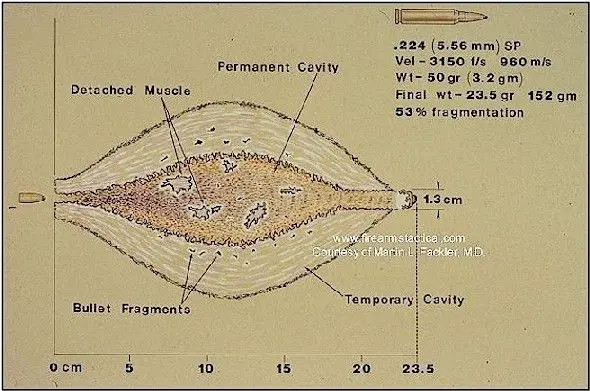 The 30-30 has a KE value of 1536 fpe 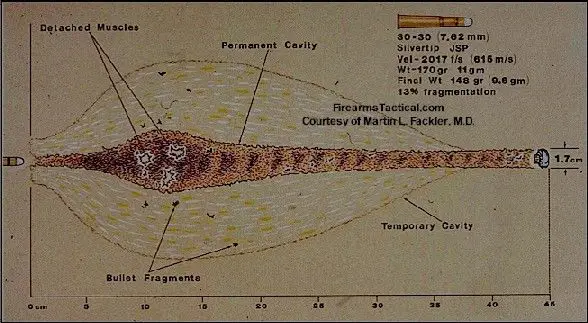 The Foster type rifled slug has a KE value of 2222 fpe.  |
| All times are GMT -8. The time now is 05:12 AM. |
Copyright © 2026 MH Sub I, LLC dba Internet Brands. All rights reserved. Use of this site indicates your consent to the Terms of Use.