


Where to put a treestand and why?
 06-19-2006 | 03:36 AM
#1

Thread Starter
Joined: Jun 2006
Posts: 36
Likes: 0
From:
 Where to put a treestand and why?
Hey ya'll
New to the forum, where are the best places to put a tree stand and please don't attach a link unless it is extremely goooood. But any help would be nice and also if you could could post any success stories with a ground blind for deer.And one last thing if you have any success stories with a stand share forthe good of the group.
New to the forum, where are the best places to put a tree stand and please don't attach a link unless it is extremely goooood. But any help would be nice and also if you could could post any success stories with a ground blind for deer.And one last thing if you have any success stories with a stand share forthe good of the group.

 HCH[/align]
06-19-2006 | 06:50 PM
HCH[/align]
06-19-2006 | 06:50 PM
#4

Giant Nontypical
Joined: Feb 2003
Posts: 5,514
Likes: 0
From: Port Neches, Texas
RE: Where to put a treestand and why?
Welcome to the board!
As said, funnels are great areas! Deer are no different than any other animal, they will take the easy route most of the time, so any steep creek banks, and land contours are good stand choices! Also, if you are not crowding other land owners, fences lines can be great too!
Look for "edge areas", where big woods meet fields, and/or clear-cuts!
Put these "edge areas" together with funnels and fence lines, and you've got yourelf a sure honey hole! Good luck!
As said, funnels are great areas! Deer are no different than any other animal, they will take the easy route most of the time, so any steep creek banks, and land contours are good stand choices! Also, if you are not crowding other land owners, fences lines can be great too!
Look for "edge areas", where big woods meet fields, and/or clear-cuts!
Put these "edge areas" together with funnels and fence lines, and you've got yourelf a sure honey hole! Good luck!
 06-19-2006 | 10:02 PM
#7

Joined: Dec 2004
Posts: 1,177
Likes: 0
From:
RE: Where to put a treestand and why?
welcome and remember the 2 most important things any animal needs. food and water. but also keep in mind that they stage in the woods so travel areas are prime. dont set up right ontop of a well traveled trail but instead set up right off the trail. also set up a few stands so you can hunt with the wind as well it can be your best friend or your worst enemy. also it wouldnt hurt to set up trail cams on those potential hot spots
06-20-2006 | 08:25 AM
#8
Giant Nontypical
Joined: Feb 2003
Posts: 6,744
Likes: 1
From: Darien, IL
RE: Where to put a treestand and why?
Travel lanes, water sources, funnels, fencelines, are all fine and good. I particularly like creek croosings and ravines where the deer have to usually keep moving and don't usually have an opportunity to stop and look around till they reach the otherside.
But I never place a stand on these places. I place my stands back off the travel lane,water source, funnel, fenceline, ravine or creekwhere I can still see and have a shooting lane, whether the shooting lane is natural or cut.
As far as placement detail. I always make sure I am not siloutted against the sky or open space. I like to have stuff behind me to break it up.
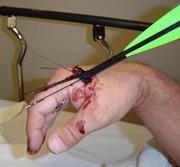
Now let's talk SAFETY.
Inspect all stands for integrity ATLEAST ANNUALLY whether constructed of wood or steel. Repair or dispose as necessary. No one wants another story of"Danny the Deer Dropper" fell when that platform cable snapped. And those cables are notorious for geting water in the jacketing, corroding and weaking.................SNAP!
NEVER carry anything up with you into a stand. NEVER & ANYTHING! Use a pull up line and NEVER pull up a loaded weapon! Very important that the pull up line not be too strong. About capable of 15 lbs will do fine. Reason being is that should you fall while climbing up and should become entangled in the line you won't wind up hung or a limb jerked into dislocation or severed even. Know what I mean? Place the pull up line off to the side as well as possible to provide an even greater margin of safety.
Use a FULL BODY safety harness. Most common injuries and cause of deaths (by far) is a fall, even from "it's not that high stands". I don't like the feel of harnesses but have recently got a couple that are pretty comfortable as they aren't just a harness but incorporated in a vest. As far as harnesses go, NEVER use a simple waist belt type, if your left hanging for even ta short amount of time, you'll most likely pass out because your diaphram will be useless and you can't breath. Those types of harnesses are a thing of the past and are just for limiting movement (like for roofers to keep them from the edge or kep workers away from hazzards - not fall protection!). Plus using a waist belt will likely cause injury in a fall such as a broken back. Ever see a dog run hard only to quickly find the end of the leash? Many of the stands on my place have seat belts because they're quite comfortable when sitting during gun season and that's mostly what is done down there. When bowhunting a harness can still be worn.
Be safe and good luck.
But I never place a stand on these places. I place my stands back off the travel lane,water source, funnel, fenceline, ravine or creekwhere I can still see and have a shooting lane, whether the shooting lane is natural or cut.
As far as placement detail. I always make sure I am not siloutted against the sky or open space. I like to have stuff behind me to break it up.
Now let's talk SAFETY.
Inspect all stands for integrity ATLEAST ANNUALLY whether constructed of wood or steel. Repair or dispose as necessary. No one wants another story of"Danny the Deer Dropper" fell when that platform cable snapped. And those cables are notorious for geting water in the jacketing, corroding and weaking.................SNAP!
NEVER carry anything up with you into a stand. NEVER & ANYTHING! Use a pull up line and NEVER pull up a loaded weapon! Very important that the pull up line not be too strong. About capable of 15 lbs will do fine. Reason being is that should you fall while climbing up and should become entangled in the line you won't wind up hung or a limb jerked into dislocation or severed even. Know what I mean? Place the pull up line off to the side as well as possible to provide an even greater margin of safety.
Use a FULL BODY safety harness. Most common injuries and cause of deaths (by far) is a fall, even from "it's not that high stands". I don't like the feel of harnesses but have recently got a couple that are pretty comfortable as they aren't just a harness but incorporated in a vest. As far as harnesses go, NEVER use a simple waist belt type, if your left hanging for even ta short amount of time, you'll most likely pass out because your diaphram will be useless and you can't breath. Those types of harnesses are a thing of the past and are just for limiting movement (like for roofers to keep them from the edge or kep workers away from hazzards - not fall protection!). Plus using a waist belt will likely cause injury in a fall such as a broken back. Ever see a dog run hard only to quickly find the end of the leash? Many of the stands on my place have seat belts because they're quite comfortable when sitting during gun season and that's mostly what is done down there. When bowhunting a harness can still be worn.
Be safe and good luck.
06-23-2006 | 11:25 AM
#9
Fork Horn
Joined: Oct 2005
Posts: 180
Likes: 0
From:
RE: Where to put a treestand and why?
I'm not sure what kind of habitat your hunting but, if your hunting agriculture at all some of the best places to look are corners. Where fields and woods create a corner. Another would be fingers or where a strip of timber leads out into a open field. If your hunting big woods at all then you need to look for funnels or transition areas. Like where two swamps with a strip of timber running between them. Or where you have a hard woods timber that butts up to a thick nasty swamp or maybe a stand of pines or a spruce swamp. Sometimes its hard to understand what we mean by a funnel or a transition area and the easiest way to figure this out to look for edges. There are edges everywhere if you use your head alittle and understand that and edge isn't always a place that has an opening. Two different kinds of timber that meet create an edge. Even in a field where you might have some alfalfa buttup to a corn field create an edge. If you just thinking aboutedges when your out scouting your gonna start seeing things that you neverrealized or paid attention to before.Hope this helps. Good luck

