


Questions about shotguns with doves.
 09-18-2005 | 11:11 PM
#1
Thread Starter
Joined: Sep 2005
Posts: 11
Likes: 0
 Questions about shotguns with doves.
I own two shotguns. One is a maverick 88 with a 28" non-ported barrell and the other is a mossberg 500 field version with a ported barrell. Yesterday i was hunting dove and I was using winchester 7 1/2 with low brass and the maverick. I was taking down everone I shot at. Today i decided to use the mossberg and same ammo, I shot at a bird and hit it, it flipped and then flew off. Well i was upset at this, I switched back to the maverick cause I didn't want to wound anymore doves(i hate it when any suffers). I didn't have any problems out of the maverick.
Now the question is "Was the ported barrell causing my shot to slow down so much that when it hit the bird it just wounded it and didn't drop it?" I really would like to use the mossberg, even if that means I new barrell and the chokes on the shotguns where the same too. Please help
~bigun
Now the question is "Was the ported barrell causing my shot to slow down so much that when it hit the bird it just wounded it and didn't drop it?" I really would like to use the mossberg, even if that means I new barrell and the chokes on the shotguns where the same too. Please help
~bigun
 09-19-2005 | 04:50 AM
#2
Joined: Sep 2005
Posts: 510
Likes: 0
From:
RE: Questions about shotguns with doves.
Doves are not difficult birds to bring down. If I had to guess, I'd guess your problem was due to not centering the dove rather than some miniscule loss of velocity caused by porting. I've never seen any ballistics tests comparing ported to non-ported barrels, but the fact that ported barrels are used by many serious clays shooters would suggest that any loss of velocity is negligible. I don't like ported barrels because they are too loud.
Most folks would consider the patterning of the two guns much more important than the porting and that would depend on their chokes. You might try patterning the two guns at a distance you think you take most of your shots and compare the two. Some guns just don't like some loads, so if you pattern, you might try two or three loads as well.
Most folks would consider the patterning of the two guns much more important than the porting and that would depend on their chokes. You might try patterning the two guns at a distance you think you take most of your shots and compare the two. Some guns just don't like some loads, so if you pattern, you might try two or three loads as well.
09-19-2005 | 07:57 AM
#3
Dominant Buck
Joined: Feb 2005
Posts: 26,323
Likes: 0
From: WC FL
RE: Questions about shotguns with doves.
Big, what chokes are you using? As the season progresses, the doves fly
higher. The first day I start with IC and then switch to Mod. Make sure
you are not shooting reduced loads. I like Express loads for dove cause
they are experts at acrobatics in the air. Are you comming from behind,
leading and following thru? Do you know if you are Right dominate eye
or Left dominate?
higher. The first day I start with IC and then switch to Mod. Make sure
you are not shooting reduced loads. I like Express loads for dove cause
they are experts at acrobatics in the air. Are you comming from behind,
leading and following thru? Do you know if you are Right dominate eye
or Left dominate?
09-19-2005 | 10:24 AM
#4
Dominant Buck
Joined: Feb 2005
Posts: 26,323
Likes: 0
From: WC FL
RE: Questions about shotguns with doves.
How To Take More Doves
Here's some secrets that will help you take more doves this season.
1. Look for loafing trees to find doves. Doves always seem to light in certain trees around fields, water, roosting areas or flyways to rest. If you'll take a stand close to one of these loafing trees, you'll bag more doves.
2. Search for water in the first part of dove season, which usually has very warm weather. Take a stand by creeks, lakes or even puddles where doves will come to drink, particularly later on in the mornings.
3. Use dove decoys. Often, a dove passing high and fast over a field will drop down and come into range if the bird sees a decoy.
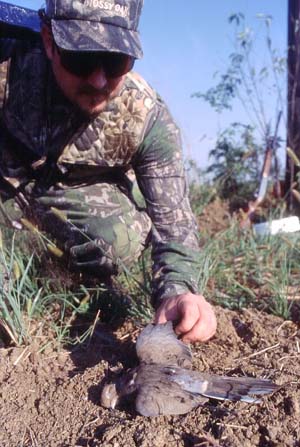 4. Don't move when you hunt doves. Doves have very good eyesight. If you move before the bird comes into range, more than likely, you'll cause it to flare, and the dove will present a more difficult shot.
 5. Shoot XX skeet load shells. These shells cost about $1 more a box than the dove shells most hunters use. But these more-expensive, better-made shells will produce better patterns at greater distances.
6. Put the bead of your shotgun on the bird's nose, and pull up as you shoot, when a dove flies straight at you. If you don't pull up just as you shoot, you'll shoot behind the dove.
7. Mark the spot where a dove falls with some type of landmark. Then go straight to the bird. Don't worry about trying to take a second or third target. Recover the dove you have already downed.
 8. Mount your gun, and prepare to shoot at the next bird, if you've missed some doves. However, instead of squeezing the trigger when the bird comes into range, stop. Make sure you have your face against the stock, your eye looking straight down the barrel, the stock in the right position on your shoulder and correct shooting form. You may miss doves because you have incorrect form.
 9. Never take a second shot at a dove. Often a hunter will rely on his second shot if he misses the first one. However, if you learn to take only one shot at the doves you see, you'll make sure the dove has come into range before you shoot and use correct form before you squeeze the trigger.
10. Don't take out-of-range shots, hoping to get lucky. Instead, each time you shoot, try and execute a perfect shot. Then you'll take more birds.
[align=center][/align]
09-19-2005 | 07:46 PM
#5
Thread Starter
Joined: Sep 2005
Posts: 11
Likes: 0
RE: Questions about shotguns with doves.
Well we where leading and following through. I will work with them a little more. I'm gonna take my guns to the range and check spreads on them with different types of ammo. I was using a mod choke in both guns.
Does anyone else hunt with a Mossberg and what ammo are they using?
Does anyone else hunt with a Mossberg and what ammo are they using?
09-28-2005 | 10:50 AM
#6
Dominant Buck
Joined: Feb 2005
Posts: 26,323
Likes: 0
From: WC FL
RE: Questions about shotguns with doves.
5. Shoot XX skeet load shells. These shells cost about $1 more a box than the dove shells most hunters use. But these more-expensive, better-made shells will produce better patterns at greater distances.

Thread
Thread Starter
Forum
Replies
Last Post
Higg
Waterfowl Hunting
10
07-28-2006 12:38 PM
