


Drop away rest question
 01-09-2009 | 02:06 PM
#21
Nontypical Buck
Joined: Feb 2003
Posts: 2,299
Likes: 0
From: Central PA
 RE: Drop away rest question
If I may jump into this conversation.
I have always been under the impression that drop away rests are more forgiving because they drop out of the way and there is less time for the shooter to impart any torque on the arrow. This meaning the rest contacts the arrow for say...the first 10 inches or so, then drops out of the way and allows the arrow to flex as it wishes. The 10" comment is just for example, I have no idea how long a typical rest contacts the arrow until falling out of the way.
With a traditional, prong style rest, the arrow is in contact the entire time. Any torque imparted by the shooter will show up. Yes, the prong tension is there to flex as the arrow flexes across it.
TFOX, so what you're saying is that drop aways really are to no advantage besides fletching clearance? I believe you can obtain fletching clearence with almost any prong style rest. I agree though, that you can use more radical helicals, and larger fletching with a drop away that you most likely won't get away with with a fixed rest.
I think for hunting purposes, where form is not perfect, drop aways are a very good solution. Especially with some of the full containment options out there.
TFOX, I know you're a Whammy advocate. I've been looking for a new rest for hunting. My only worry with that rest is containment. How do the prongs do as far as containment?
I have always been under the impression that drop away rests are more forgiving because they drop out of the way and there is less time for the shooter to impart any torque on the arrow. This meaning the rest contacts the arrow for say...the first 10 inches or so, then drops out of the way and allows the arrow to flex as it wishes. The 10" comment is just for example, I have no idea how long a typical rest contacts the arrow until falling out of the way.
With a traditional, prong style rest, the arrow is in contact the entire time. Any torque imparted by the shooter will show up. Yes, the prong tension is there to flex as the arrow flexes across it.
TFOX, so what you're saying is that drop aways really are to no advantage besides fletching clearance? I believe you can obtain fletching clearence with almost any prong style rest. I agree though, that you can use more radical helicals, and larger fletching with a drop away that you most likely won't get away with with a fixed rest.
I think for hunting purposes, where form is not perfect, drop aways are a very good solution. Especially with some of the full containment options out there.
TFOX, I know you're a Whammy advocate. I've been looking for a new rest for hunting. My only worry with that rest is containment. How do the prongs do as far as containment?
 01-09-2009 | 03:13 PM
#22
Giant Nontypical
Joined: Feb 2003
Posts: 6,634
Likes: 0
From: HENDERSON KY USA
RE: Drop away rest question
ORIGINAL: bigcountry
I have tuned folks bows that wouldn't have thier shoulder down. Had punching problems, no follow thru, gripped thier bow. I would have a bow tuned well, with a TM hunter, or biscuit, they come and are getting wild inconsistent tears on paper. I then have installed NAP drop aways', MZE, QAD's, ripcords, and thier shooting improved immediately. I can only tell someone they are overbowed so much and they have to keep thier shoulder down. No new shooter likes to hear that they cannot heal a bow and grip it with a deathgrip. Why? Because its comfortable for them with such high wieght draw.
I have read all the articles on spot hogg, read many more on forgiving setups. I just happen to think they are marketing to different folks.
ORIGINAL: TFOX
How have you done that?
If someone has torquing issues that bad,nothing is forgiving.BUT,the whole term "forgiving" is to mean,to shooter errors.
oranges comparisoWe will just have to disagree. I have proved it time and time again. With a person who has a torqueing issue, or punches, a drop away will be more forgiving. Your comparing shooting champs to 98% of the shooting population.
If someone has torquing issues that bad,nothing is forgiving.BUT,the whole term "forgiving" is to mean,to shooter errors.
I have read all the articles on spot hogg, read many more on forgiving setups. I just happen to think they are marketing to different folks.
They could have contact issues due to their bad form as well.Bullet holes or a better tear doesn't equate to shooting better.
And I agree the tm hunter rest is junk.

Remember,the Whammy and LB are both drop aways,they just do it better.IMO
01-09-2009 | 03:15 PM
#23
Giant Nontypical
Joined: Feb 2003
Posts: 6,634
Likes: 0
From: HENDERSON KY USA
RE: Drop away rest question
ORIGINAL: muzzyman88
If I may jump into this conversation.
I have always been under the impression that drop away rests are more forgiving because they drop out of the way and there is less time for the shooter to impart any torque on the arrow. This meaning the rest contacts the arrow for say...the first 10 inches or so, then drops out of the way and allows the arrow to flex as it wishes. The 10" comment is just for example, I have no idea how long a typical rest contacts the arrow until falling out of the way.
With a traditional, prong style rest, the arrow is in contact the entire time. Any torque imparted by the shooter will show up. Yes, the prong tension is there to flex as the arrow flexes across it.
TFOX, so what you're saying is that drop aways really are to no advantage besides fletching clearance? I believe you can obtain fletching clearence with almost any prong style rest. I agree though, that you can use more radical helicals, and larger fletching with a drop away that you most likely won't get away with with a fixed rest.
I think for hunting purposes, where form is not perfect, drop aways are a very good solution. Especially with some of the full containment options out there.
TFOX, I know you're a Whammy advocate. I've been looking for a new rest for hunting. My only worry with that rest is containment. How do the prongs do as far as containment?
If I may jump into this conversation.
I have always been under the impression that drop away rests are more forgiving because they drop out of the way and there is less time for the shooter to impart any torque on the arrow. This meaning the rest contacts the arrow for say...the first 10 inches or so, then drops out of the way and allows the arrow to flex as it wishes. The 10" comment is just for example, I have no idea how long a typical rest contacts the arrow until falling out of the way.
With a traditional, prong style rest, the arrow is in contact the entire time. Any torque imparted by the shooter will show up. Yes, the prong tension is there to flex as the arrow flexes across it.
TFOX, so what you're saying is that drop aways really are to no advantage besides fletching clearance? I believe you can obtain fletching clearence with almost any prong style rest. I agree though, that you can use more radical helicals, and larger fletching with a drop away that you most likely won't get away with with a fixed rest.
I think for hunting purposes, where form is not perfect, drop aways are a very good solution. Especially with some of the full containment options out there.
TFOX, I know you're a Whammy advocate. I've been looking for a new rest for hunting. My only worry with that rest is containment. How do the prongs do as far as containment?
I can lay my bow on it's side and the arrow not fall out of the prongs.
Some have issues setting the Whammy up,I haven't so that may or may not be an issue.To me it is simple.I hear the LB is absolutely one of the easiest to set up,never set one up so I can't say for sure but it looks like it would be.
01-09-2009 | 03:30 PM
#24
Giant Nontypical
Joined: Feb 2003
Posts: 6,634
Likes: 0
From: HENDERSON KY USA
RE: Drop away rest question
ORIGINAL: bigcountry
Oh, guaranteed, if you put two bows on a hooter shooter long distance, a well tuned spring rest will be much more accurate than say a QAD. But a hooter shooter doesn't push the bow to the left after a shot, a hooter shooter doesn't creep, or move the string so slightly away from his face at the shot.
And these flaws show up on experienced shooters too espeically in a hunting sitsuation. Not everyone will be taking deer in a field from the ground with perfect stance. They might be on a 15X15" platform swung all the way around a tree.
ORIGINAL: drockw
BC i think you are right if you are considering a shooter in to play. IF there is no shooter involved, the long travel rests would be more accurate though. The shooter will make a difference, but taking out the shooter do you agree the longer travel is better?
Derek
BC i think you are right if you are considering a shooter in to play. IF there is no shooter involved, the long travel rests would be more accurate though. The shooter will make a difference, but taking out the shooter do you agree the longer travel is better?
Derek
And these flaws show up on experienced shooters too espeically in a hunting sitsuation. Not everyone will be taking deer in a field from the ground with perfect stance. They might be on a 15X15" platform swung all the way around a tree.
YES IT DOES,one of the biggest advantages of a Hooter shooter imo.Creep tuning made easy.
There are a couple things I want to bring up and then I am going to back out.Remember,when you torque a bow the issue that one has is at the string.This is where the most movement occurs(why deflex is more forgiving than reflex) when this happens with a drop away(that drops too early) the arrow is in contact with the string but no quidance on the front side,and it is basically getting slammed sideways on the back end and left to do what ever at the front end.The string is traveling sideways when torque is applied and not toward the target.So the back end is trying to pass the front end.
When you still have guidance on the front end,the arrow is't being pushed as far sideways because you have 2 points of contact instead of 1.This is the basic jist of the whole argument.
Another thing that was clear in the springsteel video was when there is excessive paradox.The rest will aid in keeping the arrow on path.As long as the rest is soft,it is a help,if not soft,it can be a problem.
Some dropaways are definately better than others.The video I showed shows why you don't want a rest dropping too early .You can see the arrow dropping with the rest,this is a real problem if your bow does not have level nock travel.
I like a few dropaways,like the Trophy Taker.They can be tuned and timed so they do not fall too early.I am not trying to keep anyone from using a fallaway,just don't be looking for the ones that claim they fall faster than the others.My experience with the QAD is limited so I will refrain from comment on it.
01-09-2009 | 03:42 PM
#25
Guest
Posts: n/a
RE: Drop away rest question
ORIGINAL: TFOX
YES IT DOES,one of the biggest advantages of a Hooter shooter imo.Creep tuning made easy.
YES IT DOES,one of the biggest advantages of a Hooter shooter imo.Creep tuning made easy.
When you still have guidance on the front end,the arrow is't being pushed as far sideways because you have 2 points of contact instead of 1.This is the basic jist of the whole argument.
Another thing that was clear in the springsteel video was when there is excessive paradox.The rest will aid in keeping the arrow on path.As long as the rest is soft,it is a help,if not soft,it can be a problem.
Another thing that was clear in the springsteel video was when there is excessive paradox.The rest will aid in keeping the arrow on path.As long as the rest is soft,it is a help,if not soft,it can be a problem.
I will agree to disagree on this one. One thing that is consistent in every video you showed was the bow didn't move after the shot. This is the critical part to the argument. Real life shooting by 90% of the shooting population, this is not the case. Apples to oranges. But thanksforthe discussion.
01-09-2009 | 03:53 PM
#26
Giant Nontypical
Joined: Feb 2003
Posts: 6,634
Likes: 0
From: HENDERSON KY USA
RE: Drop away rest question
ORIGINAL: bigcountry
When I mean creep, I am trying to compare a joe smoe who doesn't do it consistently. Sure you can short draw on a machine, I am just trying to explain, in the real world, with real hunting situations, a hooter shooter cannot mimic that.
As us trad archers know, paradox is a good thing for us to get around a shelf. And long as its consistent, it doesn't matter. Thats why its so critical in trad archery shooting off shelf that you have consistent finger release.
I will agree to disagree on this one. One thing that is consistent in every video you showed was the bow didn't move after the shot. This is the critical part to the argument. Real life shooting by 90% of the shooting population, this is not the case. Apples to oranges. But thanks for the discussion.
ORIGINAL: TFOX
YES IT DOES,one of the biggest advantages of a Hooter shooter imo.Creep tuning made easy.
YES IT DOES,one of the biggest advantages of a Hooter shooter imo.Creep tuning made easy.
When I mean creep, I am trying to compare a joe smoe who doesn't do it consistently. Sure you can short draw on a machine, I am just trying to explain, in the real world, with real hunting situations, a hooter shooter cannot mimic that.
When you still have guidance on the front end,the arrow is't being pushed as far sideways because you have 2 points of contact instead of 1.This is the basic jist of the whole argument.
Another thing that was clear in the springsteel video was when there is excessive paradox.The rest will aid in keeping the arrow on path.As long as the rest is soft,it is a help,if not soft,it can be a problem.
Another thing that was clear in the springsteel video was when there is excessive paradox.The rest will aid in keeping the arrow on path.As long as the rest is soft,it is a help,if not soft,it can be a problem.
As us trad archers know, paradox is a good thing for us to get around a shelf. And long as its consistent, it doesn't matter. Thats why its so critical in trad archery shooting off shelf that you have consistent finger release.
I will agree to disagree on this one. One thing that is consistent in every video you showed was the bow didn't move after the shot. This is the critical part to the argument. Real life shooting by 90% of the shooting population, this is not the case. Apples to oranges. But thanks for the discussion.
I know,I was actually coming back just to point that out.
Traditional shooters also need a much closer spine match to ensure this paradox is perfect.
The bow not moving after the shot is definately a major issue in accuracy.
 01-12-2009 | 08:52 AM
#29
Nontypical Buck
Joined: Feb 2003
Posts: 2,299
Likes: 0
From: Central PA
RE: Drop away rest question
TFOX, thanks for the insight on arrow guidance and such with drop aways. That makes sense to me.
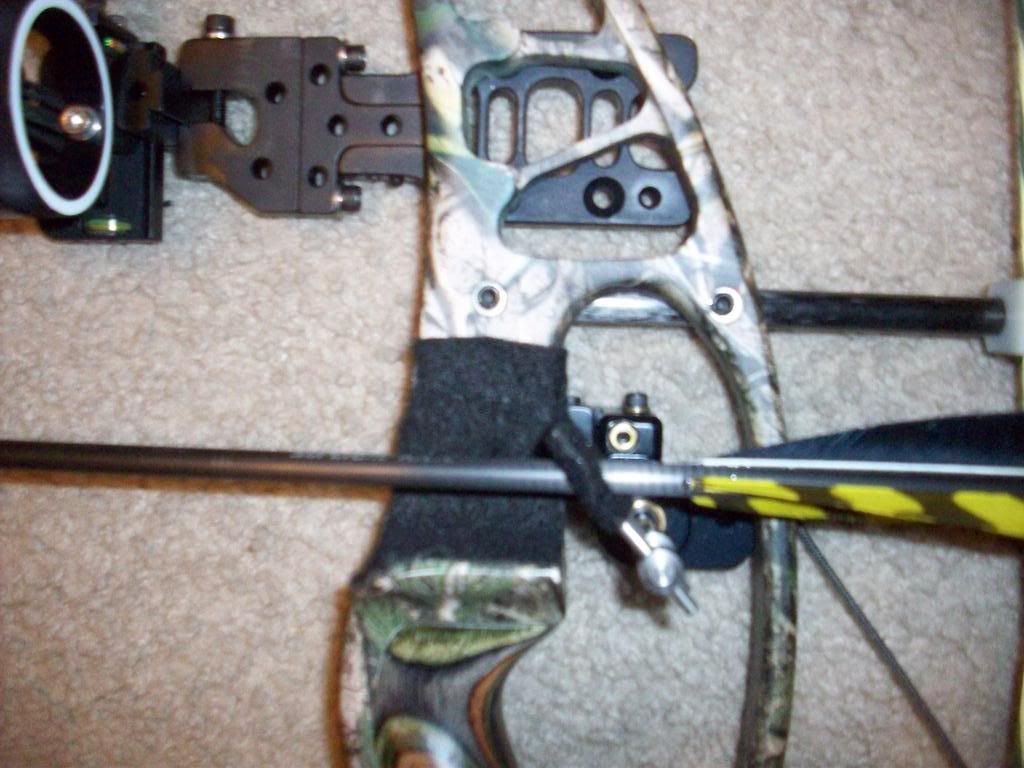
Also, thanks for the pics of your Whammy setup. That rest almost looks perfect for my tastes. I already shoot a Hogg-it sight, might as well compliment it with a rest too.
Have you had any issues with this rest coming out of time? I've read somewhere that people have encountered issues with this. I'm guessing it's improper setup.
Also, how is the noise level with this rest?
Also, thanks for the pics of your Whammy setup. That rest almost looks perfect for my tastes. I already shoot a Hogg-it sight, might as well compliment it with a rest too.
Have you had any issues with this rest coming out of time? I've read somewhere that people have encountered issues with this. I'm guessing it's improper setup.
Also, how is the noise level with this rest?
01-12-2009 | 03:26 PM
#30
Giant Nontypical
Joined: Feb 2003
Posts: 6,634
Likes: 0
From: HENDERSON KY USA
RE: Drop away rest question
The rest has never come out of time for me,but I guess over time with considerable cable stretch,it could happen but if it gets to that point,you have other issues.Might be a setup issue.
It is a very quiet rest,as long as you put mole skin on the prongs,it doesn't have that smack associated with most fallways.
It is a very quiet rest,as long as you put mole skin on the prongs,it doesn't have that smack associated with most fallways.