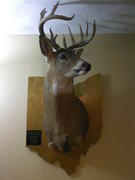


Got my mount back. How does it look?
 05-02-2009 | 06:04 PM
#11
Nontypical Buck
Joined: Sep 2008
Posts: 2,646
Likes: 0
From: Chippewa county, WI.
 RE: Got my mount back. How does it look?
Congrats on a very nice buck. As far as preserving goes my taxidermist told me to wipe it off gently with a damp rag to get the dust off and then wipe it down with olive oil.
 05-03-2009 | 04:37 AM
#14
Typical Buck
Joined: Dec 2006
Posts: 764
Likes: 0
From: grottoes,va.
RE: Got my mount back. How does it look?
to preserve your mounts get some taxidermy magic.check the link below. this stuff is amazing. use it a few times a year on any mount.
http://www.mckenziesp.com/taxid_store/catalog_product.asp?ProductFamilyID=%7B6D3F803E%2D 7C2F%2D4492%2DBAA0%2DEBF42EA120AA%7D&mscssid=E 66XD3QC0PC38JGFQRLBA0HW0EAUE1SC
http://www.mckenziesp.com/taxid_store/catalog_product.asp?ProductFamilyID=%7B6D3F803E%2D 7C2F%2D4492%2DBAA0%2DEBF42EA120AA%7D&mscssid=E 66XD3QC0PC38JGFQRLBA0HW0EAUE1SC
05-03-2009 | 11:30 AM
#15
Thread Starter
Nontypical Buck
Joined: Dec 2007
Posts: 1,519
Likes: 0
RE: Got my mount back. How does it look?
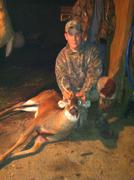
Do these ears look really weird or normal. Not the actual ears but the skin part going out before the ears? Seems like the ears should start almost right at the head but maybe not. They are looking weird to me for some reason. However, a few of the pictures I have of the deer before it was mounted sort of look like this a little but it's hard to tell as I never got pictures of it that were good of the ears and they also weren't pointed up like this. Here are more pictures. Do these look normal?


 05-03-2009 | 10:04 PM
#17
Typical Buck
Joined: Feb 2003
Posts: 760
Likes: 0
From: Grand Forks BC Canada
RE: Got my mount back. How does it look?
hometheaterman, that's a beautiful buck no matter how you slice it. I'd be tickled with one like that, too.
Regarding the mount, that's often a ticklish subject for guys who are proud of their deer but don't necessarily have the experience to judge quality of work. You seem to be really willing to learn as much as you can by your questions, so I'll weigh in a bit.
Incorrect positioning of ears seems to be one of the most frequent errors taxidermists make, and I'm not sure why. When you're in the business, this is one of the easiest things to know about. On a live deer, which will be actively controlling its ear position (and similarly a life-like mount), there may be enough space between the base of the antler and ear for one finger to fit in between - but not more. The cape on yours seems to be set in the wrong position - perhaps incorrect form size - and the ears are too low.
There should also be significant muscling on the ear butt, which allows the amazing ear movement on a live deer. Your mount appears to have this, but perhaps not enough; hard to tell from the pictures. A taxidermist will either use plastic ear liners that include this feature, or build muscling internally in the cape with sculpting clay.
When a deer has expired, of course, there is no active muscle control and the ears will flop down. Under this circumstance, the one-finger rule won't apply, although the muscling is still obvious.
Here's a pictureof a mule deer I took a couple years ago which demonstrates the points mentioned.

I hope this information is helpful; it's not meant in any way to be nasty. The first deer I ever had mounted is one I still have from 25 years ago and it's a terrible job in many ways.At the time, I had no ideaand was thrilled with it. I was always going to redo it myself once I started doing my own but it hasn't happened yet.[&:]
Regarding the mount, that's often a ticklish subject for guys who are proud of their deer but don't necessarily have the experience to judge quality of work. You seem to be really willing to learn as much as you can by your questions, so I'll weigh in a bit.
Incorrect positioning of ears seems to be one of the most frequent errors taxidermists make, and I'm not sure why. When you're in the business, this is one of the easiest things to know about. On a live deer, which will be actively controlling its ear position (and similarly a life-like mount), there may be enough space between the base of the antler and ear for one finger to fit in between - but not more. The cape on yours seems to be set in the wrong position - perhaps incorrect form size - and the ears are too low.
There should also be significant muscling on the ear butt, which allows the amazing ear movement on a live deer. Your mount appears to have this, but perhaps not enough; hard to tell from the pictures. A taxidermist will either use plastic ear liners that include this feature, or build muscling internally in the cape with sculpting clay.
When a deer has expired, of course, there is no active muscle control and the ears will flop down. Under this circumstance, the one-finger rule won't apply, although the muscling is still obvious.
Here's a pictureof a mule deer I took a couple years ago which demonstrates the points mentioned.
I hope this information is helpful; it's not meant in any way to be nasty. The first deer I ever had mounted is one I still have from 25 years ago and it's a terrible job in many ways.At the time, I had no ideaand was thrilled with it. I was always going to redo it myself once I started doing my own but it hasn't happened yet.[&:]