


My Biggest Buck So Far.
 08-18-2005 | 04:05 PM
#1
Thread Starter
Typical Buck
Joined: Dec 2003
Posts: 590
Likes: 0
 My Biggest Buck So Far.
I first crossed paths with the heavy-horned buck on in mid-November of 2003. I matched wits with him for six days, and he won. Although I saw him three more times, I went home at the end of my vacation with my tag still in my pocket. I renewed the contest in November 2004.
I had gotten access in 2003 to an exciting new piece of ground in eastern Montana, andon my first huntI crawled up to an observation point to get a look at my new hunting area without spooking too many deer. I hoped to find a couple of good stand sites for the next few days. I no sooner peeked over the edge of a high bluff into thebrushin the coulee below than I saw him.
He was bedded 300 yards below me, a heavy-horned 8-pointer, 3 1/2 years old,that would score in the low 120s. Since my biggest buckto that pointscored in at 117 net, I was interested. However,it was early in the hunt, and I considered the range a bit long for the tricky angles a bedded deer presents, so I passed on that first shot opportunity. Being really creative with names, I dubbedhim the Heavy-Horned 8-Pointer. Ispotted two really good looking stand sites, and snuck away having seennearly40 head of deer that evening.
Two days later I was ensconced in my new favorite deer stand. It was located on the tip of a bluff's edge, hangingclifflike 80 feetabove the back edge of a major doe bedding area.I saw theheavy-horned buck againthat day. This time, he was out of range at 400 yards, but I watched himspar with another nice 8-pointer on alittle brush flat I call Battle Flat.Consequently, I call the other buck the Prickly Peter Buck, but that's another story for another day.(Hint: maybe after the '05 season plays out.)
Like clockwork, I saw my heavy-horned buck again two days later from the same stand. This story takes a while to tell correctly. The coulee below my stand has two major funnels that collect 99% of the deer traffic. The nearer funnel, 60 yards below, is an old ranch road pinched between the bluff and a creek. The far funnel, 300 yards out, is on the other side of the creek along a line of stunted trees leading to Battle Flat. That morning, the action began with the first blush of daylight.
I picked up deer coming through Battle Flat, still too far to shoot. I soon identified the heavy-horned buck through my binos. He was trailing a couple does with fawns. I was so interested in this action that I forgot about the near funnel right beneath my stand. That was my second mistake.
I made my first mistake early that morning when I chose to hunt this stand even though the wind wasn't ideal for the setup. I justified the choice because time was running down on the hunt. However, any deer in the near funnel were going to have a chance to smell me. I took that chance and paid for it.
As I stared through my binoculars at my heavy-horned buck, willing him to come into shooting range, I became suddenly aware of motion in the bottom of my vision, under my binoculars. I dropped the binoculars to see a mess of deer standing 75 yards below me, on high alert, looking desperately around them trying to locate the smelly human. Among them was a buck that immediately took my mind off the heavy-horned buck. This buck was a main frame 10-pointer with split brow tines. I had seen him earlier in the hunt and thought he would score at least 130.
Frantically, I began grabbing my rifle and bringing it to bear. All the activity of these last two paragraphs played out in the space of about 5 seconds, and before I was ready to shoot, the big buck blew out. He had not located me yet, so he flew away in a red-alert panic. I don't take running shots, so all I could do was watch him go and curse myself. He was still running full tilt when he disappeared over the curve of the horizon 1 1/2 miles away! I never saw him again.
Interestingly, the group of deer in the other lane did not spook, even though the 12-pointer ran right past them. This group, including my heavy-horned buck bedded down where they were, still out of range. The day wore on, and I lost sight of the heavy-horned buck in his bed, but I knew he was still there with the does. Around midafternoon, another hunter appeared.
This nimrod was still hunting down into the coulee from the side opposite my stand, and he was headed right for my heavy-horned buck! Still hunting the way he was doing it isn't a great idea in this country. He was skylined coming over the bluff tops above the coulee bottom, and deer began standing up when he was still 500 yards away. I got very excited, because I could see the does that were with the heavy-horned buck getting ready to bolt, and they were going to come right under my stand when they came. I was sure the heavy-horned buck was mine, this guy was going to drive him to me!
Well, it didn't work that way. Even though that guy soon blew the does out, and they ran under my stand, the buck stayed put. That guy walked a perfect half circle within 80 yards of the spot I knew the heavy-horned buck lay, but that buck never moved, and the guy never knew how close he came. I went home that night with anewfound respect for the heavy-horned buck.
The very next day was my last day to hunt, and in desperation, I bailed right down into the bottomland cover where I was sure the heavy-horned buck was hanging out. Probably I should have taken a lesson from the folly of the guy the day before, but I had to try it.
I wouldn't make his mistake of skylining myself. I'd be down in the bottom before shooting light, edge along the cover's edge, take my time, and root the heavy-horned buck out of his hidey hole. About midmorning, I found him.
I goosed his does out of a string of brush about 80 yards wide, and they panicked out onto the wide open flat on the other side of the creek I was following. My heavy-horned buck did not panic, although I had slipped within 50 yards. He simply ran to the far edge of the brush patch and stopped, with the heavy brush between him and me. Although I could see him vaguely, I had no shot. He seemed to know this, and looked over at me with something likecontempt. I tried to move to a spot that might allow an open lane, but he merely trotted away along his edge of the brush and disappeared. He hadn't even broken a sweat. I conceded the victory to him, and went home.
The winter of '03-'04 was a real killer in that portion of Montana. I heard the biologist on the phone telling me that 30% of the herd had died. I know that winter kill is hardest on fawns and big bucks, and I wondered if my heavy-horned buck would still be out there for me to hunt again when the '04 season finally rolled around. Time has its own pace, but eventually hunting season did arrive. I had a nine-day vacation set aside for mid-November, and on the appointed day I headed into the field with visions of heavy-horned bucks dancing in my head.
I hunted for four days with no sight of my heavy-horned buck. I did see his sparring partner, now a 4 1/2 year old animal with a high 130s rack. He earned his new name, the Prickly Peter Buck, on the fourth day of my hunt. Day five found me on my favorite stand before daylight.
As daylight broke, I immediately spotted three or four groups of muleys, and a pair of coyotes. I enjoyed watching the coyotes working across a ridge a mile away, but I was determined not to let such sights distract me this day from the main event. So, I saw the buck when he broke cover 500 yards down coulee. He was headed the wrong way!
He was walking out stiff-legged toward a little yearling buck, intent on showing this little fellow who was boss. Halfway to the yearling, he stopped to attack an offending sage brush in his path. When he resumed his march, the yearling made a very clear point of portraying unoffending body language, and the big buck let him off with a warning. Up to this point, I didn't know this buck was my heavy-horned buck, but I knew he was big. The problem was that he was going further away from me. Then my deliverance arrived.
Deliverance in this case was embodied by a doe with twin fawns. She was coming up from the alfalfa below,headed for bed. She saw the big buck on her path, and this being pre-rut, she wanted no part of male companionship. So, she tried to high tail it past the big buck. She ran my way, and the big buck followed.
Now a mature buck trailing a doe is still a wary beast most of the time. He took his time following her. She ran all the way up under my stand and turned off to bed 100 yards beneath me, but he didn't follow right away. He took his time about, stopping to scrape and sniff periodically, and more than once I gave up on him. But eventually, 20 minutes after the first sighting, he broke the last bit of cover that prevented me from shooting.
When he broke cover, he came on at a run, and 275 yards became 100 yards in seconds. He paused in the road beneath me to try to spot the doe ahead, and I shot him. Myjoy when I approached this magnificent creature is just way too much for pale words on a sheet of paper. Crying and whooping and dancing.
My heavy-horned buck had sprouted another set of points in his fifth year. He was a heavy, compact 10-pointer who net scored 140 1/8, nearly a quarter of this score was in mass measurements. I estimated his live weight at 255 lbs. I display his head proudly in my apartment.
I had gotten access in 2003 to an exciting new piece of ground in eastern Montana, andon my first huntI crawled up to an observation point to get a look at my new hunting area without spooking too many deer. I hoped to find a couple of good stand sites for the next few days. I no sooner peeked over the edge of a high bluff into thebrushin the coulee below than I saw him.
He was bedded 300 yards below me, a heavy-horned 8-pointer, 3 1/2 years old,that would score in the low 120s. Since my biggest buckto that pointscored in at 117 net, I was interested. However,it was early in the hunt, and I considered the range a bit long for the tricky angles a bedded deer presents, so I passed on that first shot opportunity. Being really creative with names, I dubbedhim the Heavy-Horned 8-Pointer. Ispotted two really good looking stand sites, and snuck away having seennearly40 head of deer that evening.
Two days later I was ensconced in my new favorite deer stand. It was located on the tip of a bluff's edge, hangingclifflike 80 feetabove the back edge of a major doe bedding area.I saw theheavy-horned buck againthat day. This time, he was out of range at 400 yards, but I watched himspar with another nice 8-pointer on alittle brush flat I call Battle Flat.Consequently, I call the other buck the Prickly Peter Buck, but that's another story for another day.(Hint: maybe after the '05 season plays out.)
Like clockwork, I saw my heavy-horned buck again two days later from the same stand. This story takes a while to tell correctly. The coulee below my stand has two major funnels that collect 99% of the deer traffic. The nearer funnel, 60 yards below, is an old ranch road pinched between the bluff and a creek. The far funnel, 300 yards out, is on the other side of the creek along a line of stunted trees leading to Battle Flat. That morning, the action began with the first blush of daylight.
I picked up deer coming through Battle Flat, still too far to shoot. I soon identified the heavy-horned buck through my binos. He was trailing a couple does with fawns. I was so interested in this action that I forgot about the near funnel right beneath my stand. That was my second mistake.
I made my first mistake early that morning when I chose to hunt this stand even though the wind wasn't ideal for the setup. I justified the choice because time was running down on the hunt. However, any deer in the near funnel were going to have a chance to smell me. I took that chance and paid for it.
As I stared through my binoculars at my heavy-horned buck, willing him to come into shooting range, I became suddenly aware of motion in the bottom of my vision, under my binoculars. I dropped the binoculars to see a mess of deer standing 75 yards below me, on high alert, looking desperately around them trying to locate the smelly human. Among them was a buck that immediately took my mind off the heavy-horned buck. This buck was a main frame 10-pointer with split brow tines. I had seen him earlier in the hunt and thought he would score at least 130.
Frantically, I began grabbing my rifle and bringing it to bear. All the activity of these last two paragraphs played out in the space of about 5 seconds, and before I was ready to shoot, the big buck blew out. He had not located me yet, so he flew away in a red-alert panic. I don't take running shots, so all I could do was watch him go and curse myself. He was still running full tilt when he disappeared over the curve of the horizon 1 1/2 miles away! I never saw him again.
Interestingly, the group of deer in the other lane did not spook, even though the 12-pointer ran right past them. This group, including my heavy-horned buck bedded down where they were, still out of range. The day wore on, and I lost sight of the heavy-horned buck in his bed, but I knew he was still there with the does. Around midafternoon, another hunter appeared.
This nimrod was still hunting down into the coulee from the side opposite my stand, and he was headed right for my heavy-horned buck! Still hunting the way he was doing it isn't a great idea in this country. He was skylined coming over the bluff tops above the coulee bottom, and deer began standing up when he was still 500 yards away. I got very excited, because I could see the does that were with the heavy-horned buck getting ready to bolt, and they were going to come right under my stand when they came. I was sure the heavy-horned buck was mine, this guy was going to drive him to me!
Well, it didn't work that way. Even though that guy soon blew the does out, and they ran under my stand, the buck stayed put. That guy walked a perfect half circle within 80 yards of the spot I knew the heavy-horned buck lay, but that buck never moved, and the guy never knew how close he came. I went home that night with anewfound respect for the heavy-horned buck.
The very next day was my last day to hunt, and in desperation, I bailed right down into the bottomland cover where I was sure the heavy-horned buck was hanging out. Probably I should have taken a lesson from the folly of the guy the day before, but I had to try it.
I wouldn't make his mistake of skylining myself. I'd be down in the bottom before shooting light, edge along the cover's edge, take my time, and root the heavy-horned buck out of his hidey hole. About midmorning, I found him.
I goosed his does out of a string of brush about 80 yards wide, and they panicked out onto the wide open flat on the other side of the creek I was following. My heavy-horned buck did not panic, although I had slipped within 50 yards. He simply ran to the far edge of the brush patch and stopped, with the heavy brush between him and me. Although I could see him vaguely, I had no shot. He seemed to know this, and looked over at me with something likecontempt. I tried to move to a spot that might allow an open lane, but he merely trotted away along his edge of the brush and disappeared. He hadn't even broken a sweat. I conceded the victory to him, and went home.
The winter of '03-'04 was a real killer in that portion of Montana. I heard the biologist on the phone telling me that 30% of the herd had died. I know that winter kill is hardest on fawns and big bucks, and I wondered if my heavy-horned buck would still be out there for me to hunt again when the '04 season finally rolled around. Time has its own pace, but eventually hunting season did arrive. I had a nine-day vacation set aside for mid-November, and on the appointed day I headed into the field with visions of heavy-horned bucks dancing in my head.
I hunted for four days with no sight of my heavy-horned buck. I did see his sparring partner, now a 4 1/2 year old animal with a high 130s rack. He earned his new name, the Prickly Peter Buck, on the fourth day of my hunt. Day five found me on my favorite stand before daylight.
As daylight broke, I immediately spotted three or four groups of muleys, and a pair of coyotes. I enjoyed watching the coyotes working across a ridge a mile away, but I was determined not to let such sights distract me this day from the main event. So, I saw the buck when he broke cover 500 yards down coulee. He was headed the wrong way!
He was walking out stiff-legged toward a little yearling buck, intent on showing this little fellow who was boss. Halfway to the yearling, he stopped to attack an offending sage brush in his path. When he resumed his march, the yearling made a very clear point of portraying unoffending body language, and the big buck let him off with a warning. Up to this point, I didn't know this buck was my heavy-horned buck, but I knew he was big. The problem was that he was going further away from me. Then my deliverance arrived.
Deliverance in this case was embodied by a doe with twin fawns. She was coming up from the alfalfa below,headed for bed. She saw the big buck on her path, and this being pre-rut, she wanted no part of male companionship. So, she tried to high tail it past the big buck. She ran my way, and the big buck followed.
Now a mature buck trailing a doe is still a wary beast most of the time. He took his time following her. She ran all the way up under my stand and turned off to bed 100 yards beneath me, but he didn't follow right away. He took his time about, stopping to scrape and sniff periodically, and more than once I gave up on him. But eventually, 20 minutes after the first sighting, he broke the last bit of cover that prevented me from shooting.
When he broke cover, he came on at a run, and 275 yards became 100 yards in seconds. He paused in the road beneath me to try to spot the doe ahead, and I shot him. Myjoy when I approached this magnificent creature is just way too much for pale words on a sheet of paper. Crying and whooping and dancing.
My heavy-horned buck had sprouted another set of points in his fifth year. He was a heavy, compact 10-pointer who net scored 140 1/8, nearly a quarter of this score was in mass measurements. I estimated his live weight at 255 lbs. I display his head proudly in my apartment.




 08-19-2005 | 12:27 PM
#7

Nontypical Buck
Joined: Jul 2004
Posts: 3,132
Likes: 0
From: Fairbanks, AK
RE: My Biggest Buck So Far.
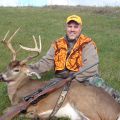
WE WANT PICS!!! WE WANT PICS!!! Great story, ok I'll be truthful..AWESOME story.But it will never reach its full potential without pics. So congrats on the deer, but we still want PICS!!!
08-19-2005 | 06:09 PM
#10
Dominant Buck
Joined: Jan 2005
Posts: 25,123
Likes: 3
From: Central Florida
RE: My Biggest Buck So Far.
Meet the tech retard that got educated. If your scanner is anything like mine it may give you three options...low ...med and high quality. If I choose the low setting, it will let me post the picture. You can also do tha twith a digital camera. Just set the camera on low quality.
Chuck
If your scanner is anything like mine it may give you three options...low ...med and high quality. If I choose the low setting, it will let me post the picture. You can also do tha twith a digital camera. Just set the camera on low quality. Chuck

