


Smokey Grey Gobbler
 05-09-2006 | 08:08 PM
#11
Nontypical Buck
Joined: Feb 2003
Posts: 2,850
Likes: 0
From: Arkansas Born, Army Bound
 RE: Smokey Grey Gobbler
ORIGINAL: TurkeyStalker
domestic birds will not survive in the wild it is a proven fact. Awesome bird.
domestic birds will not survive in the wild it is a proven fact. Awesome bird.

 05-10-2006 | 07:34 PM
#15
Typical Buck
Joined: Jun 2004
Posts: 581
Likes: 0
From: South Dakota
RE: Smokey Grey Gobbler
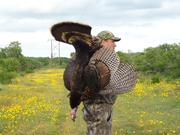
Not saying it's definitely a domestic bird, but... it does look a lot like a Royal Palm:
http://www.ansi.okstate.edu/poultry/turkeys/index.htm
http://search.msn.com/images/results.aspx?FORM=MSNHB&q=royal%20palm%20turke y
http://www.cacklehatchery.com/turkeypage.html

http://www.ansi.okstate.edu/poultry/turkeys/index.htm
http://search.msn.com/images/results.aspx?FORM=MSNHB&q=royal%20palm%20turke y
http://www.cacklehatchery.com/turkeypage.html
05-11-2006 | 12:29 PM
#17
Nontypical Buck
Joined: Jan 2006
Posts: 3,050
Likes: 0
From: North Louisiana
RE: Smokey Grey Gobbler
Those are some beautiful turkeys. Actually Ridge Runner, domestic turkeys will not survive in the wild. They are usually easily taken by preditors. They don't have the survival instincts of wild turkeys. Often they cannot fly, so that is a death warrant in the wild. A domestic turkey will even drown itself in the rain. They will look skyward while it's raining and actually drown by opening their mouths. Sounds silly but it's true. There may be an exception or two, but in just about every case a domestic turkey released in the wild has perished, by means other than hunters. I know a person who released 10 or 12 domestic turkeys in the wild. None made it. It's against the law anyway. They don't want an inferior cross breed to take over. That would spell doom to turkeys in an area.
05-12-2006 | 05:07 PM
#18
Typical Buck
Joined: Jun 2004
Posts: 581
Likes: 0
From: South Dakota
RE: Smokey Grey Gobbler
ORIGINAL: superstrutter
A domestic turkey will even drown itself in the rain. They will look skyward while it's raining and actually drown by opening their mouths. Sounds silly but it's true.
A domestic turkey will even drown itself in the rain. They will look skyward while it's raining and actually drown by opening their mouths. Sounds silly but it's true.
Original: http://www.snopes.com/critters/wild/turkey.htm
Claim: Domesticated turkeys are so lacking in intelligence that they will look up at falling rain until they drown.
Status: False.
Origins:First
of all, this belief as described is based upon a couple of false premises:
[ul][*]Turkeys do not look up in order to "see" rain. Turkeys, like most birds, do not have binocular vision (i.e., the ability to focus both eyes on the same object); they have eyes set on opposite sides of their heads, a feature which gives them a greater field of vision and thus enables them more effectively spot potential predators. (On the other hand, birds of prey such as the owl need to be able to focus on their targets, and they therefore have both eyes set in the front of their heads to provide binocular vision at the cost of a more limited field of vision.) The notion that a turkey trying to see something above its field of vision would tilt its head backward is an anthropomorphization -- a turkey's eyes point sideways, so even if a turkey tilted its head backward, it would still be looking to its sides, not up. A turkey attempting to look at something above the plane of its normal field of vision will tilt its head sideways (not up) in order to bring one eye to bear on whatever it's trying to see. [*]The notion that a "dumb" animal would be fascinated by something as mundane as rain is another anthropomorphization. The concept of "fascination" requires a level of intelligence that even the smartest turkeys do not possess. Animals of this order react to a phenomenon such as rain in one of two very simple ways: If they don't mind it, they ignore it (as ducks do); if they don't like it, they seek shelter from it. [/ul]
...
Sources:
Dunbar, Maria. "Nurturing Keeps 'Em Hustling."
The Indianapolis Star. 18 April 1997 (p. N1).
Jones, Rebecca. "Storms Bring out the Turkey in Turkeys."
The Denver Rocky Mountain News. 16 January 1998 (p. D2).
Tunstall, Jim. "Time to Face Facts."
The Tampa Tribune. 29 March 1999 (Baylife; p. 1).
Claim: Domesticated turkeys are so lacking in intelligence that they will look up at falling rain until they drown.
Status: False.
Origins:First
of all, this belief as described is based upon a couple of false premises:
[ul][*]Turkeys do not look up in order to "see" rain. Turkeys, like most birds, do not have binocular vision (i.e., the ability to focus both eyes on the same object); they have eyes set on opposite sides of their heads, a feature which gives them a greater field of vision and thus enables them more effectively spot potential predators. (On the other hand, birds of prey such as the owl need to be able to focus on their targets, and they therefore have both eyes set in the front of their heads to provide binocular vision at the cost of a more limited field of vision.) The notion that a turkey trying to see something above its field of vision would tilt its head backward is an anthropomorphization -- a turkey's eyes point sideways, so even if a turkey tilted its head backward, it would still be looking to its sides, not up. A turkey attempting to look at something above the plane of its normal field of vision will tilt its head sideways (not up) in order to bring one eye to bear on whatever it's trying to see. [*]The notion that a "dumb" animal would be fascinated by something as mundane as rain is another anthropomorphization. The concept of "fascination" requires a level of intelligence that even the smartest turkeys do not possess. Animals of this order react to a phenomenon such as rain in one of two very simple ways: If they don't mind it, they ignore it (as ducks do); if they don't like it, they seek shelter from it. [/ul]
...
Sources:
Dunbar, Maria. "Nurturing Keeps 'Em Hustling."
The Indianapolis Star. 18 April 1997 (p. N1).
Jones, Rebecca. "Storms Bring out the Turkey in Turkeys."
The Denver Rocky Mountain News. 16 January 1998 (p. D2).
Tunstall, Jim. "Time to Face Facts."
The Tampa Tribune. 29 March 1999 (Baylife; p. 1).

Thread
Thread Starter
Forum
Replies
Last Post
saltflyz
Camp Cooking and Game Processing
1
02-17-2008 08:56 AM
minuteman1970
Hunting Gear
0
12-27-2005 12:00 PM
