


Extreme small game
 05-11-2005 | 06:58 PM
#1

Thread Starter
Giant Nontypical
Joined: Feb 2003
Posts: 6,440
Likes: 0
From: California
 Extreme small game
Okay well these aren't really game but there sure is alot and hard to avoid stepping on or running over with car lol. I noticed this couple of weeks ago but i never realize how many were out there. I was taking out the trash last week and notice there were TONS of baby toads running around. They are very very tiny, some 1/8 of an inch, some more, some less. My nephew had a field day catching some and even though he caught probably about 100 (he puts them in 2 large fish tanks as pets) I don't think he came close to putting a dent in the population lol. Its really tricking to walk up to the door or pull up in the drive way without squashing a few. Does anyone else have a problem such as this? If so, any suggestions on how i could at least put a dent in the population? I'm getting tired of having to clean up squashed toads.
 05-11-2005 | 07:30 PM
#2

Nontypical Buck
Joined: Apr 2004
Posts: 1,572
Likes: 0
From:
RE: Extreme small game
I don't think your local Fish and Wildlife officer would appreciate you "putting a dent in the population". In fact he would probably reward you with fines and/or jail time. They will disperse on their own soon enough it's totally natural as far as I know.
05-11-2005 | 07:32 PM
#3

Nontypical Buck
Joined: Feb 2003
Posts: 2,271
Likes: 0
From: Crescent Valley, NV
RE: Extreme small game
Wait until you see an infestation of Mormon Crickets, then you will love those little toads. These crickets we have here come in the MILLIONS per square mile. You can run over THOUSANDS in a mile's time. They cause the highways to get slick, and reak havok to anything that grows. Its hard to get rid of them. Not much you can do. Things like these come in waves, over many years time. Just sit and be patient. They will eventually go away.
05-11-2005 | 09:12 PM
#4

Nontypical Buck
Joined: Jun 2004
Posts: 3,171
Likes: 0
From: A flat lander lost in the mountains of Northern,AZ
RE: Extreme small game
Those toads are more help then harm..... they keep the insect population down, not to mention mosquito populations down especially with the west nile disease around I like having those toads around.
05-11-2005 | 11:04 PM
#5
Thread Starter
Giant Nontypical
Joined: Feb 2003
Posts: 6,440
Likes: 0
From: California
RE: Extreme small game
Everyone had some good points....but there is no law in regarding toad population out here in CA brutal lol
I'll just have to live with them for little awhile then
I'll just have to live with them for little awhile then
05-11-2005 | 11:14 PM
#6
Nontypical Buck
Joined: Apr 2004
Posts: 1,572
Likes: 0
From:
RE: Extreme small game
I'm sure they have some protection as a nongame species. Here is a listing of the "listed amphibians", if there are this many amphibians that are "species of special concern", you can bet that any native amphibian is probably protected in some way.
05-11-2005 | 11:42 PM
#7
Thread Starter
Giant Nontypical
Joined: Feb 2003
Posts: 6,440
Likes: 0
From: California
RE: Extreme small game
As far as i know there is no protection law of toads. I believe the Salamadar is protected out here though. I have really no desire to kill amphiibians. My idea about trying to get rid of some of the baby toads out here was some sort of non-lethal ''trap'' or something of that nature
05-12-2005 | 09:38 AM
#8

Joined: Feb 2005
Posts: 74
Likes: 0
From:
RE: Extreme small game
I have a collecting permit for protected reptiles and amphibians, you only need a fishing license for most. Also, most of them may be taken only by hand, dip-net, snake stick, or lizard noose. But Reptile gathering generally falls under your fishing or small game license in most states...
Here is what we can and can't collect in California:
5.60. Reptiles.
(a) General Provisions: Only the following reptiles may be taken under the authority of a
sportfishing license, subject to the restrictions in this section. The limit for each of the species
listed below is two, unless otherwise provided. Limit, as used in this section, means daily
bag and possession limit. No reptiles shall be taken from ecological reserves designated
by the commission in Section 630 or from state parks, or national parks or monuments.
(b) No sportfishing license is required for the sport take of any rattlesnake.
(1) Painted turtle (Chrysemys picta): Limit: No limit.
(2) Slider Turtle (Pseudemys (Trachemys) scripta): Limit: No limit.
(3) Spiny softshell turtle (Trionyx spiniferus): Limit: No limit.
(4) Western banded gecko (Coleonyx variegatus)
(5) Desert iguana (Dipsosaurus dorsalis)
(6) Chuckwalla (Sauromalus obesus)
(7) Zebra-tailed lizard (Callisaurus draconoides)
(8) Colorado Desert fringe-toed lizard (Uma notata)
(9) Mojave fringe-toed lizard (Uma scoparia)
(10) Desert spiny lizard (Sceloporus magister)
(11) Granite spiny lizard (Sceloporus orcutti)
(12) Western fence lizard (Sceloporus occidentalis): Limit: Species No. 12-16 have a
limit of twenty-five (25) in the aggregate
(13) Sagebrush lizard (Sceloporus graciosus): Limit: Species No. 12-16 have a limit of
twenty-five (25) in the aggregate
(14) Side-blotched lizard (Uta stansburiana): Limit: Species No. 12-16 have a limit of
twenty-five (25) in the aggregate
(15) Western skink (Eumeces skiltonianus): Limit: Species No. 12-16 have a limit of
twenty-five (25) in the aggregate
(16) Desert night lizard (Xantusia vigilis): Limit: Species No. 12-16 have a limit of twenty-five
(25) in the aggregate
(17) Long-tailed brush lizard (Urosaurus graciosus)
(18) Tree lizard (Urosaurus ornatus)
(19) Small-scaled lizard (Urosaurus microscutatus)
(20) Desert horned lizard (Phrynosoma platyrhinos)
(21) Short-horned lizard (Phrynosoma douglassii)
(22) Great basin collared lizard (Crotaphytus bicintores)
(23) Banded rock lizard (Petrosaurus mearnsi)
(24) Baja California collared lizard (Crotaphytus vestigum)
(25) Long-nosed leopard lizard (Gambelia wislizenii)
(26) Gilbert’s skink (Eumeces gilberti)
(27) Western whiptail (Cnemidophorus tigris)
(28) Southern alligator lizard (Elgaria multicarinata)
(29) Northern alligator lizard (Elgaria coerulea)
(30) California legless lizard (Anniella pulchra), except black legless lizard (Anniella
pulchra nigra): Limit: One (1)
(31) Rubber boa (Charina bottae), except southern rubber boa (Charina bottae umbratica)
(32) Rosy boa (Lichanura trivirgata)
(33) Ringneck snake (Diadophis punctatus)
(34) Sharp-tailed snake (Contia tenuis)
(35) Spotted leaf-nosed snake (Phyllorhynchus decurtatus)
(36) Racer (Coluber constrictor)
(37) Coachwhip (Masticophis flagellum), except San Joaquin Coachwhip (Masticophis
flagellum ruddocki)
(38) Striped whipsnake (Masticophis taeniatus)
(39) California whipsnake (striped racer) (Masticophis lateralis), except Alameda whipsnake
(Masticophis lateralis euryxanthus)
(40) Western patch-nosed snake (Salvadora hexalepis).
(41) Glossy snake (Arizona elegans)
(42) Gopher snake (Pituophis melanoleucus): Limit: Four (4)
(43) Common kingsnake (Lampropeltis getula): Limit: Four (4)
(44) California mountain kingsnake (Lampropeltis zonata), except San Diego mountain
kingsnake (Lampropeltis zonata pulchra) : Limit: One (1). Special Closure: No California
mountain kingsnakes shall be taken in Orange and San Diego counties, and in Los Angeles
County west of Interstate 5.
(45) Long-nosed snake (Rhinocheilus lecontei)
(46) Common garter snake (Thamnophis sirtalis), except San Francisco garter snake
(Thamnophis sirtalis tetrataenia): Special Closure: No common garter snakes shall be taken
in Los Angeles, Orange, Riverside, San Diego, and Ventura counties.
(47) Terrestrial garter snake (Thamnophis elegans)
(48) Western aquatic (Sierra) garter snake (Thamnophis couchii)
(49) Pacific coast aquatic garter snake (Thamnophis atratus)
(50) Northwestern garter snake (Thamnophis ordinoides)
(51) Checkered garter snake (Thamnophis marcianus)
(52) Ground snake (Sonora semiannulata)
(53) Western shovel-nosed snake (Chionactis occipitalis)
(54) California black-headed snake (Tantilla planiceps)
(55) Southwestern black-headed snake (Tantilla hobartsmithi)
(56) Lyre snake (Trimorphodon biscutatus)
(57) Night snake (Hypsiglena torquata)
(58) Western blind snake (Leptotyphlops humilis)
(c) Open season: All year.
(d) Hours: Reptiles may be taken at any time of day or night.
(e) Methods of take:
(1) Reptiles may be taken only by hand, except as provided in subsections (d)(2) and (3)
below, or by the following hand-operated devices:
(A) Lizard nooses.
(B) Snake tongs.
(C) Snake hooks.
(2) Rattlesnakes may be taken by any method.
(3) Turtles may be taken by hook and line. Fishing methods described in Section 2.00 apply
to the take of spiny softshell turtles, slider turtles and painted turtles.
(4) It is unlawful to use any method or means of collecting that involves breaking apart of
rocks, granite flakes, logs or other shelters in or under which reptiles may be found.
5.05. Amphibians.
(a) Only the following amphibians may be taken under the authority of a sportfishing
license, subject to the restrictions in this section. No amphibians may be taken from
ecological reserves designated by the commission in Section 630 or from state parks, or
national parks or monuments.
(1) Pacific giant salamander (Dicamptodon tenebrosus)
(2) California giant salamander (Dicamptodon ensatus)
(3) Southern Seep (Torrent) Salamander (Rhyacotriton variegatus)
(4) Rough-skinned newt (Taricha granulosa)
(5) California newt (Taricha torosa)
(6) Red-bellied newt (Taricha rivularis)
(7) Northwestern salamander (Ambystoma gracile)
(8) Long-toed salamander (Ambystoma macrodactylum), except Santa Cruz long-toed
salamander (Ambystoma macrodactylum croceum)
(9) Black salamander (Aneides flavipunctatus)
(10) Clouded salamander (Aneides ferreus)
(11) Arboreal salamander (Aneides lugubris)
(12) California slender salamander (Batrachoseps attenuatus): See Special Closure
(f)(1)
(13) Pacific slender salamander (Batrachoseps pacificus): See Special Closure (f)(1)
(14) Relictual slender salamander (Batrachoseps relictus): See Special Closure (f)(1)
(15) Dunn’s salamander (Plethodon dunni)
(16) Ensatina salamander (Ensatina eschscholtzii)
(17) Western toad (Bufo boreas)
(18) Woodhouse’s toad (Bufo woodhouseii)
(19) Red-spotted toad (Bufo punctatus)
(20) Great Plains toad (Bufo cognatus)
(21) Great Basin spadefoot toad (Scaphiopus (Spea) intermontana)
(22) Couch’s spadefoot toad (Scaphiopus (Spea) couchii)
(23) California chorus frog (Hyla (Pseudacris) cadaverina)
(24) Pacific chorus frog (Hyla (Pseudacris) regilla)
(25) Northern leopard frog (Rana pipiens)
(26) Southern leopard frog (Rana yutricularia)
(27) Rio Grande leopard frog (Rana berlandieri)
(28) Bullfrog (Rana catesbeiana)
(b) Open season: All year. The season closures in Chapter 3 (District Trout and Salmon
District General Regulations and Special Regulations) do not apply to fishing for
amphibians with methods other than hook and line (see sections 7.00 and 7.50(a)(2)).
(c) Limit: The daily bag and possession limit for each of the amphibian species listed in
subsection (a), above, is four except for bullfrogs, which have no daily bag or possession
limit.
(d) Hours: Amphibians may be taken at any time of day or night.
(e) Methods of take:
(1) Amphibians may be taken only by hand, hand-held dip net, or hook and line, except
bullfrogs may also be taken by lights, spears, gigs, grabs, paddles, bow and arrow, or
fishing tackle.
(2) It is unlawful to use any method or means of collecting that involves breaking apart
of rocks, granite flakes, logs, or other shelters in or under which amphibians may be
found.
(f) Special closures:
(1) No slender salamanders (Batrachoseps spp.) may be taken from Inyo and Mono
counties and from the Santa Rosa Mountains, Riverside County.
************************************************** *****
42. Protected Reptiles.
Except under special permit from the department issued pursuant to sections 650
and 670.5 of these regulations, or Section 2081 of the Fish and Game Code, none of
the following reptiles may be taken or possessed at any time.
(a) Blunt-nosed leopard lizard (Gambelia sila).
(b) Banded Gila monster (Heloderma suspectum cinctum).
(c) Southern rubber boa (Charina bottae umbratica).
(d) Alameda whipsnake (Masticophis lateralis euryxanthus).
(e) San Francisco garter snake (Thamnophis sirtalis tetrataenia).
(f) Giant garter snake (Thamnophis gigas).
(g) Desert tortoise (Gopherus agassizi).
(h) Panamint alligator lizard (Gerrhonotus panamintinus).
(i) Sonora mud turtle (Kinosternon sonoriense).
(j) Island night lizard (Xantusia riversiana).
(k) Flat-tailed horned lizard (Phrynosoma mcallii).
(l) San Diego mountain kingsnake (Lampropeltis zonata pulchra).
(m) Coachella Valley fringe-toed lizard (Uma inornata).
(n) Switak's barefoot gecko (Coleonyx switaki). (listed as the barefoot banded
gecko in Section 670.5)
(o) Leaf-toed gecko (Phyllodactylus xanti).
(p) Granite night lizard (Xantusia henshawi).
(q) Orange-throated whiptail (Cnemidophorus hyperythrus).
(r) Black legless lizard (Anniella pulchra nigra).
(s) Coast horned lizard (Phrynosoma coronatum).
(t) Western pond turtle (Clemmys marmorata).
(u) San Joaquin coachwhip (Masticophis flagellum ruddocki).
(v) Two striped garter snake (Thamnophis hammondii).
Except under special permit from the department issued pursuant to sections 650
and 670.7 of these regulations, or Section 2081 of the Fish and Game Code, none of
the following amphibians may be taken or possessed at any time:
(a) Santa Cruz long-toed salamander (Ambystoma macrodactylum croceum).
(b) Siskiyou mountain salamander (Plethodon stormi).
(c) Desert slender salamander (Batrachoseps aridus).
(d) Kern Canyon slender salamander (Batrachoseps simatus).
(e) Tehachapi slender salamander (Batrachoseps stebbinsi).
(f) Limestone salamander (Hydromantes brunus).
(g) Shasta salamander (Hydromantes shastae).
(h) Black toad (Bufo exsul).
(i) Red-legged frog (Rana aurora).
(j) Southwestern toad (Bufo microscaphus).
(k) Mt. Lyell salamander (Hydromantes platycephalus).
(l) Inyo Mountains salamander (Batrachoseps campi).
(m) California tiger salamander (Ambystoma californiense).
(n) Olympic salamander (Rhyacotriton olympicus).
(o) Del Norte salamander (Plethodon elongatus).
(p) Colorado River toad (Bufo alvarius).
(q) Yosemite toad (Bufo canorus).
(r) Foothill yellow-legged frog (Rana boylii).
(s) Mountain yellow-legged frog (Rana muscosa).
(t) Cascade frog (Rana cascade).
(u) Spotted frog (Rana pretiosa).
(v) Lowland leopard frog (Rana yavapaiensis).
(w) Tailed frog (Ascaphus truei).
(x) Western spadefoot (Scaphiopus hammondii).
Hope that helps.
Here is what we can and can't collect in California:
5.60. Reptiles.
(a) General Provisions: Only the following reptiles may be taken under the authority of a
sportfishing license, subject to the restrictions in this section. The limit for each of the species
listed below is two, unless otherwise provided. Limit, as used in this section, means daily
bag and possession limit. No reptiles shall be taken from ecological reserves designated
by the commission in Section 630 or from state parks, or national parks or monuments.
(b) No sportfishing license is required for the sport take of any rattlesnake.
(1) Painted turtle (Chrysemys picta): Limit: No limit.
(2) Slider Turtle (Pseudemys (Trachemys) scripta): Limit: No limit.
(3) Spiny softshell turtle (Trionyx spiniferus): Limit: No limit.
(4) Western banded gecko (Coleonyx variegatus)
(5) Desert iguana (Dipsosaurus dorsalis)
(6) Chuckwalla (Sauromalus obesus)
(7) Zebra-tailed lizard (Callisaurus draconoides)
(8) Colorado Desert fringe-toed lizard (Uma notata)
(9) Mojave fringe-toed lizard (Uma scoparia)
(10) Desert spiny lizard (Sceloporus magister)
(11) Granite spiny lizard (Sceloporus orcutti)
(12) Western fence lizard (Sceloporus occidentalis): Limit: Species No. 12-16 have a
limit of twenty-five (25) in the aggregate
(13) Sagebrush lizard (Sceloporus graciosus): Limit: Species No. 12-16 have a limit of
twenty-five (25) in the aggregate
(14) Side-blotched lizard (Uta stansburiana): Limit: Species No. 12-16 have a limit of
twenty-five (25) in the aggregate
(15) Western skink (Eumeces skiltonianus): Limit: Species No. 12-16 have a limit of
twenty-five (25) in the aggregate
(16) Desert night lizard (Xantusia vigilis): Limit: Species No. 12-16 have a limit of twenty-five
(25) in the aggregate
(17) Long-tailed brush lizard (Urosaurus graciosus)
(18) Tree lizard (Urosaurus ornatus)
(19) Small-scaled lizard (Urosaurus microscutatus)
(20) Desert horned lizard (Phrynosoma platyrhinos)
(21) Short-horned lizard (Phrynosoma douglassii)
(22) Great basin collared lizard (Crotaphytus bicintores)
(23) Banded rock lizard (Petrosaurus mearnsi)
(24) Baja California collared lizard (Crotaphytus vestigum)
(25) Long-nosed leopard lizard (Gambelia wislizenii)
(26) Gilbert’s skink (Eumeces gilberti)
(27) Western whiptail (Cnemidophorus tigris)
(28) Southern alligator lizard (Elgaria multicarinata)
(29) Northern alligator lizard (Elgaria coerulea)
(30) California legless lizard (Anniella pulchra), except black legless lizard (Anniella
pulchra nigra): Limit: One (1)
(31) Rubber boa (Charina bottae), except southern rubber boa (Charina bottae umbratica)
(32) Rosy boa (Lichanura trivirgata)
(33) Ringneck snake (Diadophis punctatus)
(34) Sharp-tailed snake (Contia tenuis)
(35) Spotted leaf-nosed snake (Phyllorhynchus decurtatus)
(36) Racer (Coluber constrictor)
(37) Coachwhip (Masticophis flagellum), except San Joaquin Coachwhip (Masticophis
flagellum ruddocki)
(38) Striped whipsnake (Masticophis taeniatus)
(39) California whipsnake (striped racer) (Masticophis lateralis), except Alameda whipsnake
(Masticophis lateralis euryxanthus)
(40) Western patch-nosed snake (Salvadora hexalepis).
(41) Glossy snake (Arizona elegans)
(42) Gopher snake (Pituophis melanoleucus): Limit: Four (4)
(43) Common kingsnake (Lampropeltis getula): Limit: Four (4)
(44) California mountain kingsnake (Lampropeltis zonata), except San Diego mountain
kingsnake (Lampropeltis zonata pulchra) : Limit: One (1). Special Closure: No California
mountain kingsnakes shall be taken in Orange and San Diego counties, and in Los Angeles
County west of Interstate 5.
(45) Long-nosed snake (Rhinocheilus lecontei)
(46) Common garter snake (Thamnophis sirtalis), except San Francisco garter snake
(Thamnophis sirtalis tetrataenia): Special Closure: No common garter snakes shall be taken
in Los Angeles, Orange, Riverside, San Diego, and Ventura counties.
(47) Terrestrial garter snake (Thamnophis elegans)
(48) Western aquatic (Sierra) garter snake (Thamnophis couchii)
(49) Pacific coast aquatic garter snake (Thamnophis atratus)
(50) Northwestern garter snake (Thamnophis ordinoides)
(51) Checkered garter snake (Thamnophis marcianus)
(52) Ground snake (Sonora semiannulata)
(53) Western shovel-nosed snake (Chionactis occipitalis)
(54) California black-headed snake (Tantilla planiceps)
(55) Southwestern black-headed snake (Tantilla hobartsmithi)
(56) Lyre snake (Trimorphodon biscutatus)
(57) Night snake (Hypsiglena torquata)
(58) Western blind snake (Leptotyphlops humilis)
(c) Open season: All year.
(d) Hours: Reptiles may be taken at any time of day or night.
(e) Methods of take:
(1) Reptiles may be taken only by hand, except as provided in subsections (d)(2) and (3)
below, or by the following hand-operated devices:
(A) Lizard nooses.
(B) Snake tongs.
(C) Snake hooks.
(2) Rattlesnakes may be taken by any method.
(3) Turtles may be taken by hook and line. Fishing methods described in Section 2.00 apply
to the take of spiny softshell turtles, slider turtles and painted turtles.
(4) It is unlawful to use any method or means of collecting that involves breaking apart of
rocks, granite flakes, logs or other shelters in or under which reptiles may be found.
5.05. Amphibians.
(a) Only the following amphibians may be taken under the authority of a sportfishing
license, subject to the restrictions in this section. No amphibians may be taken from
ecological reserves designated by the commission in Section 630 or from state parks, or
national parks or monuments.
(1) Pacific giant salamander (Dicamptodon tenebrosus)
(2) California giant salamander (Dicamptodon ensatus)
(3) Southern Seep (Torrent) Salamander (Rhyacotriton variegatus)
(4) Rough-skinned newt (Taricha granulosa)
(5) California newt (Taricha torosa)
(6) Red-bellied newt (Taricha rivularis)
(7) Northwestern salamander (Ambystoma gracile)
(8) Long-toed salamander (Ambystoma macrodactylum), except Santa Cruz long-toed
salamander (Ambystoma macrodactylum croceum)
(9) Black salamander (Aneides flavipunctatus)
(10) Clouded salamander (Aneides ferreus)
(11) Arboreal salamander (Aneides lugubris)
(12) California slender salamander (Batrachoseps attenuatus): See Special Closure
(f)(1)
(13) Pacific slender salamander (Batrachoseps pacificus): See Special Closure (f)(1)
(14) Relictual slender salamander (Batrachoseps relictus): See Special Closure (f)(1)
(15) Dunn’s salamander (Plethodon dunni)
(16) Ensatina salamander (Ensatina eschscholtzii)
(17) Western toad (Bufo boreas)
(18) Woodhouse’s toad (Bufo woodhouseii)
(19) Red-spotted toad (Bufo punctatus)
(20) Great Plains toad (Bufo cognatus)
(21) Great Basin spadefoot toad (Scaphiopus (Spea) intermontana)
(22) Couch’s spadefoot toad (Scaphiopus (Spea) couchii)
(23) California chorus frog (Hyla (Pseudacris) cadaverina)
(24) Pacific chorus frog (Hyla (Pseudacris) regilla)
(25) Northern leopard frog (Rana pipiens)
(26) Southern leopard frog (Rana yutricularia)
(27) Rio Grande leopard frog (Rana berlandieri)
(28) Bullfrog (Rana catesbeiana)
(b) Open season: All year. The season closures in Chapter 3 (District Trout and Salmon
District General Regulations and Special Regulations) do not apply to fishing for
amphibians with methods other than hook and line (see sections 7.00 and 7.50(a)(2)).
(c) Limit: The daily bag and possession limit for each of the amphibian species listed in
subsection (a), above, is four except for bullfrogs, which have no daily bag or possession
limit.
(d) Hours: Amphibians may be taken at any time of day or night.
(e) Methods of take:
(1) Amphibians may be taken only by hand, hand-held dip net, or hook and line, except
bullfrogs may also be taken by lights, spears, gigs, grabs, paddles, bow and arrow, or
fishing tackle.
(2) It is unlawful to use any method or means of collecting that involves breaking apart
of rocks, granite flakes, logs, or other shelters in or under which amphibians may be
found.
(f) Special closures:
(1) No slender salamanders (Batrachoseps spp.) may be taken from Inyo and Mono
counties and from the Santa Rosa Mountains, Riverside County.
************************************************** *****
42. Protected Reptiles.
Except under special permit from the department issued pursuant to sections 650
and 670.5 of these regulations, or Section 2081 of the Fish and Game Code, none of
the following reptiles may be taken or possessed at any time.
(a) Blunt-nosed leopard lizard (Gambelia sila).
(b) Banded Gila monster (Heloderma suspectum cinctum).
(c) Southern rubber boa (Charina bottae umbratica).
(d) Alameda whipsnake (Masticophis lateralis euryxanthus).
(e) San Francisco garter snake (Thamnophis sirtalis tetrataenia).
(f) Giant garter snake (Thamnophis gigas).
(g) Desert tortoise (Gopherus agassizi).
(h) Panamint alligator lizard (Gerrhonotus panamintinus).
(i) Sonora mud turtle (Kinosternon sonoriense).
(j) Island night lizard (Xantusia riversiana).
(k) Flat-tailed horned lizard (Phrynosoma mcallii).
(l) San Diego mountain kingsnake (Lampropeltis zonata pulchra).
(m) Coachella Valley fringe-toed lizard (Uma inornata).
(n) Switak's barefoot gecko (Coleonyx switaki). (listed as the barefoot banded
gecko in Section 670.5)
(o) Leaf-toed gecko (Phyllodactylus xanti).
(p) Granite night lizard (Xantusia henshawi).
(q) Orange-throated whiptail (Cnemidophorus hyperythrus).
(r) Black legless lizard (Anniella pulchra nigra).
(s) Coast horned lizard (Phrynosoma coronatum).
(t) Western pond turtle (Clemmys marmorata).
(u) San Joaquin coachwhip (Masticophis flagellum ruddocki).
(v) Two striped garter snake (Thamnophis hammondii).
Except under special permit from the department issued pursuant to sections 650
and 670.7 of these regulations, or Section 2081 of the Fish and Game Code, none of
the following amphibians may be taken or possessed at any time:
(a) Santa Cruz long-toed salamander (Ambystoma macrodactylum croceum).
(b) Siskiyou mountain salamander (Plethodon stormi).
(c) Desert slender salamander (Batrachoseps aridus).
(d) Kern Canyon slender salamander (Batrachoseps simatus).
(e) Tehachapi slender salamander (Batrachoseps stebbinsi).
(f) Limestone salamander (Hydromantes brunus).
(g) Shasta salamander (Hydromantes shastae).
(h) Black toad (Bufo exsul).
(i) Red-legged frog (Rana aurora).
(j) Southwestern toad (Bufo microscaphus).
(k) Mt. Lyell salamander (Hydromantes platycephalus).
(l) Inyo Mountains salamander (Batrachoseps campi).
(m) California tiger salamander (Ambystoma californiense).
(n) Olympic salamander (Rhyacotriton olympicus).
(o) Del Norte salamander (Plethodon elongatus).
(p) Colorado River toad (Bufo alvarius).
(q) Yosemite toad (Bufo canorus).
(r) Foothill yellow-legged frog (Rana boylii).
(s) Mountain yellow-legged frog (Rana muscosa).
(t) Cascade frog (Rana cascade).
(u) Spotted frog (Rana pretiosa).
(v) Lowland leopard frog (Rana yavapaiensis).
(w) Tailed frog (Ascaphus truei).
(x) Western spadefoot (Scaphiopus hammondii).
Hope that helps.
05-12-2005 | 05:33 PM
#10
Joined: Feb 2005
Posts: 74
Likes: 0
From:
RE: Extreme small game
If you are out here in California and they are out in force, then they are probably western toads. It happens every spring. As long as you have a fishing license, you can collect them. You have a bag limit of 4 a day. As far as killing them goes, they are very helpful to farmers and to the ecosystem, and make great pets too. There is really no need to thin the population. They're not pests. They eat pests. Anyways, it's spring, and all the tadpoles just finished growing. By summer their natural predators will have done the job just fine and everything will be balanced again. Peace out.
P.S. Do they look like this?
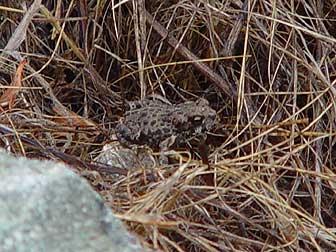
P.S. Do they look like this?