|
RE: Some nice bucks (pic)
Apparently you have a short memory and a very selective way of viewing the evidence. you predicted breeding rates would increase as the herd was reduced but, instead they decreased. That alone proves the herd was below the MSY carrying capacity of the habitat in 2000. If the harvests hadn't exceeded recruitment over the last 8 years elk Co. would still have over 25 DPFSM instead of 8 or 10. To show you I am right the over browsed habitat in 2F was still supporting 22 PS DPSM in 2005, 3A had 32 PS DPSM,2E has 32 PS DPSM2C had 20 DPSM and 4D had 21 DPSM. Isn't it amazing that all the WMUs surrounding 2G can support almost twice or more the number of deer as 2G. Explain that one if you can. It has been explained to you time and again. You just don’t like the answers so you continuously pretend the answers don’t exist or are incorrect. What is incorrect is you and your wanting to cling to those past management practices, including those estimated numbers, that have been proven to be a failure because they didn’t work to have sustainable deer habitat or higher deer populations. As for the deer numbers in the units around 2G that too has been explained. All of the units have different habitat that supports different numbers of deer. All of those units also have a management goal and objective that fits that unit, instead of just one management objective for all units. The deer and their food supply provide that management direction in each unit, just as it should be. So for over 80 years the habitat supported 25 DPSM and now you are claiming the habitat suddenly decided to control the herd ? Try again. In some areas the habitat is supporting far more then 25 deer per square mile. In other areas it is very obvious the habitat doesn’t support any way near that number of deer, and the deer themselves prove that too. R.S. Bodenhorn |
RE: Some nice bucks (pic)
ORIGINAL: Coalcracker ORIGINAL: bluebird2 The fact is the deer and their food supply have proven time after time that you are wrong. Your preferred method of deer management does not work for the long term, and that failure for the long term is exactly what got us to where we are with low deer populations in so much of the northern tier today. Explain that one if you can. Here is another quote from the SCS Report. With few exceptions, the state-wide deer density in Pennsylvania has exceeded 25 deer per square mile since the late 1920’s. Not hardly. I obviously have a lot more to do with my time then you retired guys do though. I can’t keep up with all of the posts that are made in a day and just try to hit the ones that are the most outlandish, full of nonsense and outright fairy-tails. R.S. Bodenhorn |
RE: Some nice bucks (pic)
As for the deer numbers in the units around 2G that too has been explained. All of the units have different habitat that supports different numbers of deer. All of those units also have a management goal and objective that fits that unit, instead of just one management objective for all units. Therefore, unless you are claiming the acceptable goal for 2F and 2G is poor forest health and it doesn't matter how many deer each unit has, your explanation makes no sense. In some areas the habitat is supporting far more then 25 deer per square mile. In other areas it is very obvious the habitat doesn’t support any way near that number of deer, and the deer themselves prove that too. |
RE: Some nice bucks (pic)
If deer, other wildlife, and the forest itself co exist in harmony for over 80 years at densities of 25dpsm, and suddenly in the last ten years, that same forest can no longer support a fraction of that many deer AFTER 80 YEARS!!!!! It doesn't take a genius to figure out that another factor has come into play and altered that relationship, and it's not the deer. Two possible factors being forest management and pollution. WE are still learning much about how pollution is affecting our planet. Can bad air quality affect certain species of plant regeneration, as well as acid rain? There is a a broad area of the Rothrock SF where poor red oak regeneration has been specifically attributed to acid rain, and that assessment came straight from DCNR.
|
RE: Some nice bucks (pic)
I find it amusing that the same minority that cites acid rain as the culprit for poor regeneration is also the camp that claims the PGC has been taken over by ecoextremists.
The negative effects of acid rain on regeneration arestill mostlyunproven theory and that type of theory attracts the same kind of ecoweenies that the global warming hoax does.So what it seems we have here is ecoweenies accusing the PGC of bowing to the ecoweenies[&:] |
RE: Some nice bucks (pic)
In the short time I've been on this site,I too witnessed ecoweenies accusing the PGC of bowing to ecoweenies. They want to toast the PGC weenies. Then you have the hunting weenies roasting the PGC weenies for their decisions. Then the PGC shows data to explain to the hunting weenies as to why the PGC are not weenies for their decisions. Maybe this whole matter would be better handled by Hillshire Farms?
 [/align] [/align] |
RE: Some nice bucks (pic)
The negative effects of acid rain on regeneration are still mostly unproven theory and that type of theory attracts the same kind of ecoweenies that the global warming hoax does |
RE: Some nice bucks (pic)
Steel,Red oak is tolerant of acidic soils.I can show you dozens of exclosures that were never treated and have have excellent oak regeneration.The only thing they're missing is large deer herds.I can also show you areas that were limed and you'll see no difference between the treated and un-treated areas with the exception of bracken ferns.Bracken ferns seem to take a liking to lime.
Acidic soils shave had a very pronouned effect on hard maple,not oak regeneration.The soils in oak forests are very acidic by nature,regardless of rainfall |
RE: Some nice bucks (pic)
This is what the Penn Sate School of Forestry has to say about regeneration in PA.
. Tree planting (artificial regeneration) generally is not necessary in Pennsylvania. Through the use of acceptable silvicultural practices, most of Pennsyl- vania’s forests will regenerate naturally from seeds or sprouts. Studies show that naturally regenerated trees usually grow faster and survive better than planted trees. However, trees may have to be planted to reforest former strip mine sites, old fields, conifer plantations, and areas where insects or diseases have killed all the seed-producing trees. |
RE: Some nice bucks (pic)
ORIGINAL: bluebird2 This is what the Penn Sate School of Forestry has to say about regeneration in PA. . Tree planting (artificial regeneration) generally is not necessary in Pennsylvania. Through the use of acceptable silvicultural practices, most of Pennsyl- vania’s forests will regenerate naturally from seeds or sprouts. Studies show that naturally regenerated trees usually grow faster and survive better than planted trees. However, trees may have to be planted to reforest former strip mine sites, old fields, conifer plantations, and areas where insects or diseases have killed all the seed-producing trees.  |
RE: Some nice bucks (pic)
Classic Bluebird twisting of the facts. One lone paragraph does not give a representation of Penn State Forestry School's position on deer and regeneration and you know better. Their position has been that deer have a very large impact. For all we know, it's probably all through whatever report you clipped this little sound byte from |
RE: Some nice bucks (pic)
ORIGINAL: Screamin Steel If deer, other wildlife, and the forest itself co exist in harmony for over 80 years at densities of 25dpsm, and suddenly in the last ten years, that same forest can no longer support a fraction of that many deer AFTER 80 YEARS!!!!! It doesn't take a genius to figure out that another factor has come into play and altered that relationship, and it's not the deer. Two possible factors being forest management and pollution. WE are still learning much about how pollution is affecting our planet. Can bad air quality affect certain species of plant regeneration, as well as acid rain? There is a a broad area of the Rothrock SF where poor red oak regeneration has been specifically attributed to acid rain, and that assessment came straight from DCNR. |
RE: Some nice bucks (pic)
Here is the link to the report by the SCS. The quote is from the first paragraph on page 11.
http://www.scscertified.com/PDFS/forest_statepenn.pdf |
RE: Some nice bucks (pic)
ORIGINAL: bluebird2 Classic Bluebird twisting of the facts. One lone paragraph does not give a representation of Penn State Forestry School's position on deer and regeneration and you know better. Their position has been that deer have a very large impact. For all we know, it's probably all through whatever report you clipped this little sound byte from  LOL here you go... http://pubs.cas.psu.edu/freepubs/pdfs/uh145.pdf http://www.dcnr.state.pa.us/news/resource/res2008/08-1217-naturenotes.aspx http://www.dnr.cornell.edu/ext/info/pubs/management/PA%20Regenerating%20hardwood%20forests.pdf http://psuforestmgmt.cas.psu.edu/regeneration.htm http://aginfo.psu.edu/News/2004/12/forests.html http://www.extension.org/pages/Young_Penn_State_Researcher_Immersed_in_Pennsylvan ia_Deer_Study Not all these links are straight to PSU school of forestry but all these links are either to Penn State or someone citing their research and ALL name deer as a significant factor in forest regeneration. It took just a few minutes to find these. There are most likely dozens more at least |
RE: Some nice bucks (pic)
No , I am not busted. I already had those articles on fencing bookmarked on my computer. I simply posted the quote to show the apparent effects of deer on regeneration varies depending on the author of the report.. The report I referenced didn't even mention over browsing, while the reports you listed were intended to emphasize the impact of deer on regeneration. Different authors with different agendas.
Furthermore, despite all the doom and gloom claims about overbrowsing the article I referenced shows that the amount of forested acres is still increasing. How is that possible when we had a record number of deer in 2001? |
RE: Some nice bucks (pic)
Yes, you are busted once again!
You presented one paragraph and tried to pass it off as evidence that Penn State didnt consider the negative effects of deer on regeneration. You said: Note, there is no mention of a problem of over browsing by deer!!!! |
RE: Some nice bucks (pic)
No , I am not busted. I already had those articles on fencing bookmarked on my computer. I simply posted the quote to show the apparent effects of deer on regeneration varies depending on the author of the report.. The report I referenced didn't even mention over browsing, while the reports you listed were intended to emphasize the impact of deer on regeneration. Different authors with different agendas. On the topic of deer impact on regeneration, deer arent the only factor, and its debatable wether or not there are more significant factors that magnify deer damage. Furthermore, despite all the doom and gloom claims about overbrowsing the article I referenced shows that the amount of forested acres is still increasing. How is that possible when we had a record number of deer in 2001? |
RE: Some nice bucks (pic)
[blockquote]quote: Furthermore, despite all the doom and gloom claims about overbrowsing the article I referenced shows that the amount of forested acres is still increasing. How is that possible when we had a record number of deer in 2001? [/blockquote] Very good question. One which deserves an answer, yet will most likely conveniently go ignored! (LOL It's a tired old tactic to change the subject when a lie is confronted and proven. |
RE: Some nice bucks (pic)
Here is the link to the report which I quoted and you obviously haven't read.
http://pubs.cas.psu.edu/FreePubs/pdfs/uh097.pdf So big deal, you managed to find one paragraph where deer werent mentioned. The fact that you would even try to post just that one small snippet as evidence that Penn States researchers dont consider deer is simply ridiculous. It just proves once again that you will go to any length to perpetuate your warped agenda. Once again it is you that is busted for falsely accusing me of taking the paragraph I quoted out of context and misrepresenting the content of the report. We all know that all foresters consider deer to be a potential problem regarding regeneration, but the report I quoted clearly shows that the deer have not been devastating our forests for the past 80 years. Here is another quote from the report citing the increase in forested land. According to U.S. Forest Service inventories, forest areas are actually increasing in Pennsylvania. Forest area throughout the Commonwealth is currently at its highest level since the late nineteenth century. In the heavily populated Southeast, forestland increased more than 6 percent between 1978 and 1989. Likewise, it increased 4.5 percent in the Northeast and 3 percent in the West. Even in the Poconos, an area of rapid population growth, total forestland increased 1 percent. Today, about 60 percent of Pennsylvania is forested. |
RE: Some nice bucks (pic)
Winter kill.
I wonder why it died?  |
RE: Some nice bucks (pic)
ORIGINAL: livbucks Winter kill. I wonder why it died?
|
RE: Some nice bucks (pic)
Probably the deer retaliating for density being managed higher in 2f than 2g.
It's a principle thing. |
RE: Some nice bucks (pic)
Poor BB keeps taking a beating!!
 |
RE: Some nice bucks (pic)
ORIGINAL: blkpowder Poor BB keeps taking a beating!!
|
RE: Some nice bucks (pic)
The only way to tell for sure is to bust open the femur.However,the postion the deer is in a very common way to find winter-killed deer.
Check out the overbrowsed,hedged seedling that keeps trying to grow but the deer keep hammering it.I can't tell for sure but it appears to be beecha nd if the deer are hitting the beech that hard,that habitat is very poor. |
RE: Some nice bucks (pic)
ORIGINAL: bluebird2 ORIGINAL: blkpowder Poor BB keeps taking a beating!!
When every one knows 2 F could ,would& should blah blah:eek: And now we have twice as much blahggggggggg[:-] |
RE: Some nice bucks (pic)
ORIGINAL: livbucks Probably the deer retaliating for density being managed higher in 2f than 2g. It's a principle thing. |
RE: Some nice bucks (pic)
ORIGINAL: livbucks Probably the deer retaliating for density being managed higher in 2f than 2g. It's a principle thing. Another one had a tattoo on his front leg it said Live free in 2G or die. Musta been a vet.[8D] |
RE: Some nice bucks (pic)
More nonsense!!!
|
RE: Some nice bucks (pic)
Here is an interesting quote from one of BTB's links.
The challenges are many. We can relate the failure to many issues: loss of seed sources, competing understory plants such as ferns or mountain laurel, too many poor quality trees and wrong species left after harvesting, and excessive deer populations. The latter issue is very controversial, but if there are only a few seedlings or stump sprouts of desirable browse in the woods, even a few deer can have a major effect. To learn more about your wood's future as you walk through the winter landscape, look for young trees on the forest floor. Are they poking up through flattened ferns? Are they extending above the snow? Is there a general layer of shrubs that deer apparently don’t eat? Are deer stopping to browse on the seedlings you do see? Do you see evidence of deer, turkey, and squirrel digging and scraping for seeds in the forest litter? There are many questions to consider in understanding the potential of your woods to provide future benefits. Research studies repeatedly find that if you fail to have regeneration in place before harvesting, you will struggle to get regeneration in the future. Other competing plants will have the advantage over young trees trying to establish themselves. Seedlings already on the site, that are tall and strong, can compete successfully with other plants. If repeated browsing has created misshapen seedlings with multiple tops, their ability to develop into quality stems may be frustrated. The evidence of wildlife looking for seeds clearly suggests your overstory trees are fruiting, but if none of the seed ever sprouts, there could be too much competition for mast, or light conditions either in the canopy or close to the ground may not be ideal. |
RE: Some nice bucks (pic)
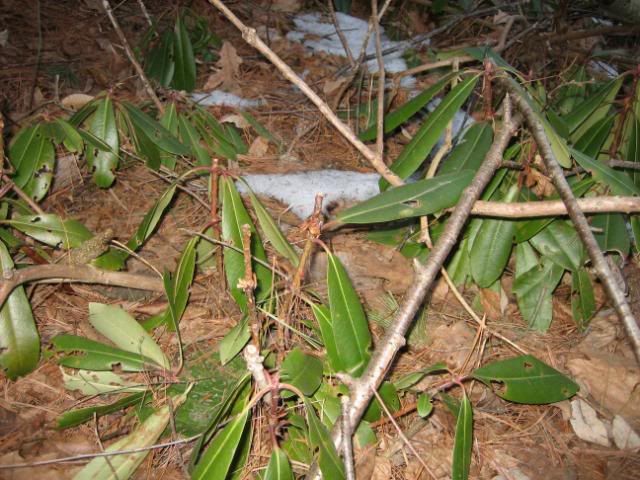
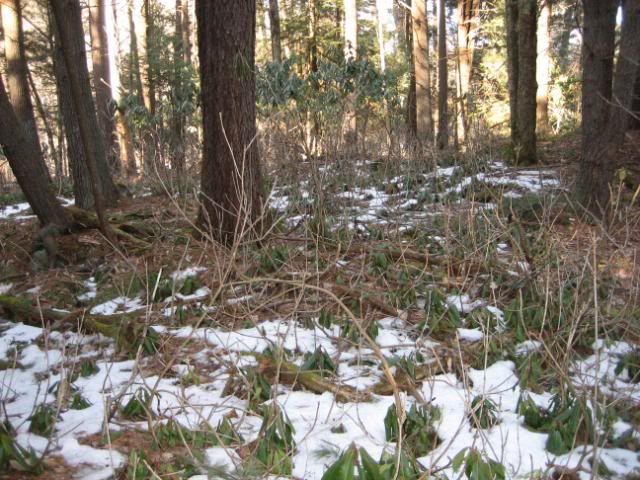
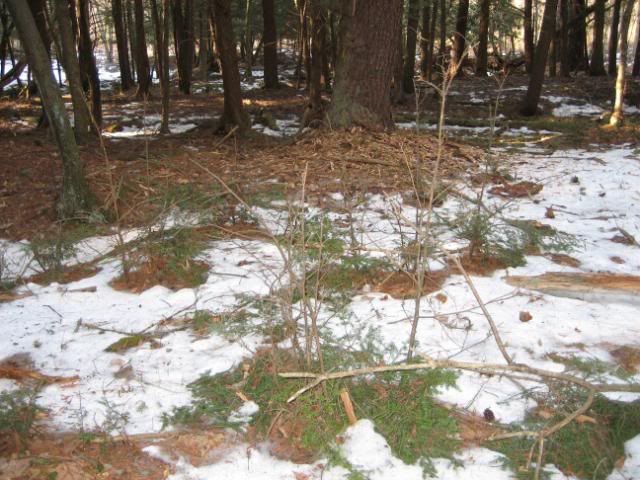
Perhaps this will help some people better understand the deer/habitat relationship. Often people question why we don’t have more deer and blame the lack of deer on hunters harvesting too many deer. Though it is possible to over harvest deer in some small pockets of any area I believe the following pictures show the biggest reason we don’t have more deer in most areas. When you have winter habitat that isseverally affected by the deer, like this obviously is,harvesting fewer deer would do nothing more then create more winter mortality and food for the predators or scavengers. These pictures were taken last week in one of the wintering grounds areas near Ridgway. The first picture shows how the deer chewed the rhododendron down to what was under the frozen snow crust where they couldn’t dig down any further. http://i151.photobucket.com/albums/s141/RBODENHORN/WinterDeerdamage001.jpg This picture shows how the deer ate all of the rhododendron that wasn’t buried beneath the snow to as high as they could reach. http://i151.photobucket.com/albums/s141/RBODENHORN/WinterDeerdamage005.jpg A view of how the hungry deer ate all of the hemlock, down to the stem, that was above the crust line. http://i151.photobucket.com/albums/s141/RBODENHORN/WinterDeerdamage008.jpg Make no mistake about the fact that the deer in this area proved that their numbers are about to the maximum the winter could have supported. Even with the winter having opened when it did it will likely still result in reduced fawn survival rates once again this year due to many not reaching the correct birth weight due to the stress mom endured through the winter. R.S. Bodenhorn |
RE: Some nice bucks (pic)
Pretty little dead deer aint it?
 |
RE: Some nice bucks (pic)
I was in my back field today with my one son, burning some of the grass and corn stalks off the field. There is still a lot laying where the harvester missed it, beans are still on the soybeans and nothing will eat the turnips we planted last year. Since the weather has broken, there is a flock of turkey in my back field that I see at least once a day. There is thirty some of them, they head West in the morning and East in the evening. With more food than the deer can eat, we also had and have herd reduction.
If the PGC knows where the deer spend their winter, what is being done to improve these winter grounds? If nothing is being done, except shooting the deer off, then shame on the PGC. |
RE: Some nice bucks (pic)
Often people question why we don’t have more deer and blame the lack of deer on hunters harvesting too many deer. Though it is possible to over harvest deer in some small pockets of any area I believe the following pictures show the biggest reason we don’t have more deer in most areas. When you have winter habitat that is severally affected by the deer, like this obviously is, harvesting fewer deer would do nothing more then create more winter mortality and food for the predators or scavengers. Claiming that the habitat is controlling the herd when there is more than twice as much food/deer available now compared to 10 years ago is irrational and irresponsible. |
| All times are GMT -8. The time now is 04:32 AM. |
Copyright © 2026 MH Sub I, LLC dba Internet Brands. All rights reserved. Use of this site indicates your consent to the Terms of Use.