


338 win mag
 03-25-2013 | 12:55 PM
#21
Nontypical Buck
Joined: Dec 2010
Posts: 1,081
Likes: 0
From: Idaho

Why do people say this? 
How many millions of AR-15/M-16 type rifles have come from the factories with a "flash suppressor" attached to their muzzles? The .223/5.56x45mm cartridge can hardly be considered a heavy recoiling cartridge.
All a flash suppressor or muzzle brake is, is a tube with holes in it's sides that is attached to the muzzle of a firearm. The shape, size, and number of holes varies, but they both do the same thing: they allow some of the expanding gasses to exit to the side of the muzzle a few milliseconds before all of the remaining gasses exit the muzzle.
It's hard to define what a "magnum" cartridge is, but basically it has more capacity than a "standard" case so it can burn more powder. Burning more powder increases velocity, noise, and recoil.
When I shoot .357 mag cartridges in my .357 mag pistols, they are way louder and have more recoil than when I shoot .38 spl cartridges in those same pistols.
OK, enough of my rant on muzzle brakes, and back to the OP's original question.
Like Big Uncle also posted, "Try shooting someone else's .338 first..." We are all built differently, we each absorb recoil differently, and each rifle will recoil differently depending on tis fit, weight, and shape. Five people can shoot the same rifle, and you can get five different opinions of how hard the recoil was.
I like to shoot, and I shoot a lot. When I was competing in registered Trap, I was shooting 10,000 12 ga shells per year. When I was competing in registered Skeet I was also shooting 10,000 shells per year, but they were not all 12 ga. I also don't like heavy recoil.
To reduce the recoil in my shotguns, I made several modifications to them. These modifications would also apply to reducing felt recoil in rifles.
First, the gun should properly fit the shooter. Length of pull and shape and drop of the comb of the stock are not too difficult to modify.
Many after market recoil pads like Limbsaver, Decelerator, and Kick Eez will "absorb" more recoil than many factory pads.
A heavier gun will kick less than a lighter gun, all else being equal. Weight can be added to a gun with lead or by installing an in-stock mercury or mechanical recoil reducer.
And finally, the barrel can be ported or a muzzle brake added.
I have done a combination or all of these things to several of my shotguns, and to my .375 RUM and .300 Wby rifles.
Out of the box, my .375 RUM kicked harder than any gun that I had ever shot. After the modifications, it's kick does not feel much more than my basically factory 7mm Rem mag.
And with the modifications, my .300 Wby does not feel like it kicks as hard as my factory .270 Win. Last year in South Africa I let my PH shoot my .300 Wby off the bench, and he said that it did not kick as hard as his 7x57. I will often take my .300 Wby to the range and shoot 20 or more shells through it then go over the the Skeet range, shoot 100 or more 12 ga shells, and have no soreness at all from recoil.
How many millions of AR-15/M-16 type rifles have come from the factories with a "flash suppressor" attached to their muzzles? The .223/5.56x45mm cartridge can hardly be considered a heavy recoiling cartridge.
All a flash suppressor or muzzle brake is, is a tube with holes in it's sides that is attached to the muzzle of a firearm. The shape, size, and number of holes varies, but they both do the same thing: they allow some of the expanding gasses to exit to the side of the muzzle a few milliseconds before all of the remaining gasses exit the muzzle.
It's hard to define what a "magnum" cartridge is, but basically it has more capacity than a "standard" case so it can burn more powder. Burning more powder increases velocity, noise, and recoil.
When I shoot .357 mag cartridges in my .357 mag pistols, they are way louder and have more recoil than when I shoot .38 spl cartridges in those same pistols.
OK, enough of my rant on muzzle brakes, and back to the OP's original question.
Like Big Uncle also posted, "Try shooting someone else's .338 first..." We are all built differently, we each absorb recoil differently, and each rifle will recoil differently depending on tis fit, weight, and shape. Five people can shoot the same rifle, and you can get five different opinions of how hard the recoil was.
I like to shoot, and I shoot a lot. When I was competing in registered Trap, I was shooting 10,000 12 ga shells per year. When I was competing in registered Skeet I was also shooting 10,000 shells per year, but they were not all 12 ga. I also don't like heavy recoil.
To reduce the recoil in my shotguns, I made several modifications to them. These modifications would also apply to reducing felt recoil in rifles.
First, the gun should properly fit the shooter. Length of pull and shape and drop of the comb of the stock are not too difficult to modify.
Many after market recoil pads like Limbsaver, Decelerator, and Kick Eez will "absorb" more recoil than many factory pads.
A heavier gun will kick less than a lighter gun, all else being equal. Weight can be added to a gun with lead or by installing an in-stock mercury or mechanical recoil reducer.
And finally, the barrel can be ported or a muzzle brake added.
I have done a combination or all of these things to several of my shotguns, and to my .375 RUM and .300 Wby rifles.
Out of the box, my .375 RUM kicked harder than any gun that I had ever shot. After the modifications, it's kick does not feel much more than my basically factory 7mm Rem mag.
And with the modifications, my .300 Wby does not feel like it kicks as hard as my factory .270 Win. Last year in South Africa I let my PH shoot my .300 Wby off the bench, and he said that it did not kick as hard as his 7x57. I will often take my .300 Wby to the range and shoot 20 or more shells through it then go over the the Skeet range, shoot 100 or more 12 ga shells, and have no soreness at all from recoil.
 03-25-2013 | 08:39 PM
#22

Typical Buck
Joined: Feb 2007
Posts: 550
Likes: 0
From: SW Montana
The flash suppressor on a AR is nothing like a muzzle brake on a hunting rifle. They are two very different things. A flash hider is meant to conceal the "flash" of gasses exploding from the barrel as the rifle is fired. It is mainly used on military rifles. A muzzle brake, on the other hand, is designed to reduce recoil. The ports, or holes in a muzzle brake direct the quickly expanding gasses away from the muzzle, thereby reducing the energy that is transferred straight back into the shooter. Rifles equipped with a muzzle brake essentially transfer some of the recoil outward from the muzzle, instead of rearward and into your shoulder. They do a good job of reducing recoil, but there is of course a cost. Rifles equipped with a muzzle brake are much louder than those without, to the point that many people will not use them. They are especially loud to those standing next to the shooter, and for that reason will not make you very many friends at the range. A good way to tell the difference is the flash suppressor is open on the end and a brake is solid except for a hole for the bullet to come out.
Like I posted earlier, both flash suppressors and muzzle brakes are an extension on the muzzle. They both have holes or ports in their sides. Some are made with circular holes, some are made with slots. They both allow some of the expanding gasses to escape through the holes to the side of the barrel. As both flash suppressors and muzzle brakes divert some of the hot, expanding gasses (smokeless powder doesn't explode) to the side of the barrel, it also changes the direction of the report, or noise.
How loud the report is would depend on the quantity and burning rate of the powder, the pressure of the expanding gasses inside the barrel, the area of the holes of the suppressor or brake, and the angle of the sides of the ports. Sound waves travel in an arc away from the source. From a tight muzzle, the source of the sound is the end of the barrel, and the sound arc travels away from the muzzle and the shooter. From a ported muzzle, the source of some sound is the ports on the side of the barrel, and these sound arcs travel from the side of the barrel. The shooter is then on the side of the arc and receives more of the sound.
On military type weapons they are called "flash suppressors" as they do re-shape and reduce the size of the muzzle flash, they also reduce recoil. On hunting rifles they are called "muzzle brakes" as they reduce some of the recoil, they also re-shape and reduce the size of the muzzle flash.
The escaping gas doesn't care what shape the holes are, it just wants to get out of the barrel as soon as it can, and when it goes out holes in the side of the muzzle it reduces the recoil and it re-shapes and reduces the size of the muzzle flash.
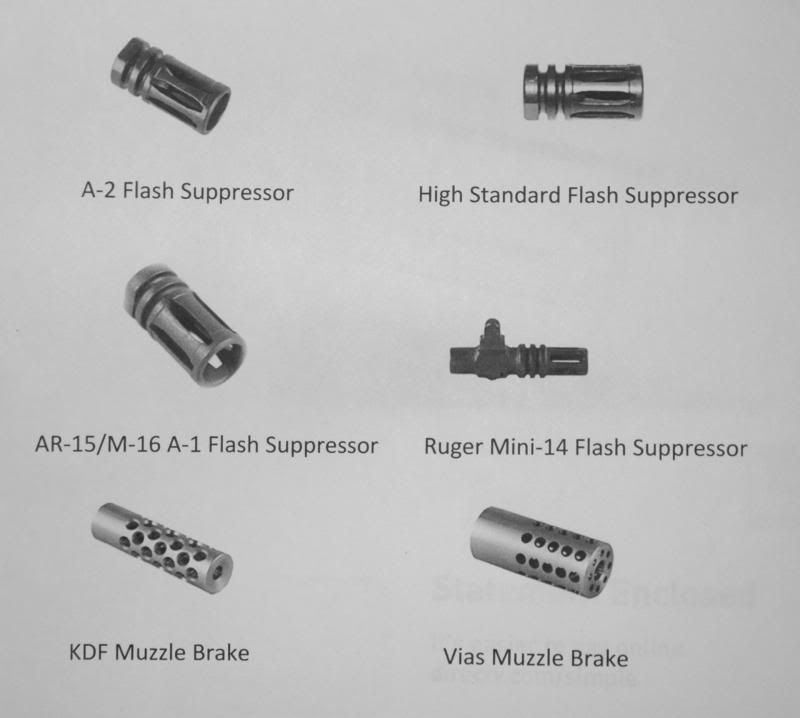
Today flash suppressors and muzzle brakes come in a large assortment of the size, shape, and location of the holes. Some suppressors are open at the end, some are closed with a solid ring. Each manufacturer makes the holes a little different and claims his product is the best.
When I went into the Army in 1968, we trained with the M-14. Every M-14 that I can ever remember seeing had a 2" or so flash suppressor that had long slots around it and had a solid ring around the muzzle end.
The first M-16s that were used in Vietnam did not have the solid ring on the end. They were open. The guys that carried them in the thick jungles quickly found that the open end caught in the vegetation. The military then re-designed the flash suppressors to have the solid ring on the end. The M-16 that I carried for a year over there had the solid ring.
Here's a few the of flash suppressors and muzzle brakes that are available on rifles today.
Last edited by buffybr; 03-28-2013 at 10:44 AM.
04-05-2013 | 02:33 PM
#23
Fork Horn
Joined: Sep 2007
Posts: 107
Likes: 0
From: michigan
as said by a few ,try one first ,i do not like any kind of break nor magnaport , period! ,if u dont like someone ask them to go shooting with u ,u will soon have no freinds , let alone they will be deaf, as far as the 338 goes , go for it great cal
Last edited by polaris754; 04-05-2013 at 02:37 PM.


