Originally Posted by
fritz1
The flash suppressor on a AR is nothing like a muzzle brake on a hunting rifle. They are two very different things. A flash hider is meant to conceal the "flash" of gasses exploding from the barrel as the rifle is fired. It is mainly used on military rifles. A muzzle brake, on the other hand, is designed to reduce recoil. The ports, or holes in a muzzle brake direct the quickly expanding gasses away from the muzzle, thereby reducing the energy that is transferred straight back into the shooter. Rifles equipped with a muzzle brake essentially transfer some of the recoil outward from the muzzle, instead of rearward and into your shoulder. They do a good job of reducing recoil, but there is of course a cost. Rifles equipped with a muzzle brake are much louder than those without, to the point that many people will not use them. They are especially loud to those standing next to the shooter, and for that reason will not make you very many friends at the range. A good way to tell the difference is the flash suppressor is open on the end and a brake is solid except for a hole for the bullet to come out.
Not exactly.
Like I posted earlier, both flash suppressors and muzzle brakes are an extension on the muzzle. They both have holes or ports in their sides. Some are made with circular holes, some are made with slots. They both allow some of the expanding gasses to escape through the holes to the side of the barrel. As both flash suppressors and muzzle brakes divert some of the hot, expanding gasses (smokeless powder doesn't explode) to the side of the barrel, it also changes the direction of the report, or noise.
How loud the report is would depend on the quantity and burning rate of the powder, the pressure of the expanding gasses inside the barrel, the area of the holes of the suppressor or brake, and the angle of the sides of the ports. Sound waves travel in an arc away from the source. From a tight muzzle, the source of the sound is the end of the barrel, and the sound arc travels away from the muzzle and the shooter. From a ported muzzle, the source of some sound is the ports on the side of the barrel, and these sound arcs travel from the side of the barrel. The shooter is then on the side of the arc and receives more of the sound.
On military type weapons they are called "flash suppressors" as they do re-shape and reduce the size of the muzzle flash, they also reduce recoil. On hunting rifles they are called "muzzle brakes" as they reduce some of the recoil, they also re-shape and reduce the size of the muzzle flash.
The escaping gas doesn't care what shape the holes are, it just wants to get out of the barrel as soon as it can, and when it goes out holes in the side of the muzzle it reduces the recoil and it re-shapes and reduces the size of the muzzle flash.
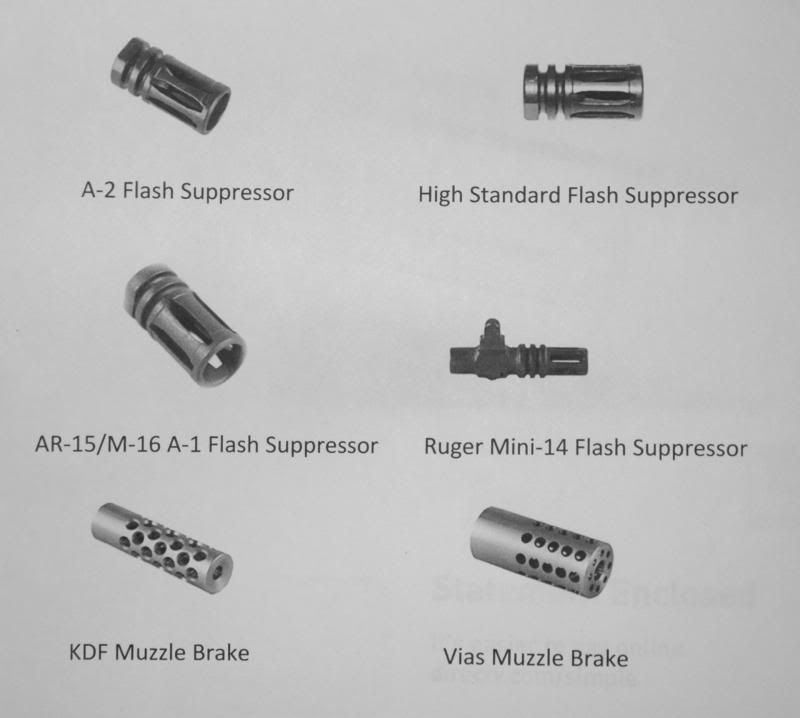
Today flash suppressors and muzzle brakes come in a large assortment of the size, shape, and location of the holes. Some suppressors are open at the end, some are closed with a solid ring. Each manufacturer makes the holes a little different and claims his product is the best.
When I went into the Army in 1968, we trained with the M-14. Every M-14 that I can ever remember seeing had a 2" or so flash suppressor that had long slots around it and had a solid ring around the muzzle end.
The first M-16s that were used in Vietnam did not have the solid ring on the end. They were open. The guys that carried them in the thick jungles quickly found that the open end caught in the vegetation. The military then re-designed the flash suppressors to have the solid ring on the end. The M-16 that I carried for a year over there had the solid ring.
Here's a few the of flash suppressors and muzzle brakes that are available on rifles today.