
|
RE: Refinishing rifle stock
I used lin-speed years ago. Best I remember it was the only one that cured hard among the linseed oils. It dried very well in my drying cabinets (heated).
|
RE: Refinishing rifle stock
ORIGINAL: stalkingbear The reason I use 0000 steel wool,successfully I may add,is the fact that I DON'T use tru-oil (linseed oil) as it never hardens or cures completely 100%. The finishes I use do harden and steel wool on a completely cured finish coat leaves NO bits or fragments of steel behind. In almost 30 years of being gunsmith,I have experimented with numerous stock finishes. I did eventually discover what I consider the perfect finish. I blend tung oil,eurethane,and epoxy with bonding agent (only way to blend them) and air brush on/steel wool between coats. I've not had steel wool remaining in finish for about 23-24 years now. I must add that each coat takes 4 days to cure. Everyone knows it hardens, but hey, yer da pro. On aside, the absolute best finish going, taught to me by asmith up in AK, is straight two part epoxy slathered on a stock heated to 120 degrees in an oven, sanded after cooling/curing, and thenseveral coats of Tru-Oil applied. Not for the beginner, but hands down, tuff 'nuff for the ruff stuff.................. |
RE: Refinishing rifle stock
The tru oil recipe changed several years ago (about 16),and I still don't use it.You try to make it seem I don't know my stuff But I supect I've been gunsmith longer than you have. Pretty obvious when you talk about making a mess of finish instead of doing it right from the very start. I experimented for years before settling on recipe I use.
|
RE: Refinishing rifle stock
Guys, here is a little twist I tried a couple of years ago. I've used Linspeed and Tru oil in the past but I tried this.
I haveone T/C Hawken with a Green Mtn Barrel that I use for almost all my ML hunting. I didn't like the shiny brass or the glossy stock so here is what I did. I removed all the old finish with sandpaper and steel wool and wiped it down with a rag dampened in mineral spirits to remove the sanding dust then let it dry for a day. The grain in this stock is beautiful. I then applied several coats of clear satin finish polyurethane to the stock. All the brass was cleaned with a degreaser and polished with steel wool to remove any oxidation. I then used commercial grade brass black that I got from my cousin that works on antiques (not the Brass Black fro Birchwood Casey) on all the brass parts. It really looks sharp and I get a lot of comments on this rifle. |
RE: Refinishing rifle stock
ORIGINAL: stalkingbear The tru oil recipe changed several years ago (about 16),and I still don't use it. ORIGINAL:stalking bear You try to make it seem I don't know my stuff ORIGINAL: stalking bear But I supect I've been gunsmith longer than you have. I was taught by someone much older than me, way better than I'll ever hope tobe, and had the disposition of a pound and a half of C4.........may that old miserable so and so rest in peace. Miss ya Virg................. ORIGINAL: stalking bear Pretty obvious when you talk about making a mess of finish instead of doing it right from the very start. YMMV, of course.............. |
RE: Refinishing rifle stock
One of the very BEST finished I've ever applied came about mostly by accident! I had a nice newWinchester Model 47 .22 single-shot that came from Sears & Roebuck with an unfinished stock. Not "knowing any better" in those days, I sanded it smooth and usedspar varnish on it. Two or three coats, IIRC.
Now a year or so later, I read in a gun magazine about how nice walnut gunstocksdeserve a hand-rubbed Linseed oil finish. So I sanded the varnish down flush wit the wood, finishing with 400A wet or dry paper, then did a "polishing job" with the finest steel wool I could find. 0000?? Don't recall! Well, it seems that what I had done in my ignorance was to have filled all the pores in the wood grain withvarnish, so the surface was absolutely smooth and filled. I didn't even realize it at the time, but I had completed filling and smoothing the wood in the best possible, although labor-intensive, way prior to applying the oil! The oil I used was plain old boiled linseed oil, no driers, no nuthin'. The instructions in the magazine (Field & Stream, Outdoor Life, or one of those) said to use very little oil, and rub it into the wood with your bare hand until the heel of your hand got so hot it almost blisteredyour hand, then after treating thewhole stock this way, set the stock aside for two or three days (depending on ambient humidity) so that it is thoroughly dry to the touch before rubbing in the next coat. Repeat. Do this as much as ten times, letting the stock dry for several weeks after the last coat. I followed the directions exactly, but I was not particularly pleased with the appearance of the final result after the tenth coat. So, I reassembled the rifle, and put it away in a wool-lined soft gun case. (Another mistake, I learned later. However, I was lucky this time, the gun did not rust.) I left the riflein the case for a month or so, and when I took it out, the stock had become beautiful! It literally glowed from within with a soft sheen, not shiny at all, looking for all the world like the "London Oil" finish one sees on Best Grade guns. And it was obvious that the finish was IN, not ON, the stock! I cannot explain HOW that finish got so much better while in that gun case, but it did!! Imagine my surprise when I saw the change! This little tale is provided as merely a story of what happened to me the very first time I tried to refinish a stock. I have not used a straight Linseed oil finish since then, after finding out that Linseed oil makes about the poorest finish of all as regards keeping moisture out of the stock wood, even if the finish looks fabulous. |
RE: Refinishing rifle stock
Well I'm no expert. but after 4 stocks that I have refinished I can attest to the fact that BirchwoodCasey's Tru-Oil will actually dry (between coats) much faster than the 50/50 mixture of boiled linseed oil and spare varnish I used on my first two projects.
Letting the stock fully dry between coats is very important and the Tru-Oil works like a dream. Here is my last project with the Tru-Oil. C. Davis  |
RE: Refinishing rifle stock
Hey..!
I thought I was the only one crazy enough to ever built a stock for a NEF.... Here's my wife's deer gun I threw together for her one winter a while back, it's got some miles on it but there's Tru Oil on it somewhere.....grins. 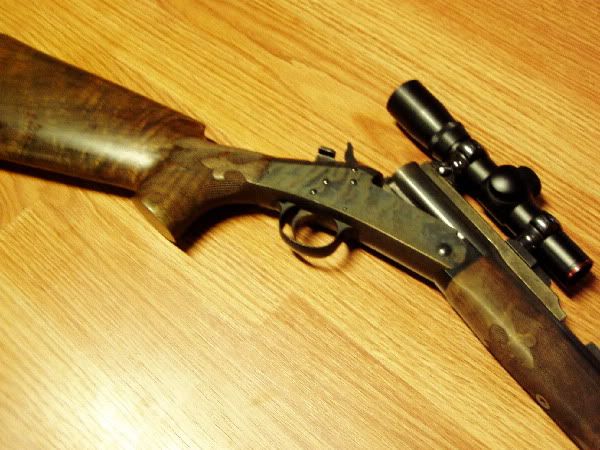 |
RE: Refinishing rifle stock
Nice stock Wilds,
ThisNEF is my tinkering, reloading, experimental gun that I have a lot of fun with. It is a Win. .270. I use it when I am out of 30-30, or muzzle loading range. This was the first time I used maple. My other projects have been with walnut. I sanded and filled the pores all the way down to 1000 grit wet auto sand paper, and the stock feels like a very smooth rock. The maple is harder than the walnut. In total, it has either 7,or 8 hand rubbed coats of Tru-Oil. I lost count. If you like to experiment and tinker, just get a NEF rifle and a Lee Loader. It is loads of fun. C. Davis |
| All times are GMT -8. The time now is 12:07 PM. |
Copyright © 2026 MH Sub I, LLC dba Internet Brands. All rights reserved. Use of this site indicates your consent to the Terms of Use.