
|
Refinishing rifle stock
I have a remington model 7 that I want to refinish. I understand how to prep it for refininshing,but I am hunting advice on how to finish it. I have read about tru oil. Does it shine and how much? Is it a satin finish or can it gloss if enough coats is applied. I also considered staining the stock, can I apply tru oil over the finish? Help and advice is appreciated.
|
RE: Refinishing rifle stock
Yes Tru Oil can be applied over stain, VERY dry stain. You might want to reconsider though as Tru Oil nearly always darkens with age.
You can make it gloss, or you can make it satin...personally I can't dig a glossy stock for any reason. Lots of ways to apply it, some are right, some are wrong, some are easy, some are hard.....sometimes therightest way is the hardest way. Refinishing: Strip old finishcompletely, sand down to at least 320 grit, further is better. You can "raise" the grain of the wood with a damp cloth and sand off the "fibers", or burn them off with a torch....but I stopped doing that when I realized it was a wasteof time.Now is the time to fix any problems with the checkering.Apply the first coat by rubbing some in with your bare skin, fingers, whatever...until it becomes "dry" to the touch. Do small patches of the stock so the stuffdoesn't get away from you. Dont let it "build up", use an old tooth brush to "clean it up" in the checkering. Once the whole stock is covered, it'll look like crap, no worries...set it aside to cure for a day or two. Once cured, sand it gently, not going too deep but just enough to smooth it all out again,with the same grit paper you did the final rawsand with...NEVER use steel wool. Repeat the above, except for the grain raising thing (that's a one time deal),at least four more times, or until you can see with a strong light that the pores of the wood are "filled". When the 5th coat is applied, or when you decide thepores are filled...you put the sand paper away and don't touch it again. From here on out you are doing a "hand rubbed oil finish". At the this point you are starting to see the rewards of your work. The first five coats usually "fill" the grain and leave a smooth surface on which the final finish is applied. The 6th coat, and beyond, is really quite simple. Slobber the Tru Oil onto the wood, within reason. Take a little care not to get it flooded into the checkering, if you do no big deal just use the tooth brush. Dabbing a little on the checkering with your finger tips and then vigorously working it inwith a toothbrush is all that's needed there.Coat the entire stock with a moderate slobbering of the oil. When, after a few minutes, the oil becomes ever so slightlytacky, use a clean cotton cloth to buff it back off. Buff it off quickly, and completely...until you can handle it and it doesn't feel sticky. Take care not to leave any "lint" stuckon the wood, if your cloth is flannel or some such. This is the crucial step...buffing the finish off. It takes a lot of elbow grease but it's how it's done. As stated, you won't need to sand again..unless you mess up something, like leave a run or heavy spot, find a pore thats not filled, leave lint on the finish, ect. Tru Oil does not need to be sanded between coats in the final stages. Take this as far as you want, I go at least thirty coats allowing each one to cure out for a day or two in between. What I end up with is a nice satin fiinish that glows but does not shine...perfectIMHO for a hunting rifle. I don't do glossy. Once finished and completely cured I coat the stock with several coats of Johnsons paste wax...for water proofing insurance. I'm sure others have their ways, this is mine and it works for me........... |
RE: Refinishing rifle stock
Should add...
Thinning Tru Oil is one way to make it "soak in" better, smooth out easier, and apply quicker....but it also allows microscopic holes to form as the finish dries. This makes the finish worthless with regards to water proofing. Wax is only the insurance, it's not magic. Apply Tru Oil straight out of the bottle and fear no issues with moisture......... |
RE: Refinishing rifle stock
Get "custom oil" from brownells and it's spray on. Rub with 0000 steel wool between coats.
|
RE: Refinishing rifle stock
Tru-Oil is available in spray also. I've used it with good results, but really perfer polyurethane better. You can achieve a gloss finish with either, but I always finish with a satin sheen. Stalkingbear is right---0000 steel wool will produce an excellent finish if used lightly and carefully during the last several finish coats. Agood paste wax will help seal the final surface.
|
RE: Refinishing rifle stock
I would agree with Wilds, should make a good finish. I use Tru Oil quite a bit, I just pour it in my hand and rub it in. I don't put quite that many coats on, but that is up to the individual. I am not a big fan of gloss either, but there again, it's a personal thing. I have a Weatherby that has the classic "Weatherby Gloss", andI like it on that particular rifle.
|
RE: Refinishing rifle stock
I am not a fan of a high gloss finish either, but i wanted to make sure I could get the sheen i want. Is tru oil by it's self going to darken when i apply it or just enhance the color of the wood.
|
RE: Refinishing rifle stock
It'll do both enhance and darken, the degree isdepending on the wood itself.
If there is "sap" wood in the piece then that will stay lighter than the rest....if it's not stained to "match". Not every piece of walnut is the same regarding density, predicting the actual color is kinda hard to do. Generally it will all look good, if the finish is done right....and it will darken to some degree. The "sheen", and the grain enhancement,come from the number of coats you apply and how diligent you areat rubbing out each coat. I again warn against using steel wool, it surely does produce a great looking finish...if adequate time is given in between coats. BUT, it also leaves fibers of steel in the finish that will eventually rust. Since I produce hunting implements that are used mostly in pretty crappy weather, rain, ice and snow, and more rain....rust prevention is at a premium. I'm guilty of going all the way down to 800 grit wet/dry paper to get the surface I want instead of usingsteel wool. Again, the final coats of Tru Oildo not need to be sanded......................... |
RE: Refinishing rifle stock
The reason I use 0000 steel wool,successfully I may add,is the fact that I DON'T use tru-oil (linseed oil) as it never hardens or cures completely 100%. The finishes I use do harden and steel wool on a completely cured finish coat leaves NO bits or fragments of steel behind. In almost 30 years of being gunsmith,I have experimented with numerous stock finishes. I did eventually discover what I consider the perfect finish. I blend tung oil,eurethane,and epoxy with bonding agent (only way to blend them) and air brush on/steel wool between coats.
I've not had steel wool remaining in finish for about 23-24 years now. I must add that each coat takes 4 days to cure. |
RE: Refinishing rifle stock
OK, you stock finishers...How many of you remember Linspeed?
 If I remember correctly, it was a boiled linseed oil, and you also applied it by hand and hand-rubbed. That stuff took forever to dry!! You spent most of the time getting the pores filled and level. The final finish coats were particularly hard to get right, as it was extremely hard to det a dry coat without some dust getting stuck to the finish somewhere. Where I used the 0000 steel wool was on the final finishes, and only after it was as dry as could be expected. The use of the wool was extremely light pressured, only to lightly dull the previous coat. It often took me a month or more to get a good job. If I remember correctly, it was a boiled linseed oil, and you also applied it by hand and hand-rubbed. That stuff took forever to dry!! You spent most of the time getting the pores filled and level. The final finish coats were particularly hard to get right, as it was extremely hard to det a dry coat without some dust getting stuck to the finish somewhere. Where I used the 0000 steel wool was on the final finishes, and only after it was as dry as could be expected. The use of the wool was extremely light pressured, only to lightly dull the previous coat. It often took me a month or more to get a good job.I think the Tru-Oil of today has a dryer of some sort in it, which really speeds up the drying time, allowing more coats much quicker than the old stuff. As I said before, I'm not afraid of steel wool. You just have to know when and when not to be using it. One more reason I've kinda gone the polyurethane route more lately, although I do have Tru-Oil in the shop too. |
RE: Refinishing rifle stock
I used lin-speed years ago. Best I remember it was the only one that cured hard among the linseed oils. It dried very well in my drying cabinets (heated).
|
RE: Refinishing rifle stock
ORIGINAL: stalkingbear The reason I use 0000 steel wool,successfully I may add,is the fact that I DON'T use tru-oil (linseed oil) as it never hardens or cures completely 100%. The finishes I use do harden and steel wool on a completely cured finish coat leaves NO bits or fragments of steel behind. In almost 30 years of being gunsmith,I have experimented with numerous stock finishes. I did eventually discover what I consider the perfect finish. I blend tung oil,eurethane,and epoxy with bonding agent (only way to blend them) and air brush on/steel wool between coats. I've not had steel wool remaining in finish for about 23-24 years now. I must add that each coat takes 4 days to cure. Everyone knows it hardens, but hey, yer da pro. On aside, the absolute best finish going, taught to me by asmith up in AK, is straight two part epoxy slathered on a stock heated to 120 degrees in an oven, sanded after cooling/curing, and thenseveral coats of Tru-Oil applied. Not for the beginner, but hands down, tuff 'nuff for the ruff stuff.................. |
RE: Refinishing rifle stock
The tru oil recipe changed several years ago (about 16),and I still don't use it.You try to make it seem I don't know my stuff But I supect I've been gunsmith longer than you have. Pretty obvious when you talk about making a mess of finish instead of doing it right from the very start. I experimented for years before settling on recipe I use.
|
RE: Refinishing rifle stock
Guys, here is a little twist I tried a couple of years ago. I've used Linspeed and Tru oil in the past but I tried this.
I haveone T/C Hawken with a Green Mtn Barrel that I use for almost all my ML hunting. I didn't like the shiny brass or the glossy stock so here is what I did. I removed all the old finish with sandpaper and steel wool and wiped it down with a rag dampened in mineral spirits to remove the sanding dust then let it dry for a day. The grain in this stock is beautiful. I then applied several coats of clear satin finish polyurethane to the stock. All the brass was cleaned with a degreaser and polished with steel wool to remove any oxidation. I then used commercial grade brass black that I got from my cousin that works on antiques (not the Brass Black fro Birchwood Casey) on all the brass parts. It really looks sharp and I get a lot of comments on this rifle. |
RE: Refinishing rifle stock
ORIGINAL: stalkingbear The tru oil recipe changed several years ago (about 16),and I still don't use it. ORIGINAL:stalking bear You try to make it seem I don't know my stuff ORIGINAL: stalking bear But I supect I've been gunsmith longer than you have. I was taught by someone much older than me, way better than I'll ever hope tobe, and had the disposition of a pound and a half of C4.........may that old miserable so and so rest in peace. Miss ya Virg................. ORIGINAL: stalking bear Pretty obvious when you talk about making a mess of finish instead of doing it right from the very start. YMMV, of course.............. |
RE: Refinishing rifle stock
One of the very BEST finished I've ever applied came about mostly by accident! I had a nice newWinchester Model 47 .22 single-shot that came from Sears & Roebuck with an unfinished stock. Not "knowing any better" in those days, I sanded it smooth and usedspar varnish on it. Two or three coats, IIRC.
Now a year or so later, I read in a gun magazine about how nice walnut gunstocksdeserve a hand-rubbed Linseed oil finish. So I sanded the varnish down flush wit the wood, finishing with 400A wet or dry paper, then did a "polishing job" with the finest steel wool I could find. 0000?? Don't recall! Well, it seems that what I had done in my ignorance was to have filled all the pores in the wood grain withvarnish, so the surface was absolutely smooth and filled. I didn't even realize it at the time, but I had completed filling and smoothing the wood in the best possible, although labor-intensive, way prior to applying the oil! The oil I used was plain old boiled linseed oil, no driers, no nuthin'. The instructions in the magazine (Field & Stream, Outdoor Life, or one of those) said to use very little oil, and rub it into the wood with your bare hand until the heel of your hand got so hot it almost blisteredyour hand, then after treating thewhole stock this way, set the stock aside for two or three days (depending on ambient humidity) so that it is thoroughly dry to the touch before rubbing in the next coat. Repeat. Do this as much as ten times, letting the stock dry for several weeks after the last coat. I followed the directions exactly, but I was not particularly pleased with the appearance of the final result after the tenth coat. So, I reassembled the rifle, and put it away in a wool-lined soft gun case. (Another mistake, I learned later. However, I was lucky this time, the gun did not rust.) I left the riflein the case for a month or so, and when I took it out, the stock had become beautiful! It literally glowed from within with a soft sheen, not shiny at all, looking for all the world like the "London Oil" finish one sees on Best Grade guns. And it was obvious that the finish was IN, not ON, the stock! I cannot explain HOW that finish got so much better while in that gun case, but it did!! Imagine my surprise when I saw the change! This little tale is provided as merely a story of what happened to me the very first time I tried to refinish a stock. I have not used a straight Linseed oil finish since then, after finding out that Linseed oil makes about the poorest finish of all as regards keeping moisture out of the stock wood, even if the finish looks fabulous. |
RE: Refinishing rifle stock
Well I'm no expert. but after 4 stocks that I have refinished I can attest to the fact that BirchwoodCasey's Tru-Oil will actually dry (between coats) much faster than the 50/50 mixture of boiled linseed oil and spare varnish I used on my first two projects.
Letting the stock fully dry between coats is very important and the Tru-Oil works like a dream. Here is my last project with the Tru-Oil. C. Davis  |
RE: Refinishing rifle stock
Hey..!
I thought I was the only one crazy enough to ever built a stock for a NEF.... Here's my wife's deer gun I threw together for her one winter a while back, it's got some miles on it but there's Tru Oil on it somewhere.....grins. 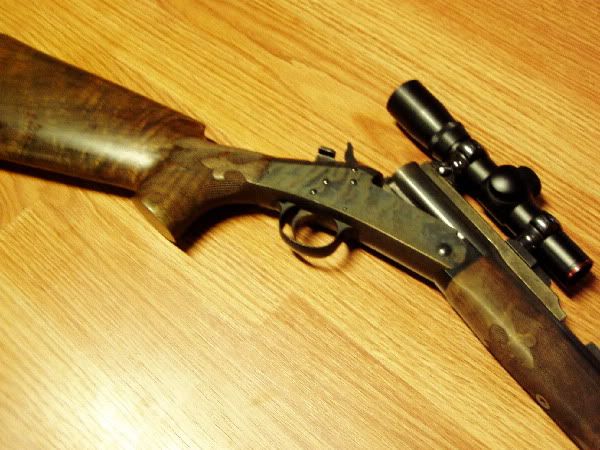 |
RE: Refinishing rifle stock
Nice stock Wilds,
ThisNEF is my tinkering, reloading, experimental gun that I have a lot of fun with. It is a Win. .270. I use it when I am out of 30-30, or muzzle loading range. This was the first time I used maple. My other projects have been with walnut. I sanded and filled the pores all the way down to 1000 grit wet auto sand paper, and the stock feels like a very smooth rock. The maple is harder than the walnut. In total, it has either 7,or 8 hand rubbed coats of Tru-Oil. I lost count. If you like to experiment and tinker, just get a NEF rifle and a Lee Loader. It is loads of fun. C. Davis |
| All times are GMT -8. The time now is 08:25 PM. |
Copyright © 2026 MH Sub I, LLC dba Internet Brands. All rights reserved. Use of this site indicates your consent to the Terms of Use.