


Whats the deal with the angle range finders?
 01-09-2008 | 05:07 PM
#11
Joined: Feb 2006
Posts: 2,877
Likes: 0
From: Kodiak, AK
 RE: Whats the deal with the angle range finders?
They're a huge tool for goat hunting in the mountains when shots can be up to 50 yards at up to a 60* angle, but I certainly wouldn't bother with it for whitetails from a treestand. You're just not high enough up in the tree for it to matter.
 01-09-2008 | 05:30 PM
#12
Nontypical Buck
Joined: Dec 2005
Posts: 1,096
Likes: 0
From: Burke, VA (raised in MD)
RE: Whats the deal with the angle range finders?
I range the horizontal distance to trees by aiming the rangefinder at the trunk at the level from which I am hunting. Or, just range the LOS and subtract a couple yards.
Point of impact will always be high (upslope or downslope) - this is counter intuitive. The difference in point of impact occurs because of the difference in angle between arrow's travel path and gravity. Gravity always acts directly downward which is 90 degrees or perpendicular to the arrow's path on flat ground. When shooting uphill/downhill this angle is less and gravity's effect is reduced. The effect is not pronounced enough to worry about inmostpopularbowhunting.
Fora practical example, take a light fishing rod with a heavy sinker tied to the end. Hold it perpendicular to the ground and it will bend. Hold it uphill or downhill and it will bend less.
Faster arrows spend less time in the air before impact therefore gravity has less time to accelerate the arrow in a downward direction. Wind resistance slows the arrow and allows gravity more opportunity to pull arrow downward.
Bottom line:
I think we have debated this before...
Point of impact will always be high (upslope or downslope) - this is counter intuitive. The difference in point of impact occurs because of the difference in angle between arrow's travel path and gravity. Gravity always acts directly downward which is 90 degrees or perpendicular to the arrow's path on flat ground. When shooting uphill/downhill this angle is less and gravity's effect is reduced. The effect is not pronounced enough to worry about inmostpopularbowhunting.
Fora practical example, take a light fishing rod with a heavy sinker tied to the end. Hold it perpendicular to the ground and it will bend. Hold it uphill or downhill and it will bend less.
Faster arrows spend less time in the air before impact therefore gravity has less time to accelerate the arrow in a downward direction. Wind resistance slows the arrow and allows gravity more opportunity to pull arrow downward.
Bottom line:
Just bend at the waist, and shoot the HORIZONTAL distance and you'll be just fine.
01-09-2008 | 06:25 PM
#13
Giant Nontypical
Joined: Feb 2003
Posts: 6,634
Likes: 0
From: HENDERSON KY USA
RE: Whats the deal with the angle range finders?
ORIGINAL: Wiaxle
[align=left]
As for trajectory, the pathagorean will hold true.
Target shooting, at 10/20/30 yards, you are shooting from one point to another, and automatically compensating for the trajectory (arc) of the arrow. This would hold true from an elevated position also, no?
And finally, how can a range finder determine true trajectory lacking the mass and velocity of the projectile? (I suppose you could bring elevation into the mix also which would affect the density of the air)
[/align]
[align=left]
As for trajectory, the pathagorean will hold true.
Target shooting, at 10/20/30 yards, you are shooting from one point to another, and automatically compensating for the trajectory (arc) of the arrow. This would hold true from an elevated position also, no?
And finally, how can a range finder determine true trajectory lacking the mass and velocity of the projectile? (I suppose you could bring elevation into the mix also which would affect the density of the air)
[/align]
Pretty good read on the subject.
http://archersadvantage.com/TipSheets/UpDownHill.htm
You are correct to assume that the range finder does not accurately determing EXACT and TRUE trajectory but from what I understand there is a rifle mode and bow mode on some of these range finders and they use a simple basic standard that is pretty darn close but not exact.
01-09-2008 | 06:30 PM
#14
Joined: Sep 2007
Posts: 28
Likes: 0
RE: Whats the deal with the angle range finders?
I experimented around when I seen these new range finders come out. I used my bushnell yardage pro range finder. I got up on hills ranged distances, and then flat on the ground, and did some math. It didn't make any noticable difference at all with my bow!
01-09-2008 | 06:35 PM
#15
Giant Nontypical
Joined: Feb 2003
Posts: 6,634
Likes: 0
From: HENDERSON KY USA
RE: Whats the deal with the angle range finders?
ORIGINAL: kwilson16
Faster arrows spend less time in the air before impact therefore gravity has less time to accelerate the arrow in a downward direction. Wind resistance slows the arrow and allows gravity more opportunity to pull arrow downward.
Bottom line:
I think we have debated this before...
Faster arrows spend less time in the air before impact therefore gravity has less time to accelerate the arrow in a downward direction. Wind resistance slows the arrow and allows gravity more opportunity to pull arrow downward.
Bottom line:
Just bend at the waist, and shoot the HORIZONTAL distance and you'll be just fine.
This is completely false,gravity does NOT speed the arrow up on a downhill shot,atleast not the way you are thinking,that effect isn't seen untill much further downrange,like 80-100 yards.
EDIT...OOPS,I MISUNDERSTOOD WHAT YOU WERE SAYING.I THOUGHT YOU WERE SAYING IT SPED THE ARROW UP,YOU ARE JUST REFERRING TO GRAVITY PULLING THE ARROW TO THE GROUND, SORRY. I am leaving the rest of my response just for information sake.
READ THE ARTICLE IN THE LINK I POSTED
If that were true,shooting uphill would slow the arrow BUT an uphill shot is shot almost exactly the same as a downhill shot.
Your fishing rod example is apples and oranges,the rod provides resistance to the equation.
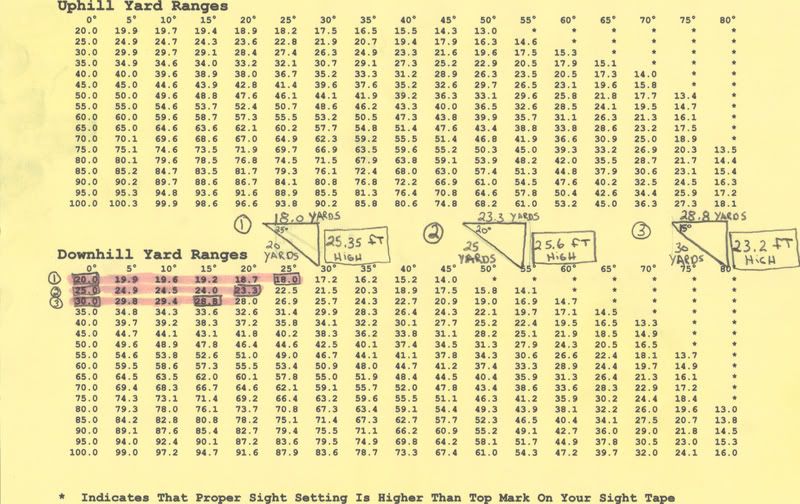
Here is an actuall uphill and downhill chart for my setup printed from my ballistcs program.Notice how close the uphill and downhill shots are to each other.
The triangles are some numbers I figured to determine height in a tree.
 01-10-2008 | 07:33 AM
#16
Nontypical Buck
Joined: Feb 2003
Posts: 2,357
Likes: 0
RE: Whats the deal with the angle range finders?
Depends how you define gimmick. What they do is give you the horizontal distance, which is what you want to hold your sight pin for (assuming excellent form cause form changes as you aim up/down will have uknown effects that mess up the hole theory of this).
However reality is for most treestand shots the difference is really under 2 yards. Is a 2 yard difference worth getting worked up over? Can you tell the difference in point of impact between 30 and 32 yards? If so, does it matter?
However out west in the moutnains shooting off cliffs, at longer distances it will matter. Line of sight could easy be well over 40 yards on a horizontal distance of 20 yards. This WILL make a difference.
At the height gets higher and the horizontal distance shorter, it makes more and more difference.
However reality is for most treestand shots the difference is really under 2 yards. Is a 2 yard difference worth getting worked up over? Can you tell the difference in point of impact between 30 and 32 yards? If so, does it matter?
However out west in the moutnains shooting off cliffs, at longer distances it will matter. Line of sight could easy be well over 40 yards on a horizontal distance of 20 yards. This WILL make a difference.
At the height gets higher and the horizontal distance shorter, it makes more and more difference.
01-10-2008 | 08:06 AM
#17

Nontypical Buck
Joined: May 2005
Posts: 2,241
Likes: 0
From:
RE: Whats the deal with the angle range finders?
My take on the whole thing is I just like so many others when I get into my stand I range tree's at level hieght so I get the exact distance's. The problem I see with the angle range finders in normal situations to get the exact distance you will have to be ranging the deer while it's walking in to your stand.. Walt
01-10-2008 | 03:04 PM
#18
Thread Starter
Joined: Oct 2007
Posts: 295
Likes: 0
From: Central Wisconsin
RE: Whats the deal with the angle range finders?

Ok, this is the way that I see it, what am I seeing wrong? I see that if the deer is 70.7 yards away (LOS) at a 45 degree angle, the range finder would tell you (approx) the deer would be a horizontal distance of 50 yards.
If you aim at that deer at 50 yards (using an bow for this example) I see that arrow falling short if you are shooting at something (or at least very low) at 70+ yards away.
I am sure I am missing something simple in this, cause I just aint quite getting it [>:]
01-10-2008 | 03:30 PM
#19
Joined: Feb 2006
Posts: 2,877
Likes: 0
From: Kodiak, AK
RE: Whats the deal with the angle range finders?
The LOS distance is irrelevant. (Your 150' radius isn't relevant. Forget it!) It's the distance that the force of gravity has to work on the arrow (perpendicular to the center of the Earth) that is important. In your instance you would shoot it as if it were 50 yards and you'd hit the mark at 70.7 yards LOS at either 45 degrees uphill or downhill. It's one of those instances, like navigating in the fog, when you have to let go of how it feels and trust your instruments. I love 3D courses with big uphill/downhill shots like this to emphasize the point and make people comfortable with these shots. If you're ever going to hunt mountain goats you need to be comfortable with these shots.
01-10-2008 | 04:06 PM
#20
Giant Nontypical
Joined: Feb 2003
Posts: 6,634
Likes: 0
From: HENDERSON KY USA
RE: Whats the deal with the angle range finders?
Check out my uphill chart,I would have to shoot a 70 yard shot on 45 deg angle for 51.4 yards and if it were the same shot downhill,I would have to shoot it for 47.8.
THIS IS FOR MY SETUP but most will be very similar.
The horizontal distance is the most important.As you can see,sight paralax(as will gravity to some degree)changes the shot at extreme distances on uphill/downhill shots but for most in normal hunting stuations,the horizontal number is all you need.
Remember that gravity doesn't know the hill is there so it is pulling the arrow to the center of the earth as KA refers to.
THIS IS FOR MY SETUP but most will be very similar.
The horizontal distance is the most important.As you can see,sight paralax(as will gravity to some degree)changes the shot at extreme distances on uphill/downhill shots but for most in normal hunting stuations,the horizontal number is all you need.
Remember that gravity doesn't know the hill is there so it is pulling the arrow to the center of the earth as KA refers to.