


Ar's and Other myths...
 12-15-2011 | 01:33 PM
#1
Thread Starter
Fork Horn
Joined: Dec 2011
Posts: 162
Likes: 0
From: Southeast
 Ar's and Other myths...
So as not to hijack the thread on how important are antlers, I am starting a new thread.
Unless very carefully done, as a general rule, most antler restrictions actually do more harm than good. In most states, the idea of an AR is to produce more larger bucks-advance the age class one year from 18 months to 30 months. Most states use a simple, faulty point count to do so. Here is what it does.
It may advance a spike or button to a six or eight point and then it gets killed. But it also gets the really superlative 18-month old, six or even eight point buck killed and those are exactly the ones you want to have breeding and eventually producing the best antlers for your area.
One AR that does some good is a combnation of spread and points. Eight points coupled with a 16" spread will move 75% of your 2.5-yr. olds to 3.5. usually at that age, they need no protection. That AR, if done on a statewide or region basis also produces a lot of poaching or deer going unreported when killed. Hard to measure spread on the run.
Age is what you should use to select what does and what does not get killed. Unfortunately 99.9% of all deer hunters are unable to age a deer by body type in a few brief seconds (including me).
So in the longrun, an antler restriction is self defeating.
Before any type of restriction is imposed, it must first be deemed bilogically sound and needed. Very few are. There is no biological basis for killing the best of your young deer. And, except in tightly controlled environments, 99.9% of the hunters would not know a cull buck one bit them in the tochus. Additionaly, except in those tightly controlled environments, nothing you do is going to alter the gene pool, state or region wide one bit. That is Ma Natures job. This is not like raising cattle except when it is.
It has been proven over the years that hunters are the very worst deer managers. And saying that has cost me a couple consulting jobs. However, it is true. Most deer hunters could not tell you their buck/doe ratio if they had to. They can only tell you what they see, not what they have.
So you bring a professional in and he tells you to simply kill as many does as you do bucks and shoot nothing that isn't out past his ears and they say he is crazy.
Unfortunately, most of us are.
Unless very carefully done, as a general rule, most antler restrictions actually do more harm than good. In most states, the idea of an AR is to produce more larger bucks-advance the age class one year from 18 months to 30 months. Most states use a simple, faulty point count to do so. Here is what it does.
It may advance a spike or button to a six or eight point and then it gets killed. But it also gets the really superlative 18-month old, six or even eight point buck killed and those are exactly the ones you want to have breeding and eventually producing the best antlers for your area.
One AR that does some good is a combnation of spread and points. Eight points coupled with a 16" spread will move 75% of your 2.5-yr. olds to 3.5. usually at that age, they need no protection. That AR, if done on a statewide or region basis also produces a lot of poaching or deer going unreported when killed. Hard to measure spread on the run.
Age is what you should use to select what does and what does not get killed. Unfortunately 99.9% of all deer hunters are unable to age a deer by body type in a few brief seconds (including me).
So in the longrun, an antler restriction is self defeating.
Before any type of restriction is imposed, it must first be deemed bilogically sound and needed. Very few are. There is no biological basis for killing the best of your young deer. And, except in tightly controlled environments, 99.9% of the hunters would not know a cull buck one bit them in the tochus. Additionaly, except in those tightly controlled environments, nothing you do is going to alter the gene pool, state or region wide one bit. That is Ma Natures job. This is not like raising cattle except when it is.
It has been proven over the years that hunters are the very worst deer managers. And saying that has cost me a couple consulting jobs. However, it is true. Most deer hunters could not tell you their buck/doe ratio if they had to. They can only tell you what they see, not what they have.
So you bring a professional in and he tells you to simply kill as many does as you do bucks and shoot nothing that isn't out past his ears and they say he is crazy.
Unfortunately, most of us are.
 12-15-2011 | 01:57 PM
#2
Spike
Joined: Dec 2011
Posts: 83
Likes: 0
That's a very good point you bring up. I never thought of it that way before. I surely have seen hundreds and hundreds of 1.5 year old bucks with 6 or 8 points brought in to be processed. And you are right.... "These are the deer that you want to keep in that gene pool"
A hunter brought us in a crotch horn with 23" inside spread to do a European skull mount. The sad part was, that was all the potential that that deer was going to produce. Although he was massive around the bases and had long main beams and incredible tine length, that was all he was ever gonna be.
Good post Scribe, I never thought of it that way, but very good point.
A hunter brought us in a crotch horn with 23" inside spread to do a European skull mount. The sad part was, that was all the potential that that deer was going to produce. Although he was massive around the bases and had long main beams and incredible tine length, that was all he was ever gonna be.
Good post Scribe, I never thought of it that way, but very good point.
12-15-2011 | 02:35 PM
#3
Thread Starter
Fork Horn
Joined: Dec 2011
Posts: 162
Likes: 0
From: Southeast
Let me add some more oil to the mix. This AR theory does not in any way take into account the genetic contribution of the doe. We know the doe is also a contributor to antlers. We just don't know how much.
12-15-2011 | 02:52 PM
#4
Spike
Joined: Jan 2011
Posts: 13
Likes: 0
From: North east Arkansas
I whole heartaly agree. I hunt in Arkansas, we have had a 3 point rule for better then 10 years now. All I can see that it has done is give us a bunch of spikes and fork horns that are in the 3 1/2 to 4 year old range. I have seen spikes that started out with 6 inch antlers 3 and 4 years ago that now have 16 to 20 inch spikes the same holds true with the fork horns. True i do see more 6 and 8 point bucks, however they are older too. Some are huge and all they ever have is small baskets. I blame TV hunters for all of this "deer management". People see the huge racks on TV and wonder why they can't have tropheys like that on every hunt. They can have them if they want to fence off land, spend $10,000 or more on food plots and supplaments and only let a select few hunt there for only 3 or 4 days a year. As for me I can't eat antlers and could care less if I ever shot a 150 class buck.(not saying I wouldn't if the chance presented it self) Just in general.
12-15-2011 | 08:55 PM
#6

Giant Nontypical
Joined: Jan 2008
Posts: 6,574
Likes: 0
From: IL
 12-15-2011 | 08:58 PM
#7
Giant Nontypical
Joined: Jan 2008
Posts: 6,574
Likes: 0
From: IL
I whole heartaly agree. I hunt in Arkansas, we have had a 3 point rule for better then 10 years now. All I can see that it has done is give us a bunch of spikes and fork horns that are in the 3 1/2 to 4 year old range. I have seen spikes that started out with 6 inch antlers 3 and 4 years ago that now have 16 to 20 inch spikes the same holds true with the fork horns. True i do see more 6 and 8 point bucks, however they are older too. Some are huge and all they ever have is small baskets. I blame TV hunters for all of this "deer management". People see the huge racks on TV and wonder why they can't have tropheys like that on every hunt. They can have them if they want to fence off land, spend $10,000 or more on food plots and supplaments and only let a select few hunt there for only 3 or 4 days a year. As for me I can't eat antlers and could care less if I ever shot a 150 class buck.(not saying I wouldn't if the chance presented it self) Just in general.
12-16-2011 | 12:45 AM
#8
Thread Starter
Fork Horn
Joined: Dec 2011
Posts: 162
Likes: 0
From: Southeast
Can someone say with certainty that the big spike is 3.5 and not a superior 1.5. Nine out of ten hunters cannot. That is one of the reasons AR's are so faulty as a management practcie. Although age strata is an important management goal, looking at the points only is not how you go about it.
I am retired now, but on most properties I managed, my goal in terms of age strata was to have as many 3.5 bucks as I did 1.5 and 2.5 combined and as many 4.5 and older as I did younger than 3.5. I found, without getting complicated that gave me all I needed.
I worked toward this by simply imposing a simple 8&16 rule. A buck had to have eight points AND 16 inches of inside spread. That is just outside his ears. That would just about protect all my 1.5 bucks and 75% of my 2.5 bucks. Once they reached 3.5, they needed no protection. The occasional buck that was so outstanding but did not have one of the criteria, such as eight points but not 16" of spread, we used common sense. On most property, it worked well. This buck, at 6.5, had eight points and a 14" spread. he scored and even 145 net. Obviously, he was an exception.
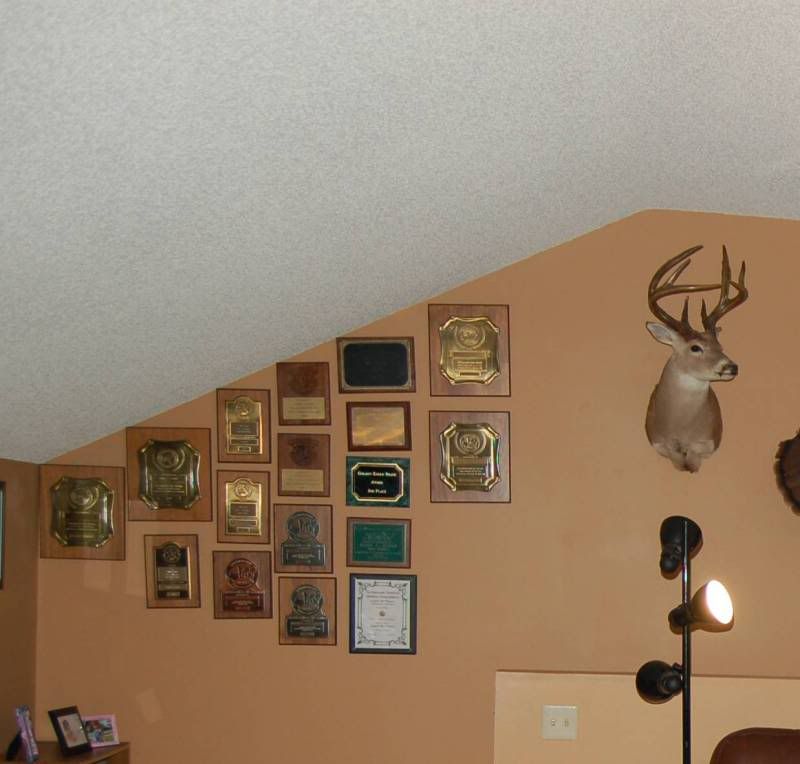
I am retired now, but on most properties I managed, my goal in terms of age strata was to have as many 3.5 bucks as I did 1.5 and 2.5 combined and as many 4.5 and older as I did younger than 3.5. I found, without getting complicated that gave me all I needed.
I worked toward this by simply imposing a simple 8&16 rule. A buck had to have eight points AND 16 inches of inside spread. That is just outside his ears. That would just about protect all my 1.5 bucks and 75% of my 2.5 bucks. Once they reached 3.5, they needed no protection. The occasional buck that was so outstanding but did not have one of the criteria, such as eight points but not 16" of spread, we used common sense. On most property, it worked well. This buck, at 6.5, had eight points and a 14" spread. he scored and even 145 net. Obviously, he was an exception.
Last edited by scribe; 12-16-2011 at 02:49 AM.
12-16-2011 | 01:20 AM
#9
Thread Starter
Fork Horn
Joined: Dec 2011
Posts: 162
Likes: 0
From: Southeast
Managing your male animals is only part of the equation. The entire herd must be taken into account. But true management involves much more than just regulating what you kill.
All wildlife management must be ecologically sound, biologically sound and economically feasible. It can get expensive however, it need not b e complicated. When you manage the animals, in most cases, all you are really doing is managing for larger antlers to keep the hunters happy. The other side of the coin is managing the habitat to provide required nutrition.
One of the most difficult facets is to convince the hunters in AL or say SC they will never have bucks like they have in IL or IA or even TX. That is where it really gets hard. But once you have them content to have the best bucks THEIR area can produce, then you can make progress. It is also difficult to keep the guy with 300 acres happy when just down the road you are managing 21,000 acres and regularly kill 20-30 bucks that are among the best in the state.
Perhaps you understand why I am retired.
Next month I am going to that 21,000 acre property for the peak of the rut and will spend most of my time on the porch telling lies.
All wildlife management must be ecologically sound, biologically sound and economically feasible. It can get expensive however, it need not b e complicated. When you manage the animals, in most cases, all you are really doing is managing for larger antlers to keep the hunters happy. The other side of the coin is managing the habitat to provide required nutrition.
One of the most difficult facets is to convince the hunters in AL or say SC they will never have bucks like they have in IL or IA or even TX. That is where it really gets hard. But once you have them content to have the best bucks THEIR area can produce, then you can make progress. It is also difficult to keep the guy with 300 acres happy when just down the road you are managing 21,000 acres and regularly kill 20-30 bucks that are among the best in the state.
Perhaps you understand why I am retired.
Next month I am going to that 21,000 acre property for the peak of the rut and will spend most of my time on the porch telling lies.
12-16-2011 | 03:41 AM
#10

Typical Buck
Joined: Jan 2011
Posts: 970
Likes: 0
From: Wisconsin
What makes a QDM (Quality Deer Management) program works is an entire hunting community in an area to learn how to age deer (not overly hard to do in Wisconsin anyways). Going with that means hunters are making certain that as many inferior bucks as possible are culled. Weak genetics mean no big bucks.
That's a simple enough concept that has proven true. When a QDM program begins, you often hear of the participating hunters identifying and harvesting the smaller bucks in the first few years while allowing the bigger bucks to procreate. Depending on the existing genetics, in 3-5 years the practice really begins to show a marked difference in the quality of bucks.
The most important aspect of a QDM program is terrain. Not as in the hills, but in the trees growing on the hills. Jack pine country in Wisconsin really drives that point home. In jack pine country bucks can be big bodied, but almost always have small racks so they can actually travel through the woods. Nothing will ever change this without having a negative effect on the population.
The next factor is food. If you don't have a good and steady supply of food, and you add in a bad winter in some places you see smaller racks not because of genetics, but because of external forces.
Wisconsin which has many different QDM regions being run by the landowners has provided a lot of data for the basis of such programs. The biggest thing that has shown through is that a statewide QDM program will almost always uneqevoicably will fail. The state does not invest the proper utilization of resources to make a QDM program work like landowners in certain areas traditionally do.
I'm against statewide QDM because I don't want more rights taken away from myself.
That's a simple enough concept that has proven true. When a QDM program begins, you often hear of the participating hunters identifying and harvesting the smaller bucks in the first few years while allowing the bigger bucks to procreate. Depending on the existing genetics, in 3-5 years the practice really begins to show a marked difference in the quality of bucks.
The most important aspect of a QDM program is terrain. Not as in the hills, but in the trees growing on the hills. Jack pine country in Wisconsin really drives that point home. In jack pine country bucks can be big bodied, but almost always have small racks so they can actually travel through the woods. Nothing will ever change this without having a negative effect on the population.
The next factor is food. If you don't have a good and steady supply of food, and you add in a bad winter in some places you see smaller racks not because of genetics, but because of external forces.
Wisconsin which has many different QDM regions being run by the landowners has provided a lot of data for the basis of such programs. The biggest thing that has shown through is that a statewide QDM program will almost always uneqevoicably will fail. The state does not invest the proper utilization of resources to make a QDM program work like landowners in certain areas traditionally do.
I'm against statewide QDM because I don't want more rights taken away from myself.