
|
plans/designs
hi guys & gals,
i'm new to this forum and i'm looking into making my first bow. before now all i've ever shot were compounds. i've looked hard on the internet trying to find plans or blue prints to follow but all i found was a huge longbow www.vintageprojects.comand some other really basic plans.i keep reading about all these traditional guys with 60"-64" but pulling 45-50 pounds. if anyone has old plans or blueprints and wouldn't mind sharing, please send them to [email protected] i'm looking to make a simple hunting/target bow without laminating (i'm new to bow-making) preferably a common wood any feedback will be greatly appreciated |
RE: plans/designs
That’s a tough one. It kinda depends on what kind of bow you want to make. Self bow, board bow, laminate bow, etc, etc,. Also, whether you want it flat, reflexed, defexed, or both.Something else that will affect the design is the materials. Some woods you can docertain designs and poundage with, others you can’t.I started by doing a board bows with slight reflex. I started by understanding the materials I plan on using and whether I could do it with said material. I figure whether the materials used will need to be backed to accomplish what I what, then pick the backing material. Cut my risers to the design that looks good at the time, glue it up (that is if I do anything fancy with the riser, which I most often do). Then glue up the bow, belly core, a power core if I need one for the chosen handle style, the belly (if I use one or did not account for it in the riser design), backing, and induce any reflex, deflex, or r/d, during the glue up. I put all that in the oven tillcured. After that, I rough it out , floor tiller, then put on the tiller tree. After that,its finishing time. Fine sanding, shaping, and putting on a good finish. I have made a few now so I’ve got copies of some of my better designs on poster board. I also have a few forms I used when adding the curves. So to answer your questing, it’s a learning process. If you are just interested in carving out a stave for a self bow, just get one and do it. You can learn a great deal out of carving out a simple self bow. You will also learn a lot about tiller and design. A self bow can be a pain in the but sometimes to get a working one though. One of the most important things is tounderstand the materials.
Some great sites to look up is Paleo world and bowers den. Don’t have them on this computer, but you can find them in a sec. through a search engine. |
RE: plans/designs
Tonight when im in my shop, Ill try to remember and measure the bow im just about to glue up tonight. Its a walnut bamboo composit. Its a very basic design.
|
RE: plans/designs
|
RE: plans/designs
thanks a lot Burbiegoeasily. i found a great, simple 50# draw weight "how to" on there :D
|
RE: plans/designs
You are very welcome. Great, I thought that would be more easy to understand than a few measurements I might post on here.
|
RE: plans/designs
now i have a new question. if i want to glue on a backing,how many pieces do i need to apply? (thehow-to i read used 3 ply of drywall tape)do i glue it before or after roughing out the basic bow shape?
what's a good glue to use? |
RE: plans/designs
Hi, Guys,
I'm in the process of making my first bow now. I'm using an osage billet. The bow will be about 68" long when finished. I've roughed it out at this point, and over the next few days or weeks, time permiting, I'll be continueing to work the bow till it's finished. I looked at the same plans at vintageprojects.com, but all I did to get started was to order the billet, trace around another longbow that I already have, and I'm on my way, right or wrong. I'm no expert by any stretch of the imagination. I figure that there's no experience other than just doing it that's gonna get the thing done. The only thing that I would change at this point,is to not make the bow from Osage. It's veryfiberous wood and really hard to work with. It's taken me quite a while as I have only used a drawknife and a spokeshave as what was suggested to me. The drawknife seems to have a mind of it own going through the woodgrain. I was told not to use a saw. I didn't ask why, and still don't know for sure about that part of it. I have a hickory billet, and I'll probably start on that one soon after the osage bow is done. A few years ago, I bought a bow off a fellow and he told me that it is osage. It has a very strong draw weight that I would estimate at about 100# or more. When I bought it, I took it to a bow shop here and the guy put it on some type of press to test it. He took it off the press before he broke his press. It was 90# at the 24" mark. It will need work before I use it, or I'll need to do some weightlifting before I use it.[&:]I hate the idea of tillering it down to bring it to a point where I can use it now. I'd rather not take the chance and ruin the guys handywork. After I tiller a few bows, I may decide to try to tiller that bow down, but not till I'm sure of what I'm doing. The bow was hand carved in 1940. |
RE: plans/designs
Guys,
If you have Osage to make a bow out of use it. You'll be hard pressed to find a better bow wood. Sure its not the easiest wood to work but it is one of, if not the best to make selfbows out of. The deal is go slow, take your time and do not rush. As much as you may want done on your first few bows you need to just go slow. You'll learn where you can get faster and where you need to slow down. The last thing you want is to get almost done and break it because you were in a hurry. This happens alot with new Bowyers. If you can find someone in your area to help that is invaluable. Try Tradgang.com for more people that build their own. As for the drawknife vs. saw. Many people use saws (bandsaw and tablesaws) for reducing the stave to near the deminsions of a bow. The problem is with any power tool a mistake is VERY easy to make and then you end up with firewood. If you use a drawknife it takes alot more effort and if your carefull you can avoid a mistake. Once you get close do your demensions for the bow slow down even with the drawknife. It takes most people some time to learn how to control a drawknife. Once you learn it, itsa great tool. Hickory is not a bad selfbow wood however In my experienceI've seen many more attemptswith hickory end up broken. It has its own set of problems. Oh and one thing to always remember never pull your bow beyond you intended draw weight. Even if your only drawing a could inches. You induce set and set it up tofail... Good luck guys and if I can be ofhelp just ask. BTW if your in the Cincinnati areaI'll help if you need it. |
RE: plans/designs
does red oak work very well?
|
RE: plans/designs
Red oak will work. Any hardwood will. The thing you need to remember is that different woods need a diferent bow design to get the most out of the wood (and sometimes to work at all)
Osage is very design forgiving. You can make it wide and thin or narrow and flat. Osage doesn't care. Hickory and oaks prefer to be wide I believe. The reason for this is the belly wood gets alot of compresion that may cause failure. Design is key with them. There are several realy good resourses for building bows that if you do not have you should consider picking up. First is Traditional Bowyers Bibles Vols 1,2,3 (4 is coming out this year if I remeber right) Hunting the Osage Bow by Dean Torges is great also. Plus Dean is a great guy and is at lot of the big Traditional gatherings. (Cloverdale etc) Like I said before Tradgang.com has a ton of info. TBB Vol 4 is being writen by some of the folks on their. Also some great people. If you don't have access to Osage many other woods work. As well as sawn boards. TBB ( I forget which Vol) goes into selecting the right board. This is key to building one from a board. Backing is also a good idea if you are unsure of a board. I have used linen, but many other things work well too. Silk(very tough) Sinew(a great choice but a bit more work) and others. I prefer an unbacked Osage. I have several with snake skin but that adds nothing to the back's strength. Also if you find Osage or plan to buy it. Read up on how to select the right stave. Some trees have bows in them some don't. BTW the way you make a bow is simple. Just remove everything that isn't a bow. LOL |
RE: plans/designs
anyone out there ever glued snake skins to a glass laminated bow? do skins go ON the glass or UNDER the glass? what glue does a person use... if snakes go on top of glass do you spray finish over skins?
|
RE: plans/designs
Mr. Longbow,
There are two ideas here. First I have done both of these. You can rough up the fiberglass a littlewith sandpaper (to give the glue something to hang on to)and use titebond 2 or 3 and glue them down. After dry sand the edges and spray your chosen finish over them. you can also lightly sand the skins to end up with a smoother finish. Or If your not hung up on real skins there are several companies puting out limb skins. They are like Arrow wraps if you have used them. Basicaly a very realistic print of a skin. They are easier to put on as they are just 3M tape. They seem to hold up and can be removed. I actually like that way better plus if you sell the bow you give the new owner the chance to remove them if you wish. A couple pics. First one done with real skins. 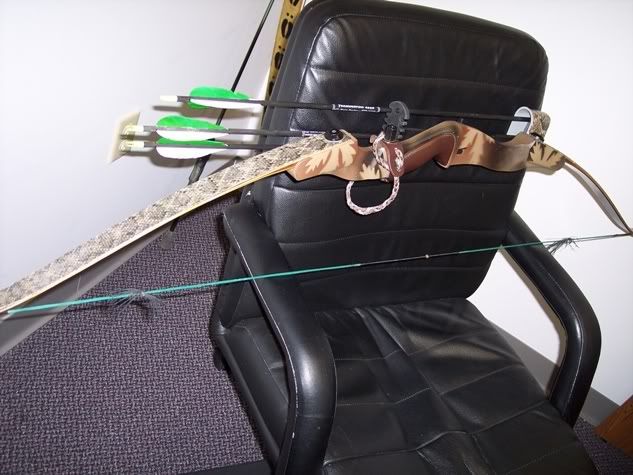 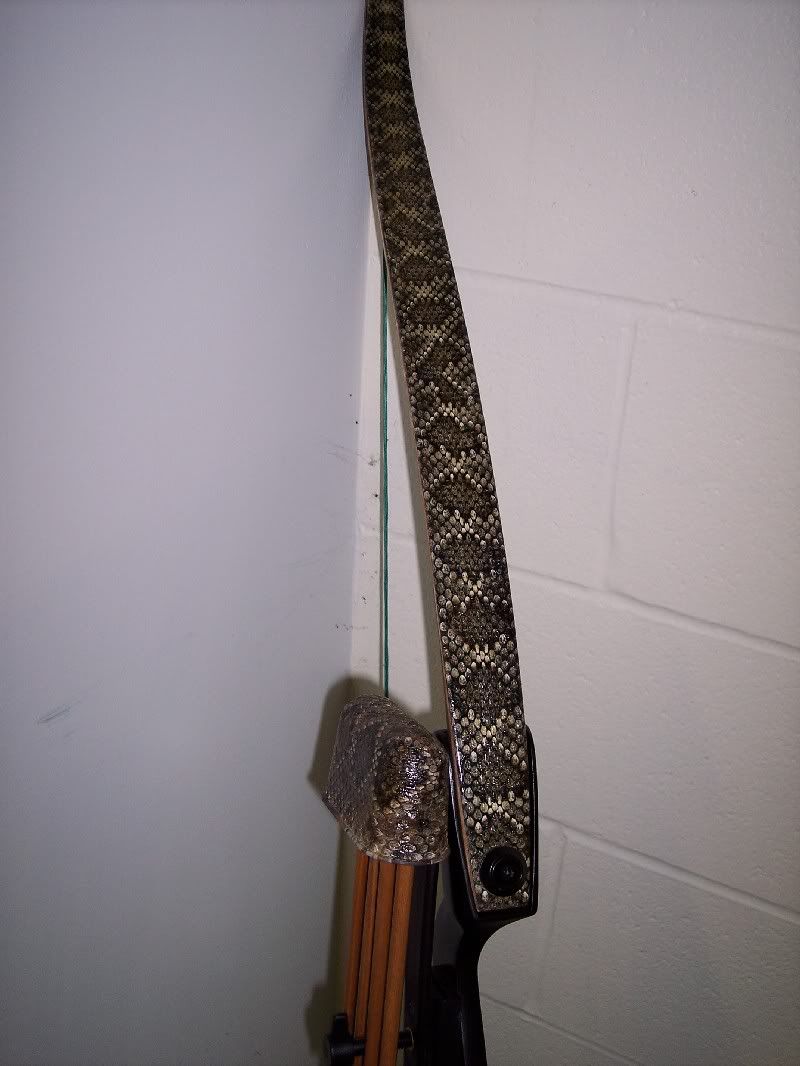 Next a bow with limb wraps from Arrow Wraps Unlimited Before 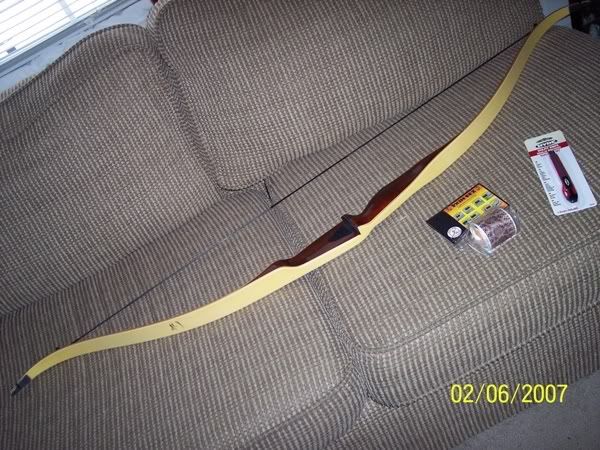 After 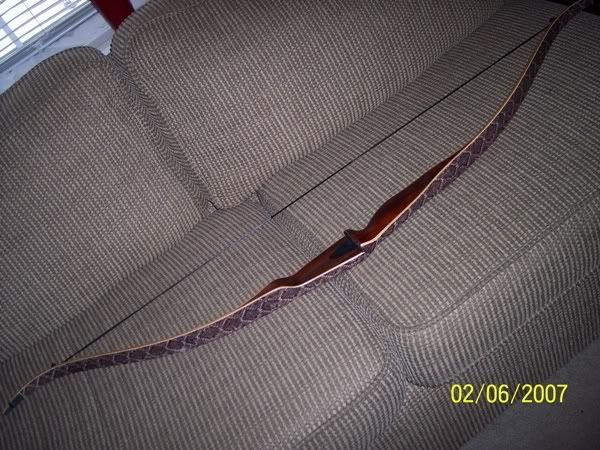 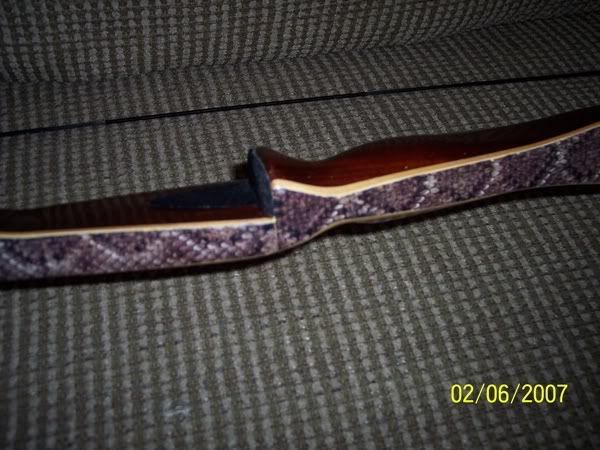 |
RE: plans/designs
ORIGINAL: Seif5034 now i have a new question. if i want to glue on a backing,how many pieces do i need to apply? (thehow-to i read used 3 ply of drywall tape)do i glue it before or after roughing out the basic bow shape? what's a good glue to use? badiuk6 Red oak is easy to work with, but takes lots of set. Id go with Hickory. Much better wood than red oak. If you are bound to use oak, use white oak. Its better than red. But if you have access to oak, you can probably find hickory. As for snake skin, ive done it. It looks great, but does nothing as a backing, thats why most people put it over glass. Use a two part epoxy. The only problem with it, you need a stringer to string the bow or you will booger up the skin. But it does look great. I have to agree, Osage (bo d arch, hedge apple, spider apple, horse apple, or any other name) is a great bow wood. It is kinda hard to work with and many times needs to be straightened with a heat gun or caul and oven. Id suggest another wood to learn with. Reason being; its not as cheap as other woods and a little harder to work with. Ipe (brazilian walnut) is an awsome wood as well. I think its easier to work with than osage, but just as expensive. I do love osage and it is the perfered wood for self bows. I like Ipe in laminates and composite board bows. But to learn, id stick with hickory. Grain is almost perfect, Its easy to work with, better set than red oak, real easy to find, and not very expensive. If you mess up your first bow, no big deal. |
RE: plans/designs
Good points Burnie,
I have a good supply of Osage and I guess I forgot its a little expensive to buy for people that don't have it availible. I am always on the lookout for wood. I've yet to try a hickory stave though. I haven't made a bow in a while though. (too busy with the kids) |
RE: plans/designs
i dont have access to osage but i do to red oak so i plan on making a red oak bow thanks for the info guys.
|
RE: plans/designs
ORIGINAL: badiuk6 i dont have access to osage but i do to red oak so i plan on making a red oak bow thanks for the info guys. Im about to do a walnut, maple, bamboo R/D bow. That is as soon as I get the time. Im finishing two zebra wood bows for my daughters and just cant find the time to get in the shop.[:@]:D |
RE: plans/designs
i didnt read your last post about hickory and white oak! yes i do have them available so i will use hickory! thank you very much!
|
| All times are GMT -8. The time now is 03:15 AM. |
Copyright © 2026 MH Sub I, LLC dba Internet Brands. All rights reserved. Use of this site indicates your consent to the Terms of Use.