
|
Recovery, What To Do After the Shot.
Thanks for the request again this year, I think this is the 8th or 9th annual and for the newbies and readers looking in but not joining, I wrote this thread more years ago than I can remember and every year our great members here add to it and also offer their own tips and experience. If only one animal is recovered every year because of this thread then it has done it's job. There are much more seasoned hunters and veterans of the woods here than myself with great knowledge of the whitetail. This thread serves as a guidline and not the final word on trailing whitetails. They are amazing animals and can survive against extreme odds.
If you have a suggestion or tip to add, by all means do so, I look forward to them every year and I certainly too try to learn from everyone as well. One of the biggest reasons why many animals are not recovered after being shot is that all too often bow hunters take up the trail too soon, simply bumping the animal away, never to be found again. What you do following the shot can make or break a successful recovery. When mortality wounded 90% of deer will bed within 250 yards of the shot. If an animal dies beyond this, most likely some outside factor pushed the animal. Think about all of the animals you've taken, found or lost. You've probably found at least one if not multiple beds within this distance. Now I' m not proclaiming myself the ultimate tracker/hunter but I can testify that my hunting partners and I have not lost an animal that has died or that we not seen another day, in many, many years and several of these recoveries were because of waiting for the right moment to trail the animal,rather than the initial shot placement. I'll give you an example of an animal that I made a poor shot on because I neglected to stop the animal and shot him on the move. At 25 yards I placed my arrow too far back on the buck. As soon as I saw the arrow hit further back than I wanted, I knew immediately not to take up the track until at least 6 hours later. I shot this animal at 7:30 am and got out of my tree at 11:00 and left the woods. At 3:30 I returned to the woods and found my buck not 50 yards inside a woods at the last point I saw him. Had I not waited, there is a very good chance thatI wouldn't have found him due to all the standing cornfields surrounding the woodlot he was bedded in. In this particular case I also glassed the animal immediately following the shot to verify the hit. One important note or tip that I always like to make is, that binoculars are an invaluable tool for archers not only to glass an animal post shot, but also to watch for his movement once he moves off. Quite often we as hunters get caught up in the heat of the moment and become unsure of our arrow's point of impact. A good set of binoculars and some quick thinking can help you verify your shot placement and help you formulate the proper game plan for recovering your animal. Binoculars aslo allow you to see past foliage. A deer can move out of eye shot and bed but you may catch it's movement with binoculars. The following is a list of several tips that I feel are invaluable for bow hunters to use when deciding what to do both before and after the shot. In the past, many members of the HuntingNet.com Message Boards have helped to tweak and add their own priceless tidbits of information as well. Hopefully one of the tips here or posted herein will aid you in a speedy recovery this hunting season. 1. Use bright fletch. You need to be able to see your arrow in flight, in the animal, and on the ground afterward. Dark arrows will not do you any good if you yourself can' t see them. If bright fletching isn’t enough, try using lighted arrow nocks for better visibility in low light conditions, if legal in your state or even white or bright arrow wraps. Find your arrow, your arrow is one of the most important pieces of the puzzle you may have. 2.Binoculars - use them post shot! They may be one of the most important tools you have after the shot. 3. Watch the animal after the shot. Quite often an animal's body movement will help indicate to you what type of shot you got. An animal that jumps straight in the air and bounds off out of sight is most likely mortally wounded and will not travel far. However, if the animal hunches up and walks off or moves off slowly there is a good chance the hit was too far back or forward and you may need to wait at least 6 hours before taking up the trail. "I hit him, now what?" Here are several sure fire steps towards recovering your animal safely and securely: 1. Unless you witness a double lung pass through, I firmly believe to let an animal go for a couple hours rather than the common misconception of a half hour wait. Too many times a half hour isn't enough. The only shots that put an animal down quickly are double lung hits and heart shots. If you don't see your animal fall within site, your best bet is to wait it out. 2. If you are not 100% sure of your hit, simply put.... wait!!! The animal isn't going to go anywhere, he's dead, why hurry? Sit back, collect your thoughts, and replay the shot, the hit, and where the animal went. Also, this gives you a chance to listen and relax. If your arrow was a pass thru, get down and get the arrow and study it and wait. Mark the direction but don' t pursue, if you wait, he'll be there or he'll live another day. 3. If you think it' s a single lung hit because of the angle, wait at least 4 hours. This includes shots that are just under the spine and because of the angle you might have caught the second lung but missed the first. Wait and let him expire. Many people believe in "the void" which they claim is an area between a deer's lungs and spine where no vital organs reside. This is a myth - if you place an arrow under the spine, you will catch the upper lobes of at least one lung. 4. If you think you caught the liver wait and the animal will bleed out. Wait at least 4 hours to take up the trail. Gun hunters can move on an animal quicker because of the damaged involved however with archery equipment it's recommended to wait at least 4 hours - the animal will not go anywhere if given the chance to expire. Jump him and he may go forever. 5. If you catch the guts only, you're in for at least a 6-hour minimum wait with 8 hours being more preferable and overnight being a worst case. It's recommended that an animal be recovered as quickly as possible but if they are not expired, your not going to recover them. Waiting overnight could be detrimental to the meat, tainted the flavor however not making them inedible. A quicker recovery means better tasting meat. If you hit an animal in the guts at 6 pm, you need to recover the animal around 2am to ensure the best meat. This should be considered when shooting late into the evening. We owe it to be conservative and ethical. In case of rain or snow you should get down, find your arrow, find the blood trail, and wait for the next morning. If you know your property, you'll find him close. It's important to get the organs out and blood out as quickly as possible, that quickness is regulated by the type of hit. 6. Coyotes can and will give the location of your animal, if your worried about them, get down, listen for the them and move on them if you know they are on your animal. IF they are there, your animal won' t be so move on the coyotes and they may lead you to the animal. 7. Whether your shot hits lungs, liver, or guts the key to a successful recovery is towait. The animal is going to die just wait him out and your blood trail should be adequate a couple hours later. 8. There are few hits that force you to move on an animal quickly to bleed them out. These hits are the most difficult to determine and more times than not you will make the wrong decision and push an animal that might otherwise lay down and expire. Again, if your unsure of the hit, wait it out. A mature whitetail carries roughly 8 pints or 1 gallon of blood in their circulatory system. They need to loose roughly 2.4 pints of blood to go into shock and not recover. Think about this, we give a pint of blood when we donate, that does not affect us. One pint of blood is alot of blood on the ground when spread over a couple hundred yards. Something to think about. 9. Many states now allow the use of tracking dogs, leashed or unleashed. Utilize their availability in your state. Many organizations are available such as the United Blood Trackers.org and Deer Recovery that offer services for tracking wounded animals free of cost. Look into such an organization prior to going hunting this season as a worst-case or even best case scenario. 10. Many wounded animals seek water. If there is water on your property and you can't find a blood line, look toward your water sources. They may even circle and I've read or have been told that a deer will circle to the direction of the side he's hit hardest on. I don't know this to be gospel but it's worth mentioning. 11. Looking for blood doesn't necessarily mean just on the ground, many times a higher hit will leave blood 2' or 3' off the ground brush or overhanging vegitation as well as under plant leaves. Let' s recover the animals’ bowhunters, we owe it to them, we owe it to each other, and we owe it to ourselves. Good luck out there.... Here's a link to a deers anatomy in case you wish to review what we already know. http://home.mn.rr.com/deerfever/Anatomy.html http://forums.mathewsinc.com/viewtopic.php?t=21358 And a link to dog trackers, United Blood Trackers A few anatomy guides. If you have serious questions on a hit, inquire with in or PM me or another. 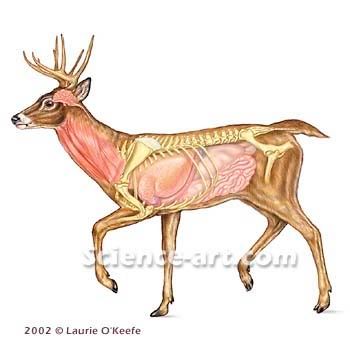 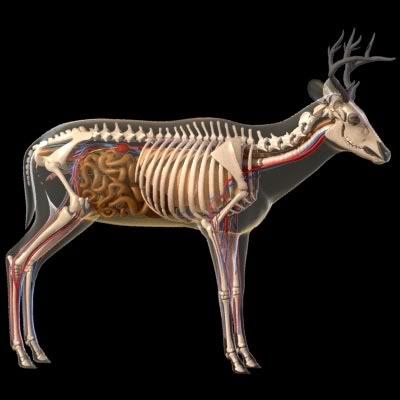  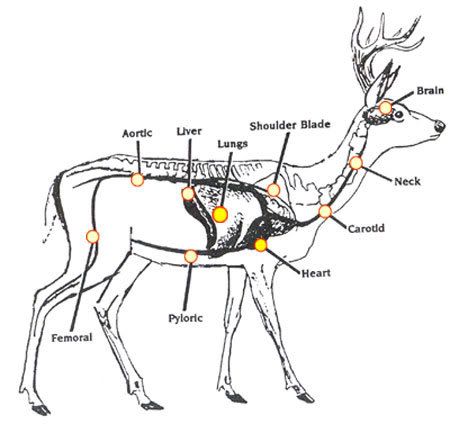 |
RE: Recovery, What To Do After the Shot.
Awesome...thanks for taking the time Rob!!!
|
RE: Recovery, What To Do After the Shot.
Very well said Rob! I'm sure this will help a ton of people recover deer!
|
RE: Recovery, What To Do After the Shot.
well said and nice avatar!
|
RE: Recovery, What To Do After the Shot.
One of the best/most helpful threads of all time!
 Nice job Rob! Nice job Rob! |
RE: Recovery, What To Do After the Shot.
Thanks that will help me if I get something this year. First time bow hunter so thats great info. Thank you
|
RE: Recovery, What To Do After the Shot.
ORIGINAL: rjdumas Thanks that will help me if I get something this year. First time bow hunter so thats great info. Thank you |
RE: Recovery, What To Do After the Shot.
All great stuff, I'll add just a couple of pics, because I think they do such a nice job of showing the difference between good "LUNG BLOOD," and "LIVER BLOOD."
These are of a doe I shot last year.... First LUNG  |
RE: Recovery, What To Do After the Shot.
Second LIVER
 |
RE: Recovery, What To Do After the Shot.
Thanks for posting this Rob.
|
RE: Recovery, What To Do After the Shot.
Great info!!!!
|
RE: Recovery, What To Do After the Shot.
Excellent info. I've always been impatient, and have lost a couple deer because of it. I've learned to think more about the animal and less about myself.
I definitely agree about getting the glasses on him post-shot. Another thing I try to do if he moves out of sight is focus on the last place I saw him, ID a landmark, so I can get right on the trail when it's time. I've been surprised at times at how far they can move from the hit before the blood starts showing up on the ground. Also, most already know this, but don't look only on the ground. If it's a good hit you'll see blood on saplings and brush about thigh-high (your thigh). |
RE: Recovery, What To Do After the Shot.
ORIGINAL: usmc1978 Excellent info. I've always been impatient, and have lost a couple deer because of it. I've learned to think more about the animal and less about myself. I definitely agree about getting the glasses on him post-shot. Another thing I try to do if he moves out of sight is focus on the last place I saw him, ID a landmark, so I can get right on the trail when it's time. I've been surprised at times at how far they can move from the hit before the blood starts showing up on the ground. Also, most already know this, but don't look only on the ground. If it's a good hit you'll see blood on saplings and brush about thigh-high (your thigh). Marking the spot visually and mentally. Things change when we're back on the ground. And, blood can be on the underside of plant leaves and brush. Great information usmc1978 I'll add it to the post. |
RE: Recovery, What To Do After the Shot.
great thread rob! I dont think that is covered enough
rick |
RE: Recovery, What To Do After the Shot.
Thanks for the great post. I forwarded it too my daughter and nephews. They are 15, 15, and 12.
|
RE: Recovery, What To Do After the Shot.
Thanks Rob, this is a great thread.
|
RE: Recovery, What To Do After the Shot.
This thread was a great help to me two years ago. It was the first time a deer didn't fall in sight for me. I remembered what I read here and put the information into practice. It took me a few hours but I found my doe. Without this thread I don't know if that would have happened. Thanks again Rob!
|
RE: Recovery, What To Do After the Shot.
ORIGINAL: OHbowhntr All great stuff, I'll add just a couple of pics, because I think they do such a nice job of showing the difference between good "LUNG BLOOD," and "LIVER BLOOD." These are of a doe I shot last year.... First LUNG
|
RE: Recovery, What To Do After the Shot.
Ahhhh yes, it's official. It's time to get after some whitetails w/ stick and string.
|
RE: Recovery, What To Do After the Shot.
wow! i didnt realize how different the color of blood is from the lung to the liver If you can't tell.....or you don't see the bright stuff...... Go home. Come back. If he's dead....he'll still be dead becasue of your wait. |
RE: Recovery, What To Do After the Shot.
Thanks Rob, awesome thread! I'm certain that if I'd had this info years ago I wouldn't have went thru the agony of lost deer.
Couple of things to add to the discussion: 1. Most know to do this but I'll say it anyway: ifpossible climb back into your stand and guide a buddy to where you last saw the deer. Even if you made a mental note of where he went, the woods look much different from the ground vs. 20' up in a tree. I've got a good friend who is adamant about doing this and it has paid off in the cases whereyou can't immediately pick up a good blood trail. 2. Rob mentioned that with certain hits one should start tracking sooner than normal. One instance I've read where this is true is with hip shots. I'd say the reasoning behind that is to keep the deer moving and bleed out. I helped on one such tracking job but we waited 4 hours before we began looking. The trail was good until the point where the arrowcame out, hardly a speckle of blood after that. Of course if you happen to hit the main artery around the hip area, you'll have a short job. I'd suggest printing Rob's tips off and keep them handy. I keep a copy in my truck just in case.Good luck fellas. |
RE: Recovery, What To Do After the Shot.
Yeah, this is a great thread. Always look forward to reading it each year. It's so easy to get caught up in the moment and want to rush over and chase that buck. Patience is huge.
Last year, I shot my buck a little back and thought I made a good hit. Once side of the trail on the shot had blood, the other guts. I hit a rib and it turn back some thru the guts. I watch the buck walk up over the hill and when I saw him walking away, I knew I couldn't push him. I left at 9:30 and went and had lunch and met my Dad at 12:30 Best move I did because I walked into the woods and could smell the deer (if you've ever hit a deer in the guts or punctured it while gutting, you know what I am talking about.) Walked my Dad back thru the shot and showed him what I found. We then went to the next spot I saw him and there he was piled up not 10 yards away. |
RE: Recovery, What To Do After the Shot.
Guys I don't have many years experience....but I hunt from a climber, almost exclusively. One thing I ALWAYS do is (Now;)) leave my climber attached to the tree if I back out.
1. (as was mentioned before) Sometimes it's beneficial to climb back up to guide someone else from your perch. Things look different from the ground. 2. It's just a plain ol good idea to mark where the shot was TAKEN from. In the dark.....a quick flash of the light to the tree is sometimes needed....and if your stand is still on that tree....it makes it more readily identifiable. LOTS of trees look the same in the dark. |
RE: Recovery, What To Do After the Shot.
One thing I would add is the use of marking tape on a trail that you have to leave and come back to or a trail that is very faint. Similar to Jeff's post above...the bushes and leaves look very similar after you leave and come back a couple of hours later. Marking the last spot of blood, especially, will make it much easier to pick the trail back up and help determine a possible direction the deer was headed after the shot.
|
RE: Recovery, What To Do After the Shot.
One other item I'll add to this is when you lose blood and are doing a search, know your terrain. think about where the deer would most likely head for cover or water, etc.
On my buck last year, the thing I failed to mention above as that instead of approaching the spot I had last seen my buck from the direction he traveled, I circle completely around. Not 60 yds from there is a well traveled road. On the other side is a house and a swamp. I don't have permission to get into that property (nor do I think I could, even for a wounded animal.) So my Dad approached from the road and I stood watching where I had last seen him from my stand. This served 2 purposes. 1. It allowed us to see if there was any blood out to the road as he first took a slow walk along the edge 2. If the deer had not expired, it allowed us to push it back into an area that we had access to and were familiar with and hopefully I'd be able to see him and mark the next location. Once I saw my Dad I slowly approached and followed the trail until I was in the spot I had visually marked as the last place to see him. As I was scanning the ground I found the leaves turned up and that's when I saw him. |
RE: Recovery, What To Do After the Shot.
One thing I will add....maybe it's in there already somewhere?
Unless you have resorted to a last ditch effort "Body Search" where you can use all the manpower you can get, resist the urge to bring everyone and their grandmother in with you to track your animal! Tracking is best done IMO with 2 people who know what the heck they are doing. 3 or more people does nothing on a bloodtrail but get people in a rush, off the trail and sign possibly mixed up, disturbed or lost entirely. Call that one other guy you can count on to go slow and work with you as a teammate on the trail andTHEN call everyone else after you've either found him, or exhausted every effort to find the animal yourself and you need to grid search. |
RE: Recovery, What To Do After the Shot.
ORIGINAL: Matt / PA One thing I will add....maybe it's in there already somewhere? Unless you have resorted to a last ditch effort "Body Search" where you can use all the manpower you can get, resist the urge to bring everyone and their grandmother in with you to track your animal! Tracking is best done IMO with 2 people who know what the heck they are doing. 3 or more people does nothing on a bloodtrail but get people in a rush, off the trail and sign possibly mixed up, disturbed or lost entirely. Call that one other guy you can count on to go slow and work with you as a teammate on the trail andTHEN call everyone else after you've either found him, or exhausted every effort to find the animal yourself and you need to grid search. |
RE: Recovery, What To Do After the Shot.
great post
about 20 years or so i shot one of my first dear with a bear recurve and i clearly gut shot it it was right at daylight i went back to my truck a couple of hundred yards away and got some marking paper i had forgot to bring my intention was to start tracking right away well as luck would have it i got stuck in the mud(always muddy down hear in souther Louisiana) 4.5 hours later i managed to get unstuck went right to where the dear went in the woods deer wasnt 150 yards down the trail that stayed in my mind for all those years and i always wait!!!! thank God for some unanswered prayers |
RE: Recovery, What To Do After the Shot.
Don't know if its in here but pack some extra toilet paper. You should anyway.;)Comes in handy while tracking. Make yourself a TP sprinkled path if you have to.
Also, I tried to find it but failed (lousy search feature). Maybe someone could post Matt/PA's thread about his buck he tracked last year. Pure determination I tell ya. I read that thread many times last year when I was in the same situation. Unfortunately, my tracking success came months later when he was just skin and bones. I tell you guys one more thing...I thought I gave my buck plenty of time to succomb last year but apparently did not. I gave him about six hours and then went after him. I wanted my buck and didn't want the meat to spoil. Sometimes you can't have it both ways. |
RE: Recovery, What To Do After the Shot.
Great post and good information!
Acouple weeks ago, I remember reading a lengthy tread debating "the void" theory. Inone of theposts someone recomended a book by John Trout Jr. called "Finding Wounded Deer". Well I went out and picked it up and was very impressed. One tip it mentiond is looking for the hair that was sliced off when the arrow entered the deer.The color and length of the hair could help determin the shot placement. I loaned the book to my buddy, but when I get it back, I'll post his guide for identifying what area the hair came from. |
RE: Recovery, What To Do After the Shot.
ORIGINAL: ducsauce Don't know if its in here but pack some extra toilet paper. You should anyway.;)Comes in handy while tracking. Make yourself a TP sprinkled path if you have to. Also, I tried to find it but failed (lousy search feature). Maybe someone could post Matt/PA's thread about his buck he tracked last year. Pure determination I tell ya. I read that thread many times last year when I was in the same situation. Unfortunately, my tracking success came months later when he was just skin and bones. I tell you guys one more thing...I thought I gave my buck plenty of time to succomb last year but apparently did not. I gave him about six hours and then went after him. I wanted my buck and didn't want the meat to spoil. Sometimes you can't have it both ways. Here ya go, the story of my deer from last year. Ya know almost a year later this is still an open wound for me. I get emotional, upset and frustrated every time I think about it because I really feel like I should have been able to put it together sooner than I did. http://www.huntingnet.com/fieldjournal/fieldjournal_detail.aspx?nID=753 I guess the moral of the story is that you have to be honest with yourself......."Have I truly done everything in my power to find that animal?" If you feel guilty that you gave up to soon then no you didn't. I trusted what I saw, and the fact that I knew I was dealing with a dead animal even though in 2 days of searching I honestly never found a single drop of blood. (other than the one drop that was on the ground where the broken half of the arrow rested.) Faith is spending 2 days on your hands and knees without the faintest clue that the deer was ever there. |
RE: Recovery, What To Do After the Shot.
What many don't know and I'm not afraid to say it, had I NOT been in a cast I would have made the drive and put my dog on Matt's trail. Although not legal yet, there is a bill in the house to make it so, ethically it was the right thing to do. It would have salvaged the meat and hide as well. Ethically I had no quams and I know we would have found it that night. Where legal, make arrangements or check the United Blood Trackers state to state listings of willing and eager trackers.
|
RE: Recovery, What To Do After the Shot.
ORIGINAL: Matt / PA I really feel like I should have been able to put it together sooner than I did. Rob I checked that United Blood Trackers site but there are no trackers in VA. Whats up with that? I mean here's a state that loves running deer and bear with dogs but we don't have any dogs availableto track a dead deer?[&:] |
RE: Recovery, What To Do After the Shot.
ORIGINAL: ducsauce ORIGINAL: Matt / PA I really feel like I should have been able to put it together sooner than I did. Rob I checked that United Blood Trackers site but there are no trackers in VA. Whats up with that? I mean here's a state that loves running deer and bear with dogs but we don't have any dogs availableto track a dead deer?[&:] 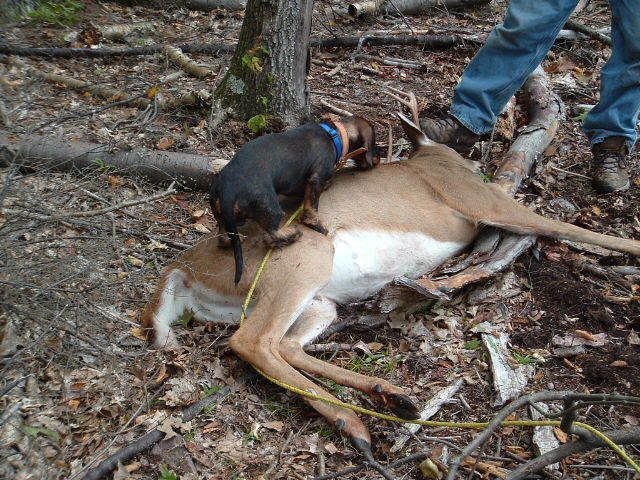 |
RE: Recovery, What To Do After the Shot.
Sure is a cute little fella.:)
Makes sense to have a deer tracking dog on hand since hunting is...well....my favorite thing to do. :D |
RE: Recovery, What To Do After the Shot.
ORIGINAL: ducsauce Sure is a cute little fella.:) Makes sense to have a deer tracking dog on hand since hunting is...well....my favorite thing to do. :D That little horn dog never misses an opportunity with anything that will stand still long enough. LOL  He'll find your buck alright but chances are it will be violated by the time you get there. :D |
RE: Recovery, What To Do After the Shot.
I was just about to say "little Axel" looks like he is getting ready for a "tea-spooning" job on that buck.
LT |
RE: Recovery, What To Do After the Shot.
ORIGINAL: Matt / PA ORIGINAL: ducsauce Sure is a cute little fella.:) Makes sense to have a deer tracking dog on hand since hunting is...well....my favorite thing to do. :D That little horn dog never misses an opportunity with anything that will stand still long enough. LOL He'll find your buck alright but chances are it will be violated by the time you get there. :D |
RE: Recovery, What To Do After the Shot.
Excellent info.!!!
|
RE: Recovery, What To Do After the Shot.
One other thing that has helped me out in the past is understanding the importance of staying undetected both before, during and after the shot. Sounds pretty straight foreward but it is so important to remain undetected after that shot. TV shows guys taking a shot, and then talking, fist pumping, whatever. If you have shot an animal and it doesnt know you are there or doesnt know what has just happened, your odds of finding that animal increase dramatically as opposed to that animal knowing a "predator" is on their trail.
|
| All times are GMT -8. The time now is 11:13 AM. |
Copyright © 2026 MH Sub I, LLC dba Internet Brands. All rights reserved. Use of this site indicates your consent to the Terms of Use.