


Flashhole Size--Muzzle Velocity
 05-03-2011 | 10:23 AM
#1
Thread Starter
Nontypical Buck
Joined: Aug 2008
Posts: 3,732
Likes: 0
From: Rapid City, South Dakota
 Flashhole Size--Muzzle Velocity
Some times after i come back to bed after draining bladder in the middle of the night, i wonder about things. Not so long ago, i started wondering whether flash hole size had much affect on ignition, and therefore muzzle velocity. So many have written about enlarging the flash hole in their breech plug. I have never seen the merit of enlarging the flash hole in a breech plug, because by doing so, one, in an instant, in effect makes the breech plug hundreds of shots older.
What i did this morning was use the V2 as the test bed for 2 different ventliner. One ventliner has a flash hole of 0.033". The other ventliner has a flash hole of 0.028" Both are 100% reliable igniting BH in warm, hot, cold, and sub-zero weather. It proved to be handy to be able to use the QRBP as a test bed, because no grease or teflon tape was involved. Changing the ventliner back and forth was quite easy.
The load was 115g of BH209 ignited by STS primer, pushing a 270g Deep Curl in a Harvester smooth sabot. When i purchased my clock, i couldn't bring myself to pay extra for a model that calculated the extra things such as SD. Today i was some sorry that i didn't. The 0.028" flash hole seemed to be more consistent, but i have no Standard Deviation # to illustrate this.
I shot 3 shots with each ventliner, and then switched to the other, and then switched to the other, and then switched to the other. The results are:
0.033" flash hole gave a muzzle velocity of 2010 fps
0.028" flash hole gave a muzzle velocity of 2017 fps

Then because it was such a nice day i placed a couple of them Black Horn jugs filled with water out there, and shot at them from 200+ yard.

What i did this morning was use the V2 as the test bed for 2 different ventliner. One ventliner has a flash hole of 0.033". The other ventliner has a flash hole of 0.028" Both are 100% reliable igniting BH in warm, hot, cold, and sub-zero weather. It proved to be handy to be able to use the QRBP as a test bed, because no grease or teflon tape was involved. Changing the ventliner back and forth was quite easy.
The load was 115g of BH209 ignited by STS primer, pushing a 270g Deep Curl in a Harvester smooth sabot. When i purchased my clock, i couldn't bring myself to pay extra for a model that calculated the extra things such as SD. Today i was some sorry that i didn't. The 0.028" flash hole seemed to be more consistent, but i have no Standard Deviation # to illustrate this.
I shot 3 shots with each ventliner, and then switched to the other, and then switched to the other, and then switched to the other. The results are:
0.033" flash hole gave a muzzle velocity of 2010 fps
0.028" flash hole gave a muzzle velocity of 2017 fps
Then because it was such a nice day i placed a couple of them Black Horn jugs filled with water out there, and shot at them from 200+ yard.
 05-03-2011 | 11:10 AM
#2

Boone & Crockett
Joined: Aug 2004
Posts: 11,703
Likes: 0
From: Idaho
ronlaughlin
Here is another experiment that I did... Do different primers change velocity? Hot primers vs. the mildest primer through a Lehigh vent liner...
The powder load stayed static... 110 grains by volume - thrown on site. Primers changed. I believe the old Remington 209-4 to be the mildest primer I have.
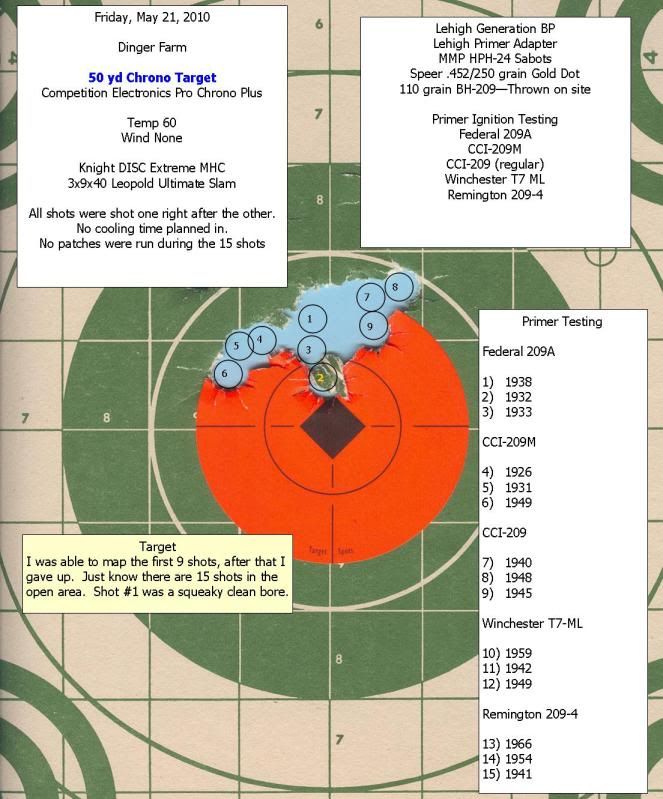
Here is another experiment that I did... Do different primers change velocity? Hot primers vs. the mildest primer through a Lehigh vent liner...
The powder load stayed static... 110 grains by volume - thrown on site. Primers changed. I believe the old Remington 209-4 to be the mildest primer I have.
 05-03-2011 | 12:13 PM
#4
Typical Buck
Joined: Feb 2011
Posts: 598
Likes: 0
From: MD/PA Line
I believe if the headspace is correct and you are getting 100% of the fire going to the powder charge of BH209 then the size of the flash hole does not really matter. I just was playing some this afternoon, before I cleaned my gun, snapping primers and I really like the Rem STS's and Fed209A's in the PR vent liner of .033. I snapped a few off with the o-ring in my breech plug and on both I had a nice steady stream of fire come out the end of the barrel. This is definitely the type of primers I want to use during cold weather shooting BH209. I have one of your grade 8 Omega plugs and it fires BH209 perfectly and I think its flash hole is .028. It is headspaced for just about any primer I want to use except Win209's and the Euro primers.
05-04-2011 | 09:29 AM
#5

Nontypical Buck
Joined: Mar 2005
Posts: 1,392
Likes: 0
From: Renfrew County, Ontario, Canada
Would not the increases in velocity have a direct relationship with a fouled bore creating more pressure even with lighter primers?
In a sealed system the strength of the primer would increase velocity as the primer power was increased would it not. To me that would make sense regardless of vent hole size.
In a flintlock I could see the liner size haveing a direct influence on velocity as gasses are vented through the vent rather than the bore.
I sometimes think of these things while bored at work.

In a sealed system the strength of the primer would increase velocity as the primer power was increased would it not. To me that would make sense regardless of vent hole size.
In a flintlock I could see the liner size haveing a direct influence on velocity as gasses are vented through the vent rather than the bore.
I sometimes think of these things while bored at work.
05-04-2011 | 09:50 AM
#6
Boone & Crockett
Joined: Aug 2004
Posts: 11,703
Likes: 0
From: Idaho
In a sealed system the strength of the primer would increase velocity as the primer power was increased would it not. To me that would make sense regardless of vent hole size.
In a flintlock I could see the liner size haveing a direct influence on velocity as gasses are vented through the vent rather than the bore.
I sometimes think of these things while bored at work.
In a flintlock I could see the liner size haveing a direct influence on velocity as gasses are vented through the vent rather than the bore.
I sometimes think of these things while bored at work.
Ron has shown that the size does not dramtically increase or decrease velocity. If you headspace leaks then you will suffer some loss of velocity. Further if you increase the size of the flash hole you further increase the amount of blow back or back pressure on the nose of the primer this can reduce velocity and if you leak pressure by the the primer the velocity may be further impacted. But in all of this I would think it would be significant.
05-04-2011 | 11:19 AM
#7
Nontypical Buck
Joined: Mar 2005
Posts: 1,392
Likes: 0
From: Renfrew County, Ontario, Canada
If you look at the velocities on my target... I think you will see exactly what you are talking about. The barrel was never patched through all of these shots and you can see even with the weaker primers the velocity moves up just a tad. The tighter the bore the better the bore seal increasing pressure and velocity.
Western has one goal... sell the powder - to do that they need to have reliable ignition across the board - to get that they feel the answer is to increase the size of the flash hole to get more heat to the powder and it makes sense but it certainly is not necessary if the plug can breath correctly.
Ron has shown that the size does not dramtically increase or decrease velocity. If you headspace leaks then you will suffer some loss of velocity. Further if you increase the size of the flash hole you further increase the amount of blow back or back pressure on the nose of the primer this can reduce velocity and if you leak pressure by the the primer the velocity may be further impacted. But in all of this I would think it would be significant.
Western has one goal... sell the powder - to do that they need to have reliable ignition across the board - to get that they feel the answer is to increase the size of the flash hole to get more heat to the powder and it makes sense but it certainly is not necessary if the plug can breath correctly.
Ron has shown that the size does not dramtically increase or decrease velocity. If you headspace leaks then you will suffer some loss of velocity. Further if you increase the size of the flash hole you further increase the amount of blow back or back pressure on the nose of the primer this can reduce velocity and if you leak pressure by the the primer the velocity may be further impacted. But in all of this I would think it would be significant.
HA
05-04-2011 | 11:31 AM
#8
Boone & Crockett
Joined: Aug 2004
Posts: 11,703
Likes: 0
From: Idaho
The problem is that guns were never designed to shoot the powder in a long term manner.
Knight at this time is and with their new releases is the only company that has made the strides to offer a BH compatible Breech PLug.
Other companies are working to get it done but with all the differenct theories out there they may be having a hard time deciding what the best design might be.
I am personally biased but i am not sure that Western can even supply the best guidance for the different rifles.
05-04-2011 | 03:18 PM
#10
Boone & Crockett
Joined: Aug 2004
Posts: 11,703
Likes: 0
From: Idaho
Not to be shot long term... what I am suggesting there is that BH does cause a 'crud ring' type of fouling but it is in the breech plug instead of the bore. At the time of BH's release I do not think this was known for sure. Current breech plugs do not have the ability to shoot long term (many shots) without doing some maintenance to the BP. Gun companies certainly did not know it for sure or they could done more preparation for a BP that would offer more long term shooting capabilities.
Stringing... If you are referring to the target I posted and the ragged group... the only thing that I would comment on is the target was not shot for accuracy, it was shot for velocities one shot after another. The purpose was to check to see if different primers would produce a significant change in velocity, which I do not think it did. At that time i was in a discussion with another forum member that felt the hotter primers would provide a significant velocity increase.
Even the labled shots are approximately locations as the target became chewed up.
Maybe help me understand what you are asking?
Last edited by sabotloader; 05-04-2011 at 03:24 PM.