
|
Should I bed or float my Omega?
I am always trying to improve accuracy on my Omega. Wondering what you guys thoughts are on bedding the barrel. I understand the difference between floating and bedding. I can run a dollar bill between the barrel and my laminated thumbhole stock now untill the recoil lug. Do you think it would be worth bedding? Also have some other muzzleloaders I might try to bed them. CVA Mag Bolt, Traditions Lightning Bolt.
|
RE: Should I bed or float my Omega?
bowbender6
With the laminate stock, with is a healthy strong stock, bedding might help accuracy... but probably un-necessary for a hunting rifle. Since you indicate that the barrel is already floating and that stock does not move it will no interfer or touch the barrel at different temperatures, either temperatures outside or temp of the barrel. Bedding the action might help and certainly would help maintain POI after strip cleaning the gun. Tightening the two lug screws equally each time is really the big thing to do + checking to make sure the lugs are tight to the barrel... Just my thoughts, but I should ask are you having accuracy problems with it? |
RE: Should I bed or float my Omega?
About 1-2" Groups @ 100 yards. They are not as consistent as I would like. Okay for hunting, but I like to play. I don't think bedding will make it worse. Might be a good winter project
|
RE: Should I bed or float my Omega?
bowbender6
PM Lemoyne - he might be able to share some really good thoughts on the process... I have bedded several centerfires and ml's but since that is one of the things he use to do (or still does) for a living - he knows secrets that I do not... |
RE: Should I bed or float my Omega?
With the magbolt, Its very easy to float. Also remove the material touching the sides of the barrel.
|
RE: Should I bed or float my Omega?
I bedded my Omega. If you go to that effort, which isn't that bad, I HIGHLY recommend you install aluminum pillars while you are at it. That part is actually a lot easier than the bedding job that follows.
The biggest benefit for me was that I now have a consistent POI; before I did it I needed to rezero every time the action was out of the stock. I do think it closed up the groups by maybe .25" too. |
RE: Should I bed or float my Omega?
Bowbender6,
I don't know who here knows what about bedding but I do know spaniel bedded his and has great groups. I did not want to modify my rifles stock. I notice however thatmy Omega's stock was touching on one side of the barrel. I removed the nibs of raised thick polyurthane? finish w/steel wool where the barrel was touching. Still touching. I had some teflon flat stock that I cut and fitted in the bottom of the stock gullies where the barrel studsdrop in. It was just about right but upon tighting I felt with such a hard laminated surface w/metal on the other side of the teflonI would get inconsistant results. I went to Lowes and found abrass cabinethinge that was a little thicker and predrilled the holes from the teflon template, and hacksawed and then filed to fit.Here is what I got! 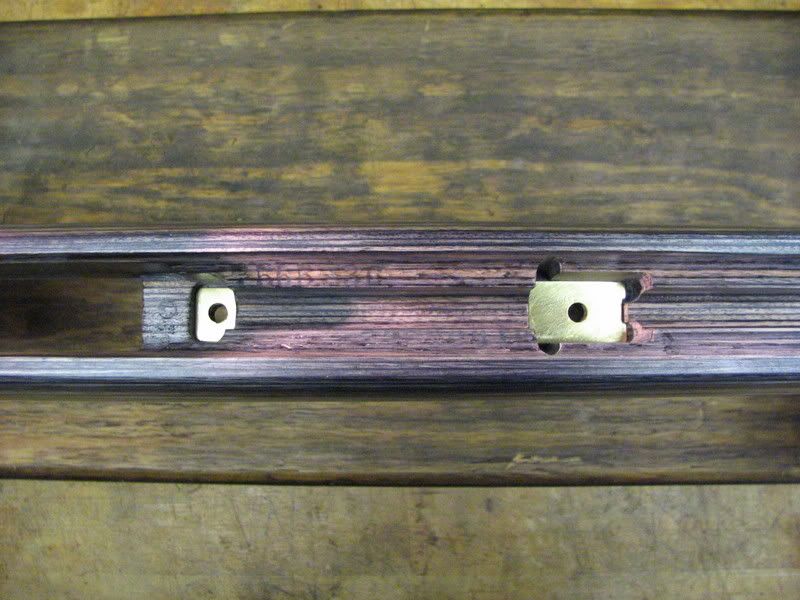 I did sand down the surfaces to remove any burs etc. on a flat surface w/ ultra fine wet dry.WhatI don't know is will this mod cause POI changes when I remove the barrel and remount. I haven't had the time to test and retest. What I can tell you is when I do my part I can touch/clover leaf@ 100 meters. I know when I pull a shot but in general 5 shot groups turn out real nice. This is just a little better than before the mod. The main thing is the dollar bill slides back to the front lug w/o and interruption. 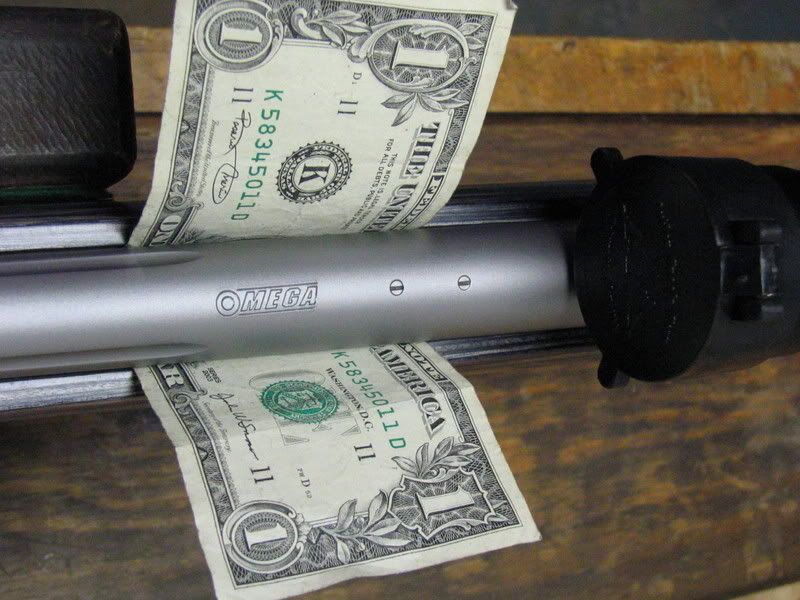 So my big question for the more experienced guys and to help me & bowbender6 is did I do something right or just headed in the right direction ????? Thanks, Steve |
RE: Should I bed or float my Omega?
SHills
Basically from what I can tell you have raised the barreled action in the stock with shims. The shims you have chosen to use will also provide you a stable and sound lug base... so as you tighten the lug screws you will not be pulling the action further down into the stock. I have down this with 3/4 omega's and it has worked very well. If the barrel is now floated it SHOULD set up the same harmonics in the barrel everytime you shoot it. Temperature, both the ambient temperature and the temperature of the barrel should not cause a change in the POI because there is room for the stock and/or the barrel to swell... I believe it is still always best to have a barrel channel and action fully bedded. This combination should stop any movement of the barreled action in the stock and pressure will be applied equally. For a target rifle that you a making money with by shoot targets I think a full bed job is a priority... For a hunting rifle getting a 1MOA @ 100 is very respectible... If you read spaniel's post he reduced his MOA a 1/4" by bedding his Omega... If your gun as you have made thse changes shoots 1 MOA or 1.5 MOA - congratulations... I think you have made a worthy improvement. The only thing you have not done is take any front/back movement out of the action - IF there is any... Usually the laminate stocks a fairly stong, especially with those deep lug pockets - just the opposit with the synthetic stocks... |
RE: Should I bed or float my Omega?
SHills -- I won't argue with it if it works for you, but... :D
The true purpose of a pillar is to remove ANY compression of the stock when you tighten the action screws. Using your "floor plate" design, you still have to tighten the head of the action screws into the stock, it's just compressing against the floor plate instead of the lug. A true pillar SHOULD still be an improvement. When my action screws bottom out on the pillar, there is ZERO play, metal to metal contact. When I can get back into a difference site, I'll see if I can retrieve an IM I sent with bedding/pillar installation instructions and copy it here. |
RE: Should I bed or float my Omega?
Personally never seen a negative to shoring up the action by bedding it. I 100% agree that if your going to go to the trouble of bedding the action take the additional step of pillars at the same time.
As mentioned your barrel is already floated and assuming your pillar/bed job is true this will remain. If for some reason you have a little stock touch after the bed/pillar job remove material from the barrel channel by using fine grid sand paper. Slow and steady wins this race - not hard but requires somepatience. |
RE: Should I bed or float my Omega?
Sabotloader and Spainel,
I was never taught how to bed andI do have a 1974 model 700 LH 270 that is bedded. A gunsmith did it for me. AllI asked was to take a ball end mill and widen the barrel channel and it came back bedded too. @ 100 rds you can shoot prone and all bullets will touch w/federal power shock factory ammo IF I'm shooting real good. When federal changed from classic to power shock I'm not sure what they did but those new bullets/ powder combo inproved in my rifle accuracy. I did nothing different. From the adsI've seen I believe all the savage syn rifles have pillars imbedded in the stocks. I'm not sure how that would work in my case. There isn't much meat left. I would like to know how you did yours... Like I said IF I'm shooting real good I can hold a tight group but we are talking 100 meters. I'm just an average shooter. When the air drops outa my lungs I am ready to squeeze and then I pick my time and boom. When I'm hunting I'm not even sure I let the airout before shooting. I take the first killing shot I can once I detemine I want that one... I don't mess around. Raise the rifle and a split second later fire. Any pic's you have of your stock would be nice if possible spaniel. Thanks, Steve |
RE: Should I bed or float my Omega?
I think it is better to bed the action and barrel. IMO the actions of MZ's are not as strong as the actions of a centerfire rifle. I believe the floated barrel puts more stress on the action. I also believe that with the smaller diametere barrel(in relation to the bore), the barrel harmonics yield a larger Sine Wave. I think bedding the barrel reduces these harmonics.
Most gunsmith's I know recommened first trying a pressure point on a barrel before they float the barrel. Just remember to use your torque driver. Tom. |
RE: Should I bed or float my Omega?
Respectfully, IMHO it's not really a concern how strong ML actions are compared to centerfire. First, the pressures involved are much lower. Second, the design is completely different for most, making a comparison irrelevent. For example, with an Omega, you don't have a barrel hanging off the front of the action, which is where you can think about bedding the barrel. For example, with a Ruger 10/22, it is standard to bed the first few inches of the barrel because it is clamped to the front of the action and not threaded in. This compared to a Rem700 action where the standard is to fully float the barrel.
An Omega is a totally different animal. The barrel IS the action -- the only thing behind the barrel is the swing-up firing pin/breech plug cover mechanism. In this case, I think it makes sense to bed up to the front recoil lug and float in front of that. There is no rationale to bed more of the barrel because it is one solid piece of metal back to the breech plug. If I get time today I'll snap some pictures of the gun/stock and post them with bedding directions. |
RE: Should I bed or float my Omega?
ORIGINAL: spaniel Respectfully, IMHO it's not really a concern how strong ML actions are compared to centerfire. First, the pressures involved are much lower. Second, the design is completely different for most, making a comparison irrelevent. For example, with an Omega, you don't have a barrel hanging off the front of the action, which is where you can think about bedding the barrel. Again IMO the barrel is basically attached to the lug, and the lug supports the barrel?? If the barrel is floated all the way out from the lug then the barrel would then be supported by the lug?? (I am currently building a target grade 22-250, and the first thing we did was put a larger stronger lug on it). Are you saying that because of lower pressures that barrel harmonics do not come in to play?? I believe harmonics are still in play. I even believe they are more in play because of the strentgh of the steel used?? And also the "stiffness" of the barrel?? That is why I think a fully bedded barrel is more accurate and more consistent. But then I could easily be wrong. I do know that the barrel on my LRH is fully supported by the stock(no free floating). And it sure is a shooter. I was thinking about bedding the rifle, but it shoots so well that I do not think bedding would help. Personally my shooting limit is 250 yards. I set this limit because of time of flight, and not because of the ability to shot farther. Accurate shooting at longer distances would not be a problem. This has been a fun discussion. Tom. |
RE: Should I bed or float my Omega?
I tried mine several different ways it likes a very light pressure point 3 inches back of the end of the forarm. Lee
|
RE: Should I bed or float my Omega?
bowbender6
If you do the bed job could you document it with pics. I would like to see this or if anyone has stepxstep with pics I would like to see it. |
RE: Should I bed or float my Omega?
I'm sure harmonics do come into play, but neither of us can say how I am sure. The purpose of floating the barrel is to allow the barrel to do its thing the same way every time without the influence of pressure from the stock. If you shoot offhand, vs from a bench, the pressure on the stock will differ and this will be transmitted straight to the barrel and affect the harmonics. You want to isolate the barrel from the stock as much as possible. With a 10/22, it's a trade-off because due to the barrel clamping mechanism if you fully float the barrel is not held firmly enough to the action to be consistent. So you create a pressure point. This is a trade-off. If you want to do it right and have the money, you have a barrel and action threaded. Competition guys do this with 10/22s so they can then fully float the barrel.
Have you ever seen an Omega out of the stock? There is no true action. The barrel goes full-length. It is actually STIFFER then say a Remington 700 action, because it's all one piece, no separate action with a barrel threaded in, and cuts in the action for ejection and such that weaken it. Some other MLs are different, but not the Omega. I would never recommend bedding a gun that is already an excellent shooter and has no apparent issues. Don't fix what isn't broke! By bedding, you also get a setup that goes together exactly the same every time. My Omega is bedded so tight that it takes some back-and-forth effort to work it out of the stock. |
RE: Should I bed or float my Omega?
I don't have pics from when I bedded my Omega, so this is the best I can do......
Here is the gun:  -First, obtain something to use as aluminum pillars. I bought centerfire pillars online but you can use any type of aluminum tube from Lowe's hardware cut to the right length and with a big enough hole for the action screw to pass thru without touching the sides. I also recommend it be as wide as the heads of the screws. -Drill holes through the stock from the outside in the exact width of the pillars centered on the old holes. The pillars should fit in pretty tight. Make sure the pillars are cut to length so that when they are inserted against the lugs and the screws screwed in tight, the screw heads come to the appropriate flushness with the outside of the stock. It is best to use a drill press and electric hacksaw with clamp to do this right; I used a hand drill and hacksaw and it turned out ok though it could have been prettier. -With appropriate epoxy, coat the pillars. Insert the action into the stock. Insert the pillar from the outside so no epoxy gets on the lug (important!). Wipe away excess so none gets on the screw. Screw the action screws in tight, and use masking tape around the action portion to lash the whole thing into the stock -- it is possible for things to tilt a little from the weight of the barrel and this would be BAD. If the barrel was floated before (this job comes first), it should still be now...otherwise you are sagging and need to lash things in tighter. The other option is to wrap the barrel with a multi-layering of masking tape too just maintain your free-float, as described in detail further below. -After everything dries very well, you can disassemble and inspect your job:   -Now take a Dremel tool and remove wood all around the tops of the pillars. This is so when you bed it, the action will pull tight to the pillars and rest on them primarily. The bedding will push out down to that level so you no longer have any stock compression. Then you need to remove a thin layer of wood (1/16 or 3/32) on every surface that the action touches all the way from the front of the trigger guard hole forward to the front of the front recoil lug. You also need to remove wood all the way around each recoil lug. When you are done, the action should not touch wood anywhere. While the pillars should keep everything in place when you screw it together, it does not hurt to mark the stock and barrel with a pencil in a couple locations to make sure that when you put it back together after adding bedding compound, everything is in the right place. The carefully remove every trace of dust. -Now you need to take modeling clay and fill in every crevice that you do NOT want bedding in. This includes the ramrod channel. The trick is to fill the channel full enough to leave room for the ramrod, but not so much that there is not a thick enough bridge of bedding over the ramrod to be solid. As you can see from mine in the pick below, I had a thin area that brok away when I tried to remove the clay. That is ok, while it is not pretty the bridge over the channel is not necessary for accuracy or stability. You are more concerned with the lugs and the sides along the barrel and as it wraps underneath towards the channel. -Remove everything possible from the action--like the trigger assembly. If any holes are positioned that they may get into bedding compound, protect them with clay. -Remove all oil from the action/barrel. Fill the ramrod channels in both lugs with clay. Double-check for any other cavities I'm forgetting to mention, the design has changed slightly since my gun. -Wrap the barrel with masking tape just in front of the lug. Carefully overlap the layers EXACTLY. Test-fit over and over until you have the exact number of layers that when the action is screwed in, the tape is just maintaining your free-float. This tape will serve as a "dam" to mark the forward limit of the bedding. The clay in the ramrod channel should butt tighty up against the bottom of the tape. -Double-check that every hole and cavity is protected. Get the bedding compound ready. -Apply release agent to EVERY SQUARE MILLIMETER of the action. If you screw this up, you are about to weld your action permanently into the stock! Most kits come with release agent. I used PAM cooking spray applied liberally. -Using a popsicle stick or other tool, apply the bedding compound, prepared according to its instructions, to the areas to be bedded. You want to add just enough to fill the cavities you have created, but not a lot of excess. I erred on the side of a little too little, as you can alwasy redo the missing areas but if you add too much you could create quite a mess. - Insert the action into the stock and tighten the action screws all the way. I also lashed everything in with masking tape to be sure. Make sure the action screws are centered in the pillars, they won't shift after this! Wherever excess bedding squeezed out, wipe it off immediately. Some will come out in the trigger guard area, and around the barrel the length of the action. Wipe it all off. You should have a thin brown line along the barrel. -Leave for whatever the kit says, probably 48 hrs. A gun vise is a good place for it, it must sit in the horizontal position with zero pressure on the barrel. -Remove the tape and action screws. Holding the stock in one hand, lightly begin tapping the barrel with the other to try and break the action free. You may have to use a rubber mallet to apply a little more force. If it still does not come free, better have a beer because you may have welded it in. But it will probably pop loose. You may have to apply pressure thru the trigger guard hole to the back of the action to work it back and forth and out if it is a tight job. -Inspect. If there are any areas you need to redo, repeat as above. -When you are finished, you should have a nice defined bed for the action and lugs:   -Carefully root out all the clay. As you can see I broke through over the ramrod channel, no big deal. Reassemble everything, remove the tape, and put it together. The barrel should be floated perfectly and the action tight. |
| All times are GMT -8. The time now is 08:37 PM. |
Copyright © 2026 MH Sub I, LLC dba Internet Brands. All rights reserved. Use of this site indicates your consent to the Terms of Use.