I've fielded some questions lately from customers about varying specs between different scopes, especially in reference to some of lesser known manufacturers. When people ask the same thing more than once, I look at it as an opportunity to put something together that I can reference later, so here we go.
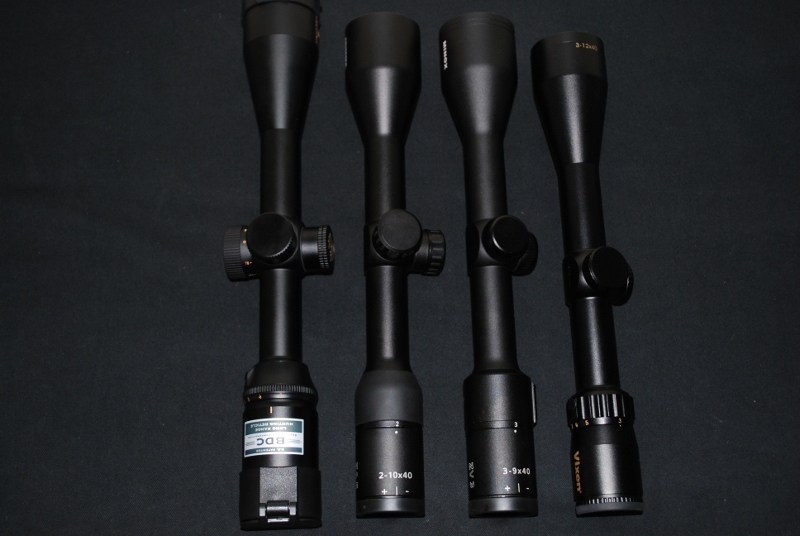
I have several comparable scopes in my inventory that constitute a wide offering of mid-range rifle scopes, and I wanted to get them side by side and do a little comparison to give an idea of exactly what is offered. The scopes are:
These aren't necessarily identical, but they do represent what you'll find in the price class in quality, features, and performance, while being comparable enough that they constitute a general picture of what you can expect when outfitting a rifle. Obviously, technical specs are going to differ slightly depending on magnification and objective size, but again, I feel that a comparison between these models is appropriate. The specs aren't so different that I would consider these scopes in different classes.
First, similarities. Each one of these scopes adheres to what I consider a minimum standard for well-built scopes in their class. They all feature a one piece anodized aluminum body, waterproofing, nitrogen purging, and fully multi-coated glass. These are all qualities that I look for in a scope when determining whether or not they are a "good buy." In addition, all scopes have one inch main body tubes. For more info on how these differ from 30mm main body tubes, we have an entry in the OpticsCamp Database on the
difference between 30mm and 1 inch scopes. Finally, all scopes have 1/4 MOA turret adjustments.
An obvious consideration, and one that has come up a lot recently, is product protection and customer support. Each one of these companies offers a lifetime warranty on the scopes featured here. Of the four, I believe Vixen has the most comprehensive, which spells out that the product warranty is a 100% no fault replacement warranty, and is transferrable. I believe Nikon's is comparable, but you have the corporate structure to deal with. Minox also features a lifetime replacement warranty, but not if it's by fault of the user. I haven't heard of any case where Minox denied a warranty return, but just to be safe, don't back your truck over your scope to test it. The end result here is that every scope on this list is protected from manufacturer defect or long-term malfunction for the life of the product.
Now, the differences.
Obvious differences first. The Nikon 3-12x42 is the only scope on the list that features a side focus and includes manufacturer-supplied scope caps. The caps are decent, and the side focus may be more attractive to those who are looking to use a 3-12x scope for mid-range distances, but I don't think it's a deal-breaker. The remaining three scopes utilize a quick focus ring around the ocular lens. Functionally, the Nikon is different, but I don't think it's a practical difference for most shooters at the distances that each of these scopes would be utilized.
That being said, it may have been more appropriate to use a 3-12x or 3-9x scope without side focus, but I don't have any in stock and I didn't want to wait to do this comparison. Again, it's still comparable.
Prices vary. The ZV3 is the most inexpensive of the group, at $199. The Vixen is next at $359. The Nikon is near the top of the list at $440, and the ZA5 has the highest price at $479. You might not think that a range of almost $300 sets them all apart, but we're dealing with the most common price class for "good buy" rifle scopes.
Country of manufacture differs between all four scopes. I don't want to get into debates on global manufacturing and trade, so we'll stick with the facts here:
- Minox ZV3 3-9x40 - China
- Minox ZA5 2-10x40 - USA
- Vixen 3-12x40 - Japan
- Nikon Monarch 3-12x42 SF - Phillipines
Let's start with size and weight. Each one of these was weighed on a zeroed postage scale to a tenth of an ounce, and measured in length to the closest quarter inch:
- Minox ZV3 3-9x40 - 13.5oz, 12.25" length
- Minox ZA5 2-10x40 - 14 12.25" length
- Vixen 3-12x40 - 13oz, 11.75" length
- Nikon Monarch 3-12x42 SF - 19oz, 13.75" length
The Vixen is the lightest and shortest of the group by a half ounce and half inch. The Nikon really tips the scales at over a pound, but that's in line with the extra length and side focus components.
Field of view, or FOV. A wide FOV is generally more desired, because a narrow FOV makes it harder to scope game. FOV is a range that varies with magnification, so I'm limiting it to low power and high power at 100 yards.
- Minox ZV3 3-9x40 - 10.5 - 31.5 ft @ 100 yards
- Minox ZA5 2-10x40 - 9.4 - 47.5 ft @ 100 yards
- Vixen 3-12x40 - 9.1 - 36.3 feet @ 100 yards
- Nikon Monarch 3-12x42 SF - 8.4-33.6 ft @ 100 yds
The highest number in FOV is the lowest magnification, and the lowest number is the highest magnification. Obviously, the ZA5 has the widest FOV at its lowest magnification because it's 2x, not 3x. But of the 3x scopes here, the Vixen 3-12x40 has the widest FOV, 36+ feet at 100 yards. It's hard to compare high magnification FOV since we have 3 different maximum magnifications, but we can derive some info from what we have. Of the 12x max magnification, the Vixen still has a slightly wider field of view - 9.1 feet when compared to the Monarch's 8.4 feet. What is interesting here is that the 9.1 ft FOV at 12x on the Vixen is only three inches narrower than the 9.4 ft FOV of the ZA5 at 10x. That's interesting.
The margins here are small, but this does show how the numbers can vary slightly. I find the Vixen's performance in this area pretty impressive. It's usually a safe bet that the higher your magnification, the less FOV you're going to have.
Eye relief. Eye relief, for those who aren't familiar with the term, is the distance from the lens closest to your eye, to the eye itself. For more info on eye relief, we have an entry on the OpticsCamp.com Database -
What is eye relief?
- Minox ZV3 3-9x40 - 4 inches
- Minox ZA5 2-10x40 - 4 inches
- Vixen 3-12x40 - 3.5 inches
- Nikon Monarch 3-12x42 SF - 4 inches
They are all pretty comparable. The 1/2" difference with the Vixen is the outlier. Given it's short body length, this might, possibly maybe, be an issue on some rifles if the maximum ring distance is too short for the action. (Edit: After looking at the photos and comparing tube length, this shouldn't be an issue, they are all about the same.)
Exit pupil. I won't try to explain exit pupil since it can be a complicated concept to wrap your head around, but here's yet another entry on the OC DB:
What is exit pupil? Once again, it's determined by magnification, so here are minimum (high magnification) and maximum (low magnification) values:
- Minox ZV3 3-9x40 - 4.4mm - 13.3mm
- Minox ZA5 2-10x40 - 4mm - 20mm
- Vixen 3-12x40 - 3.5mm - 14mm
- Nikon Monarch 3-12x42 SF - 3.5 - 14mm
Since exit pupil is calculated mathematically, and is a function of objective size and magnificaiton, you'll notice that the 3-12x scopes are similar. They show as exact here, but if you actually measure, they may differ by a few tenths of a millimeter. This also means that with similar objective lens sizes, the exit pupil will be very similar across minimum/maximum magnifications.
Internal adjustment. Each scope has a maximum adjustment range, which is referred to by minutes of angle (MOA) or quarter inches at 100 yards.
- Minox ZV3 3-9x40 - 60 MOA
- Minox ZA5 2-10x40 - 72 MOA
- Vixen 3-12x40 - 60 MOA
- Nikon Monarch 3-12x42 SF - 60 MOA
60 MOA is a general standard you'll find in most scopes in this class, but you can see here the ZA5 goes all the way up to 72 MOA. If you looked at the entry on the OC Database regarding main body tube sizes, you'll know that the main tube size is usually the limitation on internal adjustment. Somehow, Minox crammed 72 MOA into a 1 inch tube. What does this mean for you? For longer distances, you'll be able to zero a little farther on the ZA5 than you will with the others without having to fit a rail that compensates for MOA.
Moving parts. Most things can be judged on how well the moving parts operate, and rifle scopes are no exception. I'm looking at focusing mechanisms, magnification adjustment, and turret behavior.
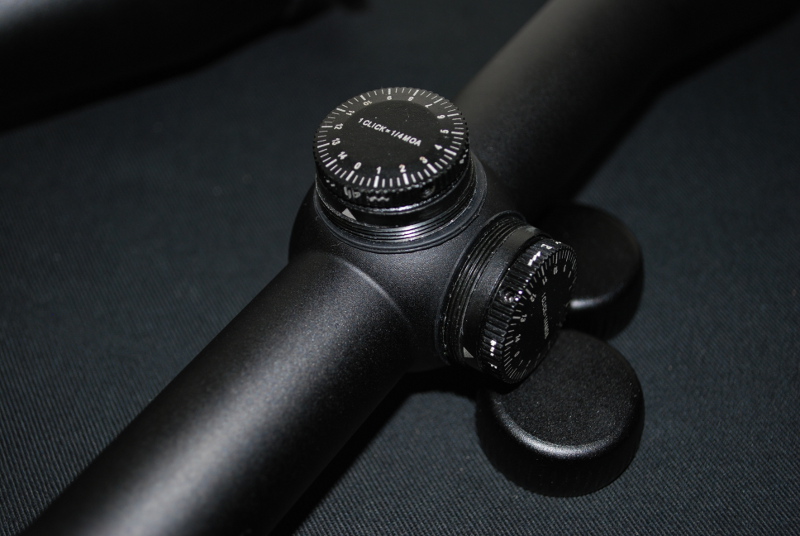
- Minox ZV3 3-9x40 - Tight focus and magnification rings. The magnification ring on this scope is metal, different from the ZA5, which may present issues when trying to adjust while wearing gloves. Still tight and precise. Turrets exhibit affirmative clicks, and a faint audible click. Some of the early ZV3 scopes I received had mushy turrets, but that problem seems to have been resolved, at least with this scope. Turrets have three allen screws to reindex after zeroing.
- Minox ZA5 2-10x40 - Rubber magnification ring, very easy to grip even when wearing gloves. Tight. No additional play. Turrets are larger than the ZV3, and much more visible when sighting. Good tactile and audible feedback. Also has reindexing capability.
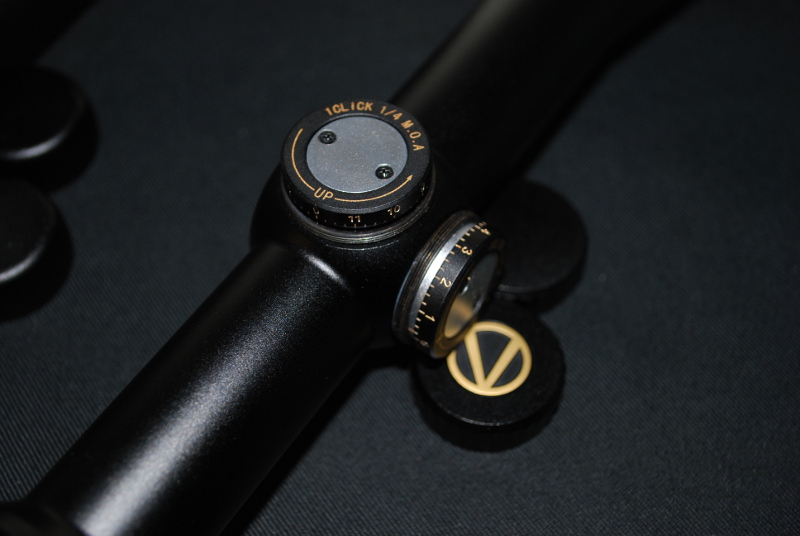
- Vixen 3-12x40 - Focusing and magnification rings exhibit tight tolerances. Turrets present good audible and tactile feedback. There are two screws on each of the turrets, but I'm unsure if this is for reindexing, or if this is just for construction. There is no mention in the manual about reindexing, I will have to confirm this with the manufacturer.
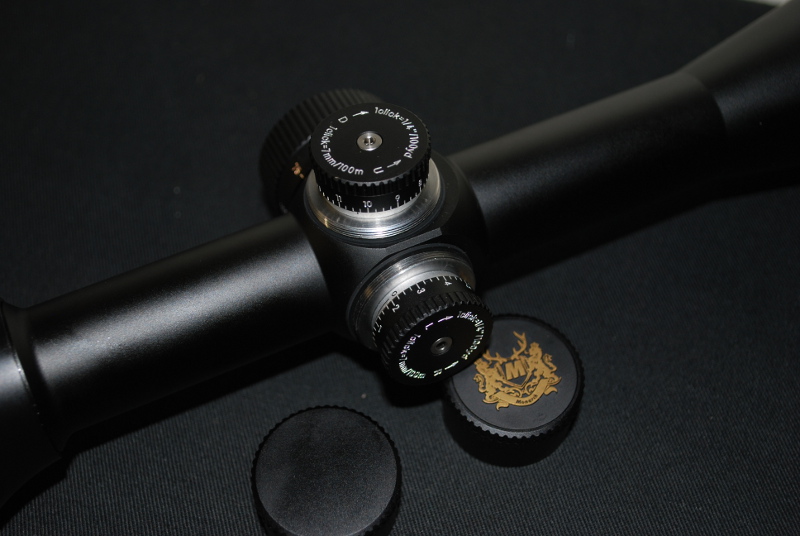
- Nikon Monarch 3-12x42 SF - Good tactile and audible feedback from the turrets. They seem to be the most stiff of the bunch.
If I had to rate the focusing and magnification on each of these scopes, here's how I would do it: The Vixen seems to have the best focusing and magnification ring adjustments - tight tolerances without being too tight. Next would be the ZA5, then the ZV3, and finally the Nikon Monarch. I don't think the Monarch is bad, but the focusing and magnification are definitely tighter than the other three - so tight in fact that in comparison I find the Vixen's to be much more desirable.
As far as turrets, the feedback from the Vixen, Monarch, and ZA5 are the most desirable. The ZV3 has the audible and tactile feedback, but it doesn't feel as pronounced as the other three.
Here's the bread and butter, the optical quality. Here's where I may lose some people, possibly due to bias, and possibly due to preconceived notions and brand favoritism. I've set aside any perosnal bias here, so I'm going strictly on my (admittedly subjective) observations.
- Minox ZV3 3-9x40 - Good edge to edge clarity. At first glance, I saw some slight fuzziness along the edges, but I checked again as I ran through the scopes and didn't notice it. Well controlled chromatic aberration, but when compared with the other scopes, the 3x magnification looked a little over 3x.
- Minox ZA5 2-10x40 - The optics are nearly identical to the ZV3, but with some more prounounced rolling ball on low magnification, probably due to the 2x minimum as opposed to the 3x minimum on the other scopes.
- Vixen 3-12x40 - Quite possibly the sharpest image of the bunch, chromatic aberration was a little better controlled than the other three, and the edge to edge clarity was best out of the four.
- Nikon Monarch 3-12x42 SF - Clarity was in line with the Minox scopes, but this scope also exhibited the most chromatic aberration of the group. Like the ZV3, 3x looked a little over the 3x on the other scopes.
All four scopes exhibited about the same level of clarity. The Vixen seemed to stand out a bit in clarity and CA control, and surprisingly, color bias was very close across the entire board. The 3x on the Minox ZV3 and the Nikon Monarch seemed to be slightly more magnified than on the other two. I'm going to attribute the rolling ball effect on the ZA5 2-10x50 to the lowest magnification being 2/3 of the other scopes. This may not be as noticable when done outside of a side-by-side test, who knows.
I've mentioned this before in other posts, but the glass on the ZV3 and ZA5 are nearly identical. I'm very hard pressed to find any meaningful difference between the two. Again, a side-by-side comparison will yield differences that you just won't notice when hunting or on the range, so take this with a grain of salt.
Overall, my initial assumption of these four scopes seems to hold true. They are all relatively comparable aside from cosmetic differences and nitpicky optical qualities.
Each one of these scopes holds its own. Each one has its own advantages and disadvantages. I think that this comparison has proven, more than anything, that there's a lot to consider when looking at scopes in this class, and price is only one of the many points.
After handling all these scopes side by side, there's a few conclusions I can make from my own experiences here:
- As far as budget, the ZV3 seems to be the best combination of glass and functionality you're going to find amongst this field of competitors. It's a good scope that's cushioned by $150+ in spare change when compared to the others.
- Considering price vs. performance, the Vixen takes the top spot for me. It just seems to have the best value in comparison to the others when you consider glass, construction, warranty, and price.
- The Nikon has the name recognition, but doesn't really have a lot to set it apart aside from the included caps and side focus at this price. I like the scope, but when you consider that two of the scopes in this test compare favorably for over $100 less, it's not as great a value (in my opinion).
- The ZA5, being the only scope in the lineup with US blood, is in a weird area where it's trying to be a top of the line scope, but compares well with the scopes presented here. The saving grace is the glass - it's got the name and the performance to compete at its price. Optically, you're getting $500 worth of Schott glass. The price is likely a result of the US labor that goes into it. But glass quality on par with Zeiss Conquest and a much lower price is attractive.
All four scopes
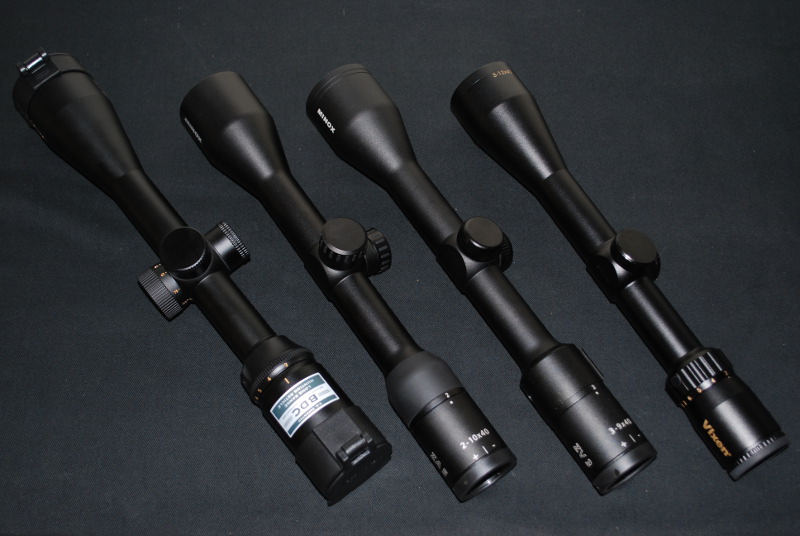
Another view of all four
ZV3 turrets
ZA5 turrets
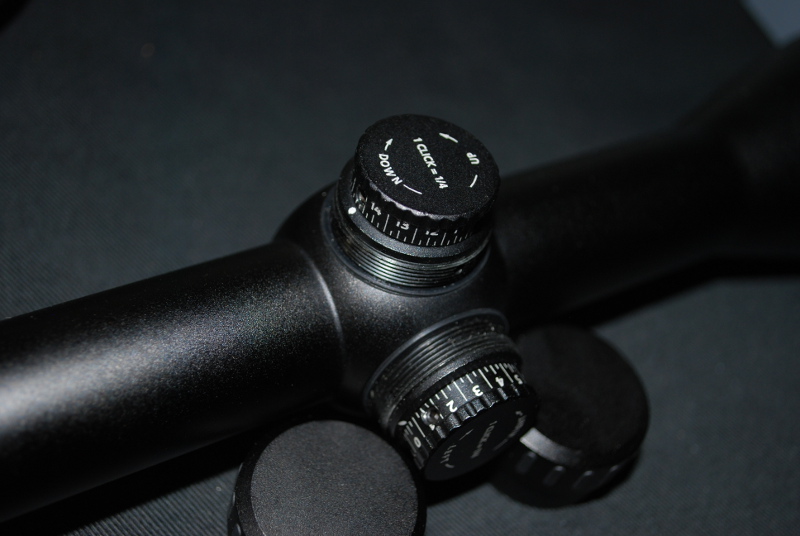
Vixen turrets
Monarch turrets
I have not been able to do any low-light testing, but I will try to set time aside next week to follow up.