ORIGINAL: TFOX
ORIGINAL: OHbowhntr
ORIGINAL: TFOX
The arrow will not gain enough speed in a hunting distance that one could ever notice.The uphill shot is shot the exact same way so that eliminates that from the equation,atleast at close distances.
Now in field archery shooting 80 yard shots uphill or downhill,then there might be some validity to that argument.
I've long since put away my Physics books, actually, sold them because as ALL COLLEGE students seemed to be, I needed money. But I thoughtthat an arrow DID gain a small amount of velocity, but you're probably right, it's not enough really that most of us would know the difference. I do know that for me, a longuphill shot shoots for more like 43-44yds rather than the 40 that my RF tells me it is. And I believe that IS due to loss of velocity.
It is because it is the hypotenuse of the angle,just like a downhill shot.
Here is a chart of my bow.Notice the difference in uphill and downhill is almost nonexistent untill you get to greater distances.Uphill has a sight paralax issue as well.That is where most of the difference comes from.
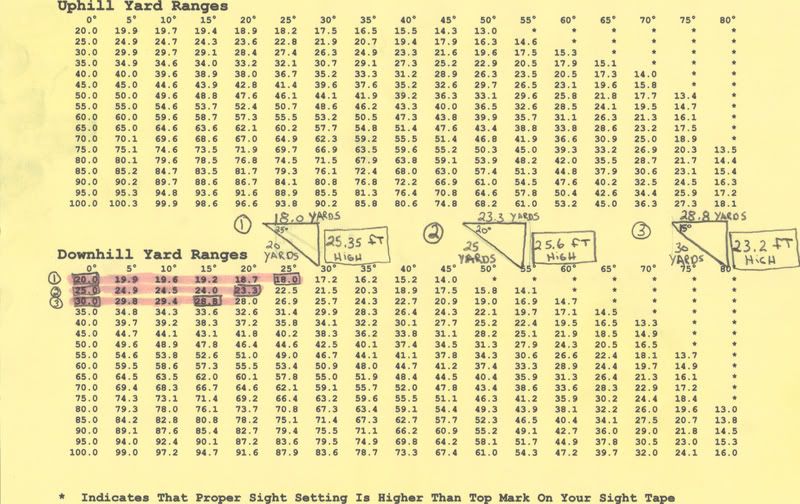
Those are mostly just numbers, but I seem to find that they don't correlate with what I get shooting uphill vs. downhill. I know it may be form or whatever, but I can put a target 35yds LINE OF SIGHT distance at my house on my hill out back, and if I shoot downhill, I'm just a touch high, not enough to worry about, but uphill, I'm lower than the downhill shot is high. Drop is about 2" uphill, 1" downhill for me personally. The elevation change is probably about 30ft, not sure what the angle is, not really that worried about it, I just know that for me personally, I find that the UPHILL shots, at least on gentle angles, less than 45* or so, I have to add yardage, not cut yardage, and the only rationale for that that I can think of is loss of velocity.

Gravity works at 9.8m per second squared, and if the arrow is in the air longer, it only makes sense that it's going to drop further than expected.