SC Sportsman
Hope some of this might help... and one other thing I might mention bullet BC is a function of Bullet velocity. When shooting ML's and the velocities+ranges that you shootBC sometimes really gets overated. Performace of the projectile through the various ranges is more important to me. There are a lot of people buying really exspenive "pointy" bullets looking for a high BC. I shoot an expensive bullet myself - but is far from pointy and I shoot either one of the two Nosler .452/260 grain HP or the Nosler .458/300 grain PP (300 for elk 260 for deer) and I would have no problem shooting both at 200 yards were the conditions right. Using Chap's "point blank range" allows you to do this very well.
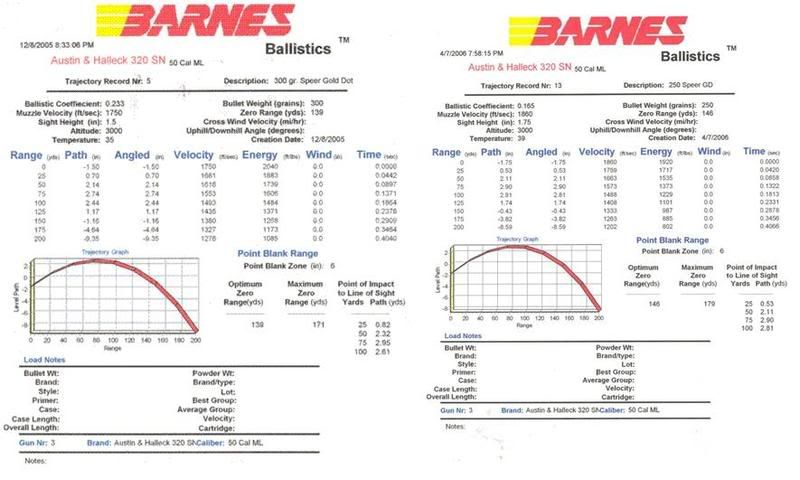
The BC for a Speer Gold 250 grain is .165
45 Revolver Gold Dot HP 45 Colt
 Part Number
Caliber
Weight Grain
Weight Gram
Construction
4484
45 Revolver
250
16.2
Uni-Cor
Use
Bullet Coefficient
Sectional Density
Diameter Inches
Diameter mm
Box Count
6
0.165
0.175
0.452
11.481
100
Part Number
Caliber
Weight Grain
Weight Gram
Construction
4484
45 Revolver
250
16.2
Uni-Cor
Use
Bullet Coefficient
Sectional Density
Diameter Inches
Diameter mm
Box Count
6
0.165
0.175
0.452
11.481
100
The BC for a 300 grain Gold Dot is .233
45 Revolver Golt Dot HP 454 Casull
 Part Number
Caliber
Weight Grain
Weight Gram
Construction
3974
45 Revolver
300
19.44
Uni-Cor
Use
Bullet Coefficient
Sectional Density
Diameter Inches
Diameter mm
Box Count
10
0.233
0.21
0.452
Part Number
Caliber
Weight Grain
Weight Gram
Construction
3974
45 Revolver
300
19.44
Uni-Cor
Use
Bullet Coefficient
Sectional Density
Diameter Inches
Diameter mm
Box Count
10
0.233
0.21
0.452
I would shoot the 250's for deer especially at short ranges. The bullet is bonded and can not come apart. Plus it shares some of the characteristics of Nosler Partitions. It will expand to the dot in the middle of the bullet - retain a shank under the mushroom and continue to drive into and most of the time through the animal.
Here is a ballistic sheet for both the 250 and the 300
Here are some pictures of recovered Gold Dots...
