Bismuth
From Wikipedia, the free encyclopedia
[/align]Jump to:
navigation,
search[/align]
83
lead ←
bismuth →
polonium
Sb
↑
Bi
↓
Uup
[/align][/align]
Periodic Table -
Extended Periodic Table[/align]
General
Name,
Symbol,
Number
bismuth, Bi, 83
Chemical series
poor metals
Group,
Period,
Block
�40[/size]41�,
�42[color=#ff00ff][size=5]43�,
p
Appearance
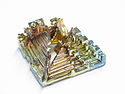
lustrous pink
 Standard atomic weight
208.98040
(1) g·mol−1
Electron configuration
[
Xe] 4f14 5d10 6s² 6p³
Electrons per
shell
2, 8, 18, 32, 18, 5
Physical properties
Phase
solid
Density (near
r.t.)
9.78 g·cm−3
Liquid
density at
m.p.
10.05 g·cm−3
Melting point
544.7
K
(271.5 °
C, 520.7 °
F)
Boiling point
1837
K
(1564 °
C, 2847 °
F)
Heat of fusion
11.30
kJ·mol−1
Heat of vaporization
151
kJ·mol−1
Heat capacity
(25 °C) 25.52 J·mol−1·K−1
Vapor pressure
P(Pa)
1
10
100
1 k
10 k
100 k
at
T(K)
941
1041
1165
1325
1538
1835
Atomic properties
Crystal structure
rhombohedral
Oxidation states
3, 5
(mildly
acidic oxide)
Electronegativity
2.02 (Pauling scale)
Ionization energies
(
more)
1st: 703
kJ·mol−1
2nd: 1610 kJ·mol−1
3rd: 2466 kJ·mol−1
Atomic radius
160
pm
Atomic radius (calc.)
143 pm
Covalent radius
146 pm
Miscellaneous
Magnetic ordering
diamagnetic
Electrical resistivity
(20 °C) 1.29 µ Ω·m
Thermal conductivity
(300 K) 7.97 W·m−1·K−1
Thermal expansion
(25 °C) 13.4 µm·m−1·K−1
Speed of sound (thin rod)
(20 °C) 1790
m/s
Young's modulus
32 GPa
Shear modulus
12 GPa
Bulk modulus
31 GPa
Poisson ratio
0.33
Mohs hardness
2.25
Brinell hardness
94.2 MPa
CAS registry number
7440-69-9
Selected isotopes
Main article:
Isotopes of bismuth
iso
NA
half-life
DM
DE (
MeV)
DP
207Bi
syn
31.55
y
ε,
β+
2.399
207
Pb
208Bi
syn
368,000
y
ε,
β+
2.880
208
Pb
209Bi
100%
(19 ± 2) ×1018
y
α
205
Tl
210 mBi
syn
3.04 ×10⁶y
IT
0.271
210Bi[/b]
References
Bismuth (
pronounced /ˈbɪzməth/) is a
chemical element that has the symbol
Bi and
atomic number 83. This heavy, brittle, white crystalline trivalent
poor metal has a pink tinge and chemically resembles
arsenic and
antimony. Of all the metals, it is the most naturally
diamagnetic, and only
mercury has a lower
thermal conductivity.
Bismuth compounds are used in
cosmetics and in medical procedures. As the toxicity of
lead has become more apparent in recent years, alloy uses for bismuth metal as a replacement for lead have become an increasing part of bismuth's commercial importance.
Contents[
hide][/align][ul]
1 Notable characteristics
2 Isotopes
3 History
4 Occurrence and production
5 Crystals
6 Applications
7 Compounds
8 Precautions
9 See also
10 References
11 External links [/ul]
//
[
edit] Notable characteristics
Bismuth is a brittle
metal with a
pinkish hue, often occurring in its native form with an
iridescent oxide tarnish showing many
refractive colors from yellow to blue. When
combusted with
oxygen, bismuth burns with a
blue flame and
its oxide forms
yellow fumes. Its
toxicity is much lower than that of its neighbors in the
periodic table such as
lead,
thallium, and
antimony.
No other
metal is more naturally
diamagnetic (as opposed to
superdiamagnetic) than bismuth, and it has a high
electrical resistance. Of any metal, it has the second lowest
thermal conductivity (after
mercury) and the highest
Hall coefficient. When deposited in sufficiently thin layers on a substrate, bismuth is a
semiconductor, rather than a
poor metal.
[1]
Elemental bismuth is one of very few substances of which the
liquid phase is
denser than its
solid phase (
water being the best-known example). Because bismuth expands on
freezing, it was long an important component of low-melting
typesetting alloys, which needed to expand to fill printing molds.
[
edit] Isotopes
Main article: Isotopes of bismuth[/align]
While bismuth was traditionally regarded as the element with the heaviest stable
isotope,
bismuth-209, it had long been suspected to be unstable on theoretical grounds. This was finally demonstrated in 2003 when researchers at the
Institut d'Astrophysique Spatiale in
Orsay,
France, measured the
alpha emission half-life of
209Bi to be
1.9 x 10¹⁹ years,
[2] over a
billion times longer than the current estimated
age of the universe. Owing to its extraordinarily long half-life, for nearly all applications bismuth can be treated as if it is stable and non-radioactive. The radioactivity is of academic interest, however, because bismuth is one of few elements whose radioactivity was suspected, and indeed theoretically predicted, before being detected in the laboratory.
[
edit] History
Bismuth (
New Latin bisemutum from
German Wismuth, perhaps from
weiße Masse, "white mass") was confused in early times with
tin and
lead because of its resemblance to those elements.
Basilius Valentinus described some of its uses in 1450.
Claude François Geoffroy showed in 1753 that this metal is distinct from lead.
Artificial bismuth was commonly used in place of the actual mineral. It was made by hammering tin into thin plates, and cementing them by a mixture of white tartar,
saltpeter, and
arsenic, stratified in a crucible over an open fire.
[3]
Bismuth was also known to the
Incas and used (along with the usual copper and tin) in a special
bronze alloy for knives.
[4]
[
edit] Occurrence and production
In the Earth's crust, bismuth is about twice as abundant as gold. It is not usually economical to mine it as a primary product. Rather, it is usually produced as a byproduct of the processing of other metal ores, especially lead, but also
tungsten or other metal alloys.
The most important
ores of bismuth are
bismuthinite and
bismite. In 2005, China was the top producer of bismuth with at least 40% of the world share followed by Mexico and Peru, reports the
British Geological Survey.
According to the
USGS, world 2006 bismuth mine production was 5,700 tonnes, of which China produced 3,000 tonnes, Mexico 1,180 tonnes, Peru 950 tonnes, and the balance Canada, Kazakhstan and other nations. World 2006 bismuth refinery production was 12,000 tonnes, of which China produced 8,500 tonnes, Mexico 1,180 tonnes, Belgium 800 tonnes, Peru 600 tonnes, Japan 510 tonnes, and the balance Canada and other nations.
The difference between world bismuth mine production and refinery production reflects bismuth's status as a byproduct metal. Bismuth travels in crude
lead bullion (which can contain up to 10% bismuth) through several stages of refining, until it is removed by the
Kroll-Betterton process or the
Betts process. The Kroll-Betterton process uses a pyrometallurgical separation from molten lead of calcium-magnesium-bismuth drosses containing associated metals (silver, gold, zinc, some lead, copper, tellurium, and arsenic), which are removed by various fluxes and treatments to give high-purity bismuth metal (over 99% Bi). The Betts process takes cast anodes of lead bullion and electrolyzes them in a lead fluosilicate-hydrofluosilicic acid electrolyte to yield a pure lead cathode and an anode slime containing bismuth. Bismuth will behave similarly with another of its major metals, copper. Thus world bismuth production from refineries is a more complete and reliable statistic.
According to the Bismuth Advocate News (BAN), the price (NY Dealer) for bismuth metal from year-end 2000 to September 2005 was stuck in a range from lows of $2.70-$3.10 per lb. in late November 2002 and $2.60-$2.90 per lb. in December 2003 to highs of $3.85-$4.15 per lb. at year-end 2000 and $3.65-$4.00 per lb. in mid June 2004. BAN shows the range pressing to $4.20-$4.60 per lb. in September 2005 and then $4.50-$4.75 per pound in mid September 2006, before bursting upwards steeply to $6.00-$6.50 per lb in mid November 2006, $7.30-$7.80 in late December 2006, $9.25-$9.75 per lb in early March 2007, $10.50-$11.00 per lb in late March 2007, $13.00-$14.50 per lb. in mid April 2007, to an all-time high of $18.00-$19.00 per lb in mid June 2007, and then backed off to $13.50-$15.00 per lb in mid November 2007. This unprecedented event reflects an extreme scarcity of bismuth, perhaps temporary.
[/align]Bismuth output in 2005[/align][/align][/align]
[
edit] Crystals
Though virtually unseen in nature, high-purity bismuth can form distinctive
hopper crystals. These colorful laboratory creations are typically sold to collectors. Bismuth is relatively nontoxic and has a low melting point just above 273 °C, so crystals may be grown using a household stove, although the resulting crystals will tend to be lower quality than lab-grown crystals.
[
edit] Applications
Bismuth oxychloride is sometimes used in
cosmetics. Bismuth subnitrate and
bismuth subcarbonate are used in medicine.
Bismuth subsalicylate (the
active ingredient in
Pepto-Bismol) is used as an
antidiarrheal and to treat some other gastro-intestinal diseases. Also, the product
Bibrocathol is an organic molecule containing Bismuth and is used to treat eye infections.
Bismuth subgallate (the
active ingredient in Devrom) is used as an internal deodorant to treat malodor from
flatulence (or
gas) and
feces.
Some other current uses:
[ul][*]Many bismuth
alloys have low
melting points and are widely used for fire detection and suppression system safety devices.[*]Bismuth is used as an alloying agent in production of malleable irons.[*]A carrier for
U-235 or U-233 fuel in
nuclear reactors[*]Bismuth has also been used in
solders. The fact that bismuth and many of its
alloys expand slightly when they solidify make them ideal for this purpose.[*]Bismuth subnitrate is a component of
glazes that produces an
iridescent luster finish.[*]
Bismuth telluride is an excellent
thermoelectric material; it is widely used.[*]A replacement propellant for
xenon in
Hall effect thrusters[*]In 1997 an antibody conjugate with Bi-213, which has a 45 minute half-life, and decays with the emission of an alpha-particle, was used to treat patients with leukemia.[*]In 2001, Professor Barry Allen and Dr. Graeme Melville at St. George Hospital in Sydney successfully produced Bi-213 in linac experiments which involved bombarding radium with bremsstrahlung photons. This cancer research team used Bi-213 in its Targeted Alpha Therapy (TAT) program. [/ul]
In the early 1990s, research began to evaluate bismuth as a nontoxic replacement for lead in various applications:
[ul][*]As noted above, bismuth has been used in solders; its low toxicity will be especially important for solders to be used in food processing equipment and copper water pipes.[*]A pigment in artists' oil paint[*]Ingredient in free-machining
brasses for
plumbing applications[*]Ingredient in free-cutting steels for precision machining properties[*]A catalyst for making acrylic fibres[*]In low-melting alloys used in fire detection and extinguishing systems[*]Ingredient in
lubricating greases[*]Dense material for
fishing sinkers[*]In crackling microstars (
dragon's eggs) in
pyrotechnics, as the
oxide,
subcarbonate, or subnitrate[*]Replacement for lead in
shot and
bullets. The
UK,
U.S., and many other countries now prohibit the use of lead shot for the hunting of wetland birds, as many birds are prone to
lead poisoning due to mistaken ingestion of lead (instead of small stones and grit) to aid digestion. Bismuth-tin alloy shot is one alternative that provides similar ballistic performance to lead. (Another less expensive but also more poorly performing alternative is "steel" shot, which is actually soft iron.)[*]Bismuth core bullets are also starting to appear for use in indoor shooting ranges, where fine particles of lead from bullets impacting the backstop can be a chronic toxic inhalant problem. Owing to bismuth's crystalline nature, the bismuth bullets shatter into a non-toxic powder on impact, making recovery and recycling easy.[
citation needed] The lack of
malleability does, however, make bismuth unsuitable for use in expanding hunting bullets.[*]
Fabrique Nationale de Herstal uses bismuth in the projectiles for its
FN 303 less-lethal riot gun. [/ul]
According to the
USGS, U.S. bismuth consumption in 2006 totaled 2,050 tonnes, of which chemicals (including pharmaceuticals, pigments, and cosmetics) were 510 tonnes, bismuth alloys 591 tonnes, metallurgical additives 923 tonnes, and the balance other uses.
[
edit] Compounds
[/align]
Please help improve this article or section by expanding it.
Further information might be found on the talk page or at requests for expansion. (December 2007)
See also: Category:Bismuth compounds
[
edit] Precautions
[/align]
Please help improve this article or section by expanding it.
Further information might be found on the talk page or at requests for expansion. (January 2008)
Bismuth is not known to be toxic, compared to its periodic table neighbours (
lead,
antimony, and
polonium), although some compounds (including
bismuth chloride) are toxic and should be handled with care.
[
edit] See also
[ul][*]
Bismuth minerals [/ul]
[
edit] References
^ Semimetal-to-semiconductor transition in bismuth thin films, C. A. Hoffman, J. R. Meyer, and F. J. Bartoli, A. Di Venere, X. J. Yi, C. L. Hou, H. C. Wang, J. B. Ketterson, and G. K. Wong, Phys. Rev. B
48, 11431 (1993)
doi:
10.1103/PhysRevB.48.11431
^ Marcillac, Pierre de; Noël Coron, Gérard Dambier, Jacques Leblanc, and Jean-Pierre Moalic (April 2003). "Experimental detection of α-particles from the radioactive decay of natural bismuth".
Nature 422: 876–878.
doi:
10.1038/nature01541.
^ This article incorporates content from the 1728 Cyclopaedia, a publication in the public domain. [1]
^ http://adsabs.harvard.edu/abs/1984Sci...223..585G [/ol][/align][ul][*]Taylor, Harold A. Jr., "Bismuth", Financial Times Executive Commodity Reports (London: Mining Journal Books Ltd.) 2000
ISBN 1-84083 326 2 [/ul]
[
edit] External links
[/align]Wikimedia Commons has media related to:
Bismuth[/align][/align][/align]
[/align][/align]Look up
bismuth in
Wiktionary, the free dictionary.[/align][/align][ul][*]
WebElements.com - Bismuth[*]
USGS 2006 Minerals Yearbook: Bismuth[*]
Bismuth Advocate News (BAN)[*]
Bismuth Statistics and Information - United States Geological Survey minerals information for bismuth[*]
Laboratory growth of large crystals of Bismuth by Jan Kihle Crystal Pulling Laboratories, Norway[*]
Bismuth breaks half-life record for alpha decay[*]
Los Alamos National Laboratory - Bismuth [/ul]
Retrieved from "
http://en.wikipedia.org/wiki/Bismuth"[/align]
Categories:
All articles with unsourced statements |
Articles with unsourced statements since June 2007 |
Articles to be expanded since December 2007 |
All articles to be expanded |
Articles to be expanded since January 2008 |
Bismuth |
Chemical elements |
Alchemical substances
[/align][/align][/align][/align]
Views
[ul]
Article
Discussion
Edit this page
History [/ul][/align][/align]
Personal tools
[ul]
Log in / create account [/ul][/align][/align][/align] if (window.isMSIE55) fixalpha();
Navigation
[ul]
Main Page
Contents
Featured content
Current events
Random article [/ul][/align][/align]
Interaction
[ul]
About Wikipedia
Community portal
Recent changes
Contact Wikipedia
Donate to Wikipedia
Help [/ul][/align][/align]
Search
[/align][/align][/align]
Toolbox
[ul]
What links here
Related changes
Upload file
Special pages
Printable version
Permanent link
Cite this page [/ul][/align][/align]
Languages
[ul]
العربية
Azərbaycan
বাংলা
Беларуская
Bosanski
Български
CatalÃ*
Česky
Corsu
Dansk
Deutsch
Eesti
Ελληνικά
Español
Esperanto
فارسی
Français
Furlan
Gaeilge
Galego
한êµ*어
Հայերեն
Hrvatski
Ido
Bahasa Indonesia
Íslenska
Italiano
עברית
Kiswahili
Kreyòl ayisyen
Kurdî / كوردی
Latina
Latviešu
Lëtzebuergesch
Lietuvių
Lojban
Magyar
मराà¤*ी
Nederlands
日本語
Norsk (bokmål)
Norsk (nynorsk)
Occitan
Polski
Português
Română
Runa Simi
Ð*усский
Sicilianu
Simple English
Slovenčina
Slovenščina
Српски / Srpski
Srpskohrvatski / Српскохрватски
Suomi
Svenska
ไทย
Tiếng Việt
Türkçe
Українська
اردو
ä¸*文 [/ul][/align][/align][/align][/align]
[/align][/align]
This page was last modified 23:40, 1 February 2008.
All text is available under the terms of the
GNU Free Documentation License. (See
Copyrights for details.)
Wikipedia® is a registered trademark of the
Wikimedia Foundation, Inc., a U.S. registered
501(c)(3) tax-deductible nonprofit charity.
Privacy policy
About Wikipedia
Disclaimers [/ul][/align]if (window.runOnloadHook) runOnloadHook();