ORIGINAL: rdy2hnt
ORIGINAL: IAhuntr
ORIGINAL: rdy2hnt
The arrow was most definitely ABOVE the spine as Rob stated. As far as the "hollow spot" "no man's land" stuff goes, it's a myth. I am not trying to start that great debate all over, but I can assure you after field dressing/butchering well over 100 deer and having two close friends who are wildlife biologists, if you place an arrow/bullet in the chest cavity of a deer, behind the shoulder, it is a dead deer.........period. It is possible to hit above the spine and cause nothing more than a flesh wound barring infection. If it is below the spine and good left/right the lungs are taken out resulting in a quick, clean kill.
Careful about using the words "always", "never", or "period". There are exceptions to every rule. I'm sure some of you already saw my bow buck thread, but in case you didn't, here's a pic of the shot placement onmy buck. My two-blade Gator shot bottom, My brother-in-laws pass thru G-5 shot from ten days prior above:
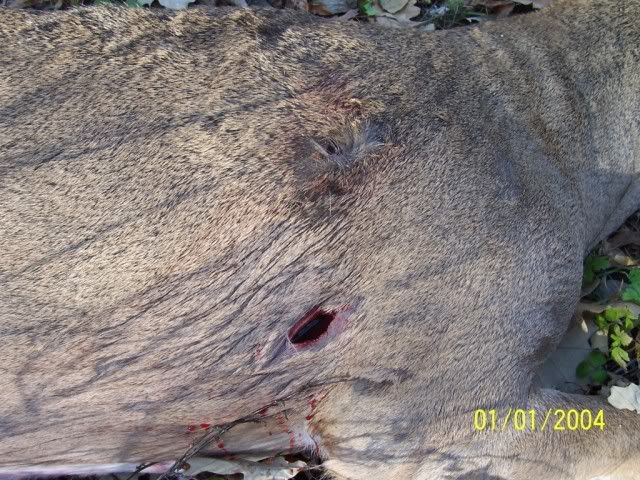
Hisentry hole on the other side was a bit higher, but it positively passed below the spine, just through the top of the chest cavity, and appeared to missed both lungs.The holes in the top of the chect cavity were quite evident upon dressing.No hemorage was identified at the top of either lung. Theprevious arrow andblood trail was consistant with a flesh wound.
The lungs are somewhat free-floating in the cavity, and it is possible for the lungs partially deflatedduring aheavy exhaleto move a bit within the cavity leaving a gap up top. Won't happen very often, but it certainly did in this case, and this deer was remarkably well healed for such a recent wound.
Ley me clarify, I believe a deer can survive on one lung, it has been proven, and I've seen it first hand. Having said that, I believe that the entrance wound in the above pic was most likely above the spine, missing the closest lung, resulting in a one lung hit. I will not be careful with my wording. If the entrance had been as low as the exit, the deer would have never been around for someone else to shoot.
Once again, if a projectile enters below the spine and passes through the rib cage, the result is a dead deer. There is no "area" below the spine, above the lungs, that can result in a "superficial wound". As others have said, I don't think alot of people understand how low the spine lies and that the lungs take up the entire rib cage when the deer is alive. The lungs are not the size that they are when you are holding them in your hand after field dressing as they are when the deer is on it's feet.
Well, in this case you are incorrect. The arrow passed below the spine, throught the top 2" of the chest cavity, and missed the lungs. I have no need to try to make you believe something you are not willing to, just presenting the facts. FWIW, for a living I am a practicing Pathology Assistant, so I'm quite familiar with vitals and lung function, human or animal, both in the body and out.My brother-in-law who first arrowed the deer is a County Conservation Directorfor the state of Iowa and is also more than adequately experienced in biology pertaining to deer. We both spent ample time examining the carcass during and after field dressing to confirm the findings as stated above. Yes, you are correct that in normal circumstances the lungs extend to the top of the chest cavity, but due to his posture and force exerted when ducking the arrow, he did infact survive what "normally" would be a lethal hit through the chest cavity. If you check closer on the diagram provided by Rob above, you will see the lungs gradually taperdownward from the spine/top of cavity as you progress forward on the animal near the junction of the shoulder and spine. Check the picture of my deer, and you will see this is precisely the spot in which the arrow passed. In any case, I am just thankful he did survive, andI was lucky enough to have another shot at a fine mature Iowa buck.