Beginners GuideTo Whitetail Deer
 Picture provided by IL-Cornfed.
PHYSICAL DESCRIPTION
A popular game species, the whitetail is so well known that it needs only a brief description. Antlers normally occur only in males and are formed and shed each year. Growth of the antler starts in April or May when the base of the antler, located on the skull, begins to enlarge. During the growth period, the soft skin and short hair which cover each antler have a plushlike quality, giving this stage the name of "velvet." Full antler size is reached in August or September, shortly before the breeding, or rutting, season. The velvet then begins to dry and peel. The buck rubs his antlers against trees and shrubs, which helps remove the skin. When all the skin has been shed, the bony core hardens and with continued rubbing is polished. The antlers are carried in this condition throughout the rut.
Sometime toward the end of the breeding season, usually from the last of December to mid-February, resorption of bone around the base causes the antlers to become loose and they are shed. After falling to the ground, they are gnawed and eventually consumed by rodents and rabbits for their minerals and protein.
Both the size of the antler and number of points depend upon many factors such as the deer's age, the quality and quantity of food, injury, and the genetics of the deer. It is not possible to tell the age of a buck by the size of the antlers or the number of points. In their first fall, fawn bucks have "buttons" that can be felt under the skin or observed as slight swellings, or they may actually have small unbranched, or spiked, antlers that have broken through the skin. In yearling bucks, antlers are always visible externally.
While some may have only the unbranched main beam at this age, most have more than one point. During the succeeding years of the buck's life, the antlers become more massive. In general, the number of points increases to a total of six to 10, but frequently a few more occur. Following the period of life when sexual activity is greatest, the size of the antlers generally dwindles with each year's renewal until an old deer may have only spikes. Abnormally shaped antlers occur occasionally and sometimes represent injury during growth. An upset in the hormone system is one factor which is probably responsible for unusual cases of antlerless bucks or for females having antlers.
In some cases, antlerless bucks are the result of hereditary factors. Hunters count all of the points, including the snag on both beams, in arriving at the total number of points on a trophy set of antlers.
In summer, both sexes are reddish brown to tan above (often called the "red" coat); the color pattern of the winter coat is similar to the summer one but is grayish to grayish brown (often called the "blue" coat). Fawns are reddish, brown or reddish yellow spotted with white. They gradually lose their spots and acquire uniform coloration between 3 and 5 months of age.
During the breeding season, the necks of males swell to approximately twice their nonbreeding size, reaching a maximum in mid-November. The factors causing this enlargement are not fully understood.
Deer are in the prime of life between 2 1/2 and 7 1/2 years of age. Some may live for about 15 years in the wild and up to 25 years in captivity.
The tarsal glands, marked by a tuft of long, coarse hair on the inside of each hind leg at the ankle, or hock, produce an oily secretion with a pronounced ammoniacal smell. Another set of glands, the metatarsals, occurs on the outside of each hind leg between the ankle and hoof.
They give off an oily substance with a pungent, musky odor which scents and possibly serves to identify the resting spots of the deer. Pedal glands, lying between the two main toes on each foot, secrete a strong and offensive odor throughout the year. This secretion is conducted to the hoofs by long hairs and doubtless scents the tracks of the animal. Small preorbital glands lie just in front of each eye. They probably scent twigs and branches where the deer feeds.
REPRODUCTION
Bucks are capable of mating successfully from September through February and possibly later, but the peak of the mating or rutting season is in November. Pregnancy lasts 6 1/2-7 months; the young are born most often in late May or early June. A doe usually has twins, but sometimes has a single offspring or triplets.
At birth, each fawn weighs between four and seven pounds (1.8 and 3.1 kg). Its eyes are open and it can stand feebly. The fawns begin to follow the doe when about 3 to 4 weeks old and start to eat their first solid foods. Weaning may begin about this time although some fawns nurse until they are 6 months old. The young continue to accompany the female until they are old enough to breed. About one-half of the young females in Missouri become sexually mature at 6 to 8 months of age and consequently breed in the year of their birth. Other females and young males breed first at 1 1/2 years of age.
DIET
Deer are browsing animals, feeding chiefly on the leaves, twigs and fruits of trees and shrubs, and the foliage of herbaceous plants. They also take seeds, fungi, mosses, lichens, succulent grasses, farm crops and sometimes small amounts of animal food like snails and fish.
Whitetails show a definite selection of plants and seemingly take first those that are most nutritious and palatable. This selectivity can have serious effects. In ranges having concentrations of deer, overbrowsing occurs. The results are a lower level of nutrition of the herd and elimination of these desirable foods from the range.
Deer require water in some form daily. They frequent any mineral licks in the vicinity, especially in spring going into the summer.
DEFENSES/ENEMIES
Whitetail deer have excellent eyesight, have good hearing due to their large years and also rely upon the sense of smell in detecting danger. Stationary objects are easily overlooked by them, but they readily detect any that are in motion. Their hearing is also very good due to the large ears that they can rotate in any direction. The whitetail deer can run up to 35 mph (56 kph) for short distances.
Whitetail deer have several distinct strategies for avoiding predators. They specializes in detecting danger by means of large ears, acute snese of smell and excellent vision.
Males can quickly detect and visually track another animal as far as 600 meters. Once danger is detected, they may choose to hide, or move into cover and cautiously outmaneuver the predator. Another strategy whitetails use is they may bound off and then trot away, stopping frequently to gain information on the disturbance. This initial bounding, combined with release of metatarsal scent that inhibits feeding, is highly advantageous in that, by alarming others, it causes other whitetail deer to bound off as well, reducing the conspicuousness of the deer who bounded off first.
This strategy would also trigger group formation. Finally, when a predator closes in, whitetail deer initiate evasive maneuvers based on sudden unpredictable changes in direction and on placing obstacles between itself and the predator. This strategy, however, does not work against group-hunting predators.
Whitetail deer are excellent swimmers but hardly ever use this means of escape. Whitetail deer bucks will use their antlers as protection from predators. Whitetail deer will also protect themselves by rearing up and slashing out with their front hooves.
The fawn's survival strategy is based on its protective coloration, its ability to remain motionless as danger approaches, and its small amount of scent which makes finding it difficult for predators. Major predators on whitetail deer are mountain lions, which are deer eating machines, coyotes, golden eagles, feral dogs, bears and bobcats.
HABITAT
Habitat and home. Deer live primarily in timbered areas, selecting the borders or edges more than dense, uniform stands. One of the main reasons for this habitat preference is that the variety of foods deer like grows best along the margins of timbered areas or in clearings in the timber. Another reason, especially true in the more agricultural sections of the country, is that the deer can utilize the forage offered by agricultural crops adjacent to timbered lands and still have the sanctuary and other attractions of the timber itself. They have no permanent structure for a home.
White tail deer cover requirements fall into two major categories: hiding cover (also known as escape or security cover) and thermal cover. Hiding cover, defined as any vegetation capable of hiding 90 percent of a deer from human view as distance equal to or less than 200 feet, provides security needed by an animal throughout the year. Scattered patches of relatively dense vegetation (woodlots or brushy draws) from 10-30 acres in size or riparian bottom lands are adequate for hiding deer, provided these areas are not more than .25-.50 mile apart.
Thermal cover, which helps an animal maintain body temperatures within tolerable limits to conserve energy for body maintenance and reproduction, must be available to protect deer from cold/hot temperatures, high winds, weather storms, and insects. Thick vegetation, such as dense stands of trees, wetland marshes, and riparian areas decrease body heat loss in whitetail deer by providing protection from winter winds, thus reducing radiant heat loss.
DAILY LIFE
White-tailed deer tend to have an average annual home range from 1/2-1 1/2 square miles (.8-2.4 square km) but can be as small as a couple hundred acres. Some individuals, particularly bucks during the rut, may cover a larger area. Local movements of deer are related primarily to the seasonal changes in food sources or cover. When acorns are not abundant in their summer area, some deer may shift to localities where they are available in fall and winter.
Deer usually spend the day in concealing cover and rarely move about, but toward evening come out to feed and drink. On bright moon-light nights they may feed all night, but on dark nights they are more active in the evening and again early in the morning. During winter when food is scarce, they may feed longer hours and even during the day. In stormy, windy weather they are restless; they browse more than usual and often change their bed spot several times a day.
The location of the bed spot depends largely upon the weather. On sunny, warm days, some shady place is selected; on cloudy, windy or cool days, a sunny spot or one protected from the wind is picked out.
Bucks commonly fight each other during the rut. Only rarely, however, do their antlers become entangled permanently. When this happens, the bucks are unable to feed properly and die of weakness and starvation.
MOVEMENT
Dear often have winter and summer ranges that differ in location and size. Usually, secure cover, food sources,reliable water supply, and hunting pressure are all important factors in establishing a home range and how big or small home ranges will be. Habitat changes may influence seasonal movements of deer by altering the availability of food and cover.
In spring and summer, the home range is usually small because does must care for their newborns and bucks are rapidlygrowing very (fragile) antlers. It increases in the fall when breeding activities demand greater movement and food becomes less abundant.In winter, ranges become smaller since the deer restrict movements to conserve energy. During this time, deer usually live off the fat reserve they built up in the fall and rely on reduced winter food supplies. In addition to these seasonal movement changes, deer movement can be altered more permanently by converting agricultural land natural habitats. This provides secure cover where none existed previously. The reverse also is true: converting natural habitats to agricultural or residential uses reduces the availability of secure cover and alters deer movements.
DISEASES
Ticks, lice, and nasal bots are parasites commonly found on and in whitetaildeer. Most deer commonly harbor light infestations of ticks and nasal blots, but not at levels high enough to present a health problem to the deer. Likewise, internal parasites, especially stomach worms, are common but are not at sufficient levels to cause clinical symptoms. However, the concentration of individuals at feeding sites increases the potential for disease transmission. Because disease-causing organisms can be transmitted through the soil, supplemental feed should not be placed on the ground. Some type of trough should be used and, ideally, the feeding site should be relocated every year or two. Evidence of exposure to bluetongue and epizootic hemorrhagic disease (EHD) has been documented in whitetiai deer. The most common disease agent among deer appears to be warts.
Today the major news headlines is about Chronic Wasting Disease, often referred to as CWD. CWD is a disease unique to North America. On our continent, it has been found in wild deer and or elk in Colorado, Wyoming, Nebraska, South Dakota, Wisconsin and Saskatchewan. In captive deer and or elk, it has been found in Colorado, Montana, South Dakota, Oklahoma, Kansas, Nebraska, New Mexico, Saskatchewan and Alberta.. CWD appears to be a prion disease that attacks the central nervous system and causes fatal damage to the brain of white-tailed deer, mule deer and Rocky Mountain elk. CWD is similar to, but significantly different from, scrapie (documented in domestic sheep for over 400 years), Bovine Spongiform Encephalopathy (BSE and often referred to as mad cow disease) and variant Creutzfeldt-Jakob disease found in humans. All of these diseases attack the central nervous system and cause small holes to form in the brains of infected animals.
There is currently no scientific evidence that CWD has or can spread to humans, either through contact with infected animals or by eating the meat of infected animals. The Center for Disease Control has conducted an exhaustive study of CWD and human risk and has stated: “The risk of infection with the CWD agent among hunters is extremely small, if it exists at all”. However, as we are still learning about this disease, state wildlife agencies recommend that hunters take precautions to limit risks. First and foremost, do not harvest any animal that appears sick or is acting strange. Note the animal’s location and contact the state personnel. Avoid cutting or puncturing the spinal cords or brains of animals taken in the areas where CWD occurs.
Do not use house-hold utensils to field dress or process your deer. Wear rubber or latex gloves when handling any harvested animal. You should also make sure about your states current regulations regarding the importation of deer or elk meat from outside your state. Some states are also considering testing all or some of the animals taken during the hunt season for CWD.
In the later stages of infection, deer and elk infected with CWD will show signs of progressive weight loss, listlessness, excessive salivation and urination, increased water intake, depression and, eventually, death. Animals can be infected with CWD for months or years before outward signs of infection are evident.
Whitetail Aging
[align=left]Age — The Determining Factor[/align][align=left][/align][align=left]
Age structure is arguably the most important factor in a quality deer herd. The presence of mature deer helps ensure normal social behavior within the herd. Mature bucks and does maintain a dominance hierarchy, whereby the “fittest” bucks do the majority of breeding and the older does command the best habitats, providing increased recruitment and higher fawn survival. In many areas across the country, more than 80 percent of the bucks harvested annually are yearlings (1½ years old). In other words, if a deer with antlers (of any size) walks out, it is shot. How can you expect to see mature bucks on your property when they are shot at 1½ years old? As one writer put it, “There is no such thing as a big spike, and a dead one won’t grow!”
Bucks achieve maximum skeletal growth at 2½ years old, but do not reach their peak weight until 4½ or 5½. Further, maximum antler length and weight are not reached until bucks are 5½ to 6½ years old. A common response by hunters regarding QDM is: “If I let a small buck walk by, someone else will shoot it.” That may be true, especially if the property is relatively small (<2000 acres),broken-up, or linear in shape. The attitudes and practices of hunters on adjoining properties definitely affect deer management on small areas. Although small properties are not large enough to contain home ranges of several bucks, a successful deer management program is possible.
[/align][align=left]Whitetail Deer Scouting
DO YOUR HOMEWORK FIRST
You can start your scouting right at home by obtaining maps, aerial photos and info from biologists and other hunters who have been in the area you are planning to hunt. USFS maps may be obtained by visiting or calling one of the USFS offices. The maps are generally about $4.00 or $7.00 for waterproof maps. U.S. Geological Survey (USGS) topographic maps can usually be obtained from drafting/engineering stores or backpacking stores or ordered online here USGS Topo maps.
If you would like info on aerial photos, computer topo map programs and how to download free topo maps off the Internet I have this on my webpage here: aerial photos or topo maps. Also you can check Topozone and Terraserver for online topo maps and aerial photos. Start networking with people who work in your target area. Hikers are another source of good info. A piece of info can come from anyone and it's another piece of the puzzle to finding the muley you want to hunt.
SCOUTING TRIP
Plan to make at least one visit to your hunting area to prescout and become familiar with the terrain and logistics like hiking time, where to camp, where to glass from etc. This is also the time to hike in, set up and glass for deer. The more time you spend in the deer's backyard the better the odds of you having a successful hunt. Find the saddles and escape routes. If hunting on public ground, knowing where the other hunters will approach from can tell you where to set up to intercept the escaping deer. Determine where and what the deer are feeding on. Knowing where the deer water, especially in drought conditions can pay off. Burn some boot leather and explore as much of the country as you can. Drag that no good brother-in-law along to help in scouring the hillsides.
GLASSING
A lot of whitetail country is open farm land, glassing is the best way to cover lots of ground and not spook the deer. To glass all day you need to stay as comfortable as possible. If you are going to use a spotting scope, get the best waterproof glass you can afford. Swarovski, Leupold, Nikon and Kowa all make good spotters. The better glass will provide less eye strain, which can ruin a hunt. Some guides and hunters use 10 x 42 or bigger binos to search hillsides and then the spotter for a closer peek. Get yourself a nice chair and put your binos or spotter on a good tripod, you'll have a better time looking for deer.
Bogan Manfrotto makes great tripods and monopods. 'Grippit' makes a strap and mount to mount your binos on a tripod for more stability. Don't skimp when buying your binos either. Swarovski, Leica, Leupold, Nikon and Zeiss all make quality waterproof binos. Crooked Horn Outfitters makes a good bino chest harness to keep your binos close to you chest when you peek over ridges or crawl on a stalk. Keep your optics dust and smudge free with a LensPen. You can also drop by the local camera shop to get some camera lens cleaning spray and cloth for your binos and spotter, your eyes will love you for this.
Whitetail are creatures of the edges.
You can glass the edges of burns, crop fields, clear cuts and meadows to find feeding deer. Keeping track of wildfire burns is a good way to find where the deer are eating the new browse. Even if the burn is recent and the hillside looks like a burnt moon landscape, a good rain shower will have the new green spouts popping out all over. The best time to glass is the first hour and last hour of daylight. Be in place on a high vantage point before daylight to have the best chance to spot a nice buck.
SIGN
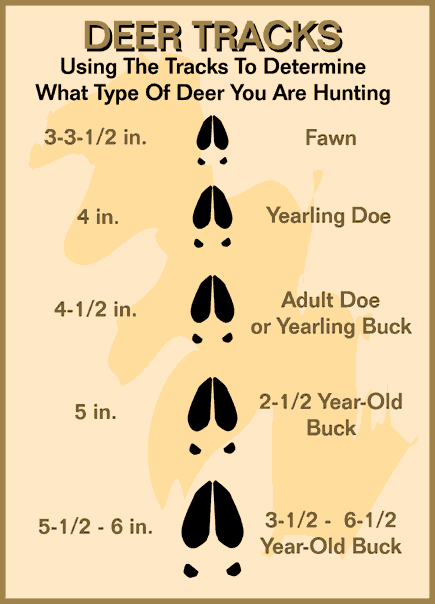
TRACKS -To see how much activity is in the area you want to hunt look for tracks and scat. Big tracks mean big bucks.
While doe and bucks intermingle sometimes, especially during the rut, you'll most likely find the biggest bucks in remote hiding spots. To find these secret hideouts, look for a secluded location that provides a buck with food, water and cover and start looking for tracks or glassing to see if Mr. Big is a resident.

 SCAT - Whitetail deer scat or turds are sure signs there are deer around and inding high concentrations of scat is a good indication the deer hang around the area. Fresh deer scat will be a light brownish green and very moist with a sheen on it almost, and soft. Older scat will be dark, almost black and very hard. Sometimes it wll be in looses piles and other times it will be clumped up in bigger blobs.
 The size of the scat pellets is anywhere from 1/4" to 3/4" in length. Bigger deer leave bigger scat and bigger piles. There is no way I know of to tell a large does scat from bucks scat.

[/align]
Typical Deer Scat:

[align=left]
SCRAPES - There are several different types of scrapes. A community scrape is usually larger and more defined since many deer use it. During the rut, bucks will stop to lick a low over hanging branch and may make a one time scape under it. I've seen bucks tend scrapes during the day and had other scrapes where I never saw the buck, but could tell he was visitng the scrape at night from using a game camera.
 RUBS - Rubs are make by bucks usually right before the rut. Whitetail bucks really like little saplings and cedar trees but will make a rub on just about anything. I've seen one buck rub up a telephone pole.

Scouting with Topo Maps[/align]
Topographic maps are created from aerial photographs and reveal the contours of the land, including hills, ridges, and valleys, as well as lakes, rivers, creeks, trails, and roads.
[ul][*]Contour lines show the elevation of the ground. [*]Contour intervals reveal how much vertical distance there is between each contour line—closely spaced contour lines indicate very steep slopes. [*]Contour lines that are sharply tapered indicate an uphill direction. [/ul][align=left]You can scout with topo maps by identifying areas or locations that need to be checked for sign. These areas include natural funnels or choke points, bedding and feeding areas, saddles, benches and water holes.
Funnels – A funnel is a narrow strip of cover, usually timber that connects two larger tracts of cover. The topo map on the right shows 2 good funnels. The deer are reluctant to drop down the steep muddy sides of the river and don't want to cross the open crop field.
If the wind is from the south or southeast, I set up at point #1 to keep my wind off the funnel trails. If the wind is from the north or northwest, I move to point # 2 and let my scent blow into the crop field. These funnels are about 50 yards wide and there are 3 distinct trails the deer use. 1 trail follows the river, 1 follows the edge of the field and the 3rd trail goes right smack down the middle.
 Saddles - Basically a salddle is a low spot in a ridgeline. Also they are a natural travel funnels and escape routes for deerbetween two high points of ground. The topo map on the right also shows where a mulie buck was bedded.A saddle can just be a dip in the elevation between two ridges or mountain peaks, they don't have to be a drastic change in elevation.
Older mature bucks will often have a young 3 point buck hanging around with them as a sentry. If you see a 3 point, look hard for the bigger buck nearby. When alerted to danger, the younger buck will usually be the first to stand up to check out the disturbance, leaving the older buck to wait for the signal to scram. Whitetails like to have a view when they bed and will bed on steep slopes.
[/b]
Inside and Double Inside Corners [/b]–a farm field or pasture can sometimes from an L in timber it adjoins. This L shaped inside corner is easy to find on a map. Deer will stay in the woods and cut around these corners when traveling from one end of the woods to the other.
Saddles - Basically a salddle is a low spot in a ridgeline. Also they are a natural travel funnels and escape routes for deerbetween two high points of ground. The topo map on the right also shows where a mulie buck was bedded.A saddle can just be a dip in the elevation between two ridges or mountain peaks, they don't have to be a drastic change in elevation.
Older mature bucks will often have a young 3 point buck hanging around with them as a sentry. If you see a 3 point, look hard for the bigger buck nearby. When alerted to danger, the younger buck will usually be the first to stand up to check out the disturbance, leaving the older buck to wait for the signal to scram. Whitetails like to have a view when they bed and will bed on steep slopes.
[/b]
Inside and Double Inside Corners [/b]–a farm field or pasture can sometimes from an L in timber it adjoins. This L shaped inside corner is easy to find on a map. Deer will stay in the woods and cut around these corners when traveling from one end of the woods to the other.
 [/b]
Points[/b] –are found at the ends of ridges where they drop down to valleys or farm fields below. Deer in the hills often use these points as bedding areas.
Benches – In hilly regions, flat areas of various widths are sometimes found on the sides of hills. Whitetails like to hang out around benches
[/b]
Points[/b] –are found at the ends of ridges where they drop down to valleys or farm fields below. Deer in the hills often use these points as bedding areas.
Benches – In hilly regions, flat areas of various widths are sometimes found on the sides of hills. Whitetails like to hang out around benches
 Types of Whitetail Deer Hunting
Stand Hunting- Stand hunting is the most effective method of deer hunting and accounts for the majority of harvested deer. Stand hunting is a relatively simple way to hunt. The hunter stays in one spot and watches for deer movement. And since he's not moving, the hunter usually can usually spot a deer before it sees him.
Deer Drives- A drive is a good technique for hunting mature bucks, especially once deer have been pressured and have retreated into dense cover. With most methods a hunter tries hard to hide from deer, but a drive functions just the opposite way. A group of drivers enter a thick area thought to harbor deer. They break all the rules of stealthy hunting. They go in with the wind at their backs, which sends their scent toward the deer. The drivers walk fast, talk and sometimes yell to make sure the whitetails know they are coming.
Types of Whitetail Deer Hunting
Stand Hunting- Stand hunting is the most effective method of deer hunting and accounts for the majority of harvested deer. Stand hunting is a relatively simple way to hunt. The hunter stays in one spot and watches for deer movement. And since he's not moving, the hunter usually can usually spot a deer before it sees him.
Deer Drives- A drive is a good technique for hunting mature bucks, especially once deer have been pressured and have retreated into dense cover. With most methods a hunter tries hard to hide from deer, but a drive functions just the opposite way. A group of drivers enter a thick area thought to harbor deer. They break all the rules of stealthy hunting. They go in with the wind at their backs, which sends their scent toward the deer. The drivers walk fast, talk and sometimes yell to make sure the whitetails know they are coming.
Of course the plan is for deer, traumatized by the sudden, noisy intrusion into their domain, to get up and flee in the opposite direction. But unknown to deer that do so, other hunters, called standers, have quietly circled around and taken stands at the far end of the drive area. The wind is in their faces, and they have selected posts with good visibility. Sometimes fleeing bucks are so preoccupied with the racket behind them that they trot past a hunter on stand, offering a shot.
Still Hunting[/b]-[/b] The term "still-hunting" is actually a misnomer because the hunter does not remain still in a fixed position. Still hunting, stalking, and glassing are various methods of moving slowly through woods and pastures or along trails, hillsides, and mountain slopes. In still hunting, you move slowly and deliberately until you spot game—before it spots you. Still hunting requires exact attention to details such as wind, sunlight, weather conditions, cover, and noise. Generally, the hunter will take a few slow, deliberate steps and then stand or squat motionless for several minutes while scanning all surrounding areas for game.[/align][align=left][/align][align=left]
In stalking, the game has been spotted and the hunter slowly and deliberately maneuvers into shooting range and position for an effective shot. [/align][align=left][/align][align=left]
Glassing is sitting for a long time at vantage points and spotting game from afar with binoculars or spotting scopes. All of these methods require patience and are usually most effective from the downwind side. [/align][/b][align=left]
Spot and Stalk- [/b]Essentially, the stalking hunter moves through the woods slowly, stopping often to glass for deer; then moving slowly forward again and stopping to glass for deer.
[/b]
Whitetail Deer Tracking and Recovery
When you take your shot with your bow or rifle, mark the spot where you shot from and where the animal was. This will help in finding any blood or hair sign to start your tracking. Studying deer hides can help you identify any hair that may have been cut by the bullet or broadhead to pinpoint the area on the deer where your bullet hit.
Bright pink frothy blood - means a lung hit and the deer shouldn't go far.
Bright red blood - indicates a muscle hit which can be a minor wound. Also look for bone fragments which can tell you if you hit a leg bone or muscle.
Stinky green or brown paunch material - means a gut shot and you should let this animal bed down and stiffen up. 4 to 6 hous in cold, 8 hours in warm weather.
Some tips on tracking wounded game:
1 and only 1 guy on the blood trail, preferably your best tracker. Keep the shooter nearby and ready in case the animal bolts from a bed, it may be your only chance to finish the job.
Use a camping lantern like a Coleman with a light reflector, they make blod really stand out at night.
Mark your trail so you can look behind yourself and get an idea of the travel route of your animal. You can use orange marker tape but PLEASE go back and remove all of that fluorescent tape when you are done. Hronk uses TP which just disappears in the first rain but if working in say snow, use the orange tape.
Sit down and take a break and have a snack or just relax. You need to calm down some and not push the animal by taking off after him immediatly. If someone is with you, have him do the tracking as he is probably calmer and less likely to be in a hurry as you are..
Animals dump their bowels when they get weak so look for scat. They also will start circling like a dog when they lay down to die.
Animals that aren't hit real bad will double back a lot to shake you off their trail.
While tracking watch for the animal's double back trail so you don't miss it or wipe it out. Bears love to do this along with deer.
Learn how to grid search. When all seems lost, look in creek bottoms and ravines. I've found many animals that dropped into them and just couldn't get out and they died there.
Keep an eye out for buzzards and crows, many times they will give up a kill.
Use a dog if legal, they are way mroe efficient at tracking. Deer Search has tracking dogs available if you don't have access in many states.
Have some hydrogen peroxide in squirt bottles handy when you get down to small blood drops or specks, it makes the blood bubble on contact. Put some bright green food coloring in you hydrogen peroxide to make the bubbles show up better.
Starlight Bloodhound, used in squirt bottles like hydrogen peroxide, is spendy but shows up faint blood trail really well, even in water.
Learn how to track by reading tracking books and practicing, it's great fun for the kids too. Learn how to tell where you hit the animal by the hair the broadhead or bullet cut when it was first hit. You can do this by keeping the hair and matching it up too a hide. The impact site can tell you a whole bunch, like if you should wait (gut shot), or if you have a fatally hit animal. If you're an archer, try to find your arrow, it will tell you exactly where you hit your game at.
Forget the IR heat seeking units like the Game Finder, they don't work worth a hoot. The only ones I've seen that worked are the military ones and they are several thousand dollars each.
Where to shoot Whitetail Deer [/align]
[align=left]
 Bullets
[/b]
Bullets harvest game by massive shock and tissue destruction. Bullets have a tremendous amount of energy, and if fired from firearms adequate for deer hunting, can smash even heavy bone and enter the vital organs.
Arrows
Arrows harvest game with razor sharp broadheads that are designed to cut tissue. Arrows cut arteries and veins resulting in massive hemorrhaging. In addition to severe bleeding, arrows passing through both lungs cause the lungs to collapse, causing rapid death due to suffocation. Arrows can cut through softer bones like ribs, but rarely penetrate heavy bones found in the shoulder, hips, head and neck. Both razor sharp broadheads and careful shot placement are crucial to game harvest.
Broadside shot
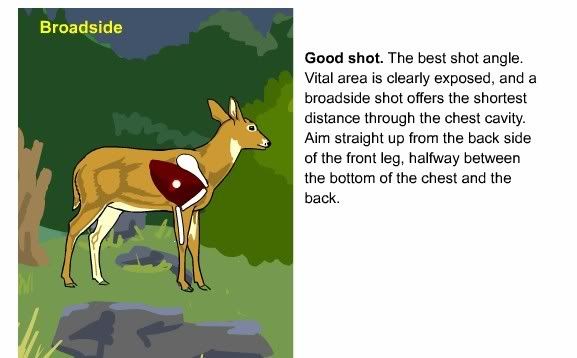
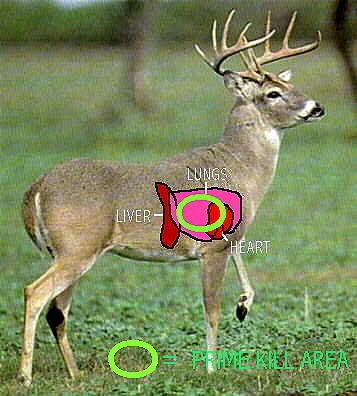
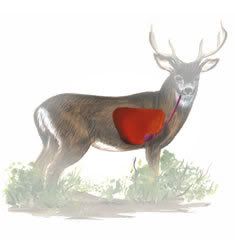
Bullet: A broadside Deer offers several excellent shots for the firearm hunter. The best target is the chest area. Find the best aiming point on a deer by picking a spot one third to halfway up the side of the animal and just behind the front shoulder. A bullet enter the lungs or heart will provide a good blood trail and a quick harvest. A head or neck shot will drop an animal instantly with little or no meat damage, but should only be used if you are proficient enough with your firearm.
Arrow: A broadside deer represents the best bow shot because it requires the least amount of penetration to reach the vital organs. The best target is the chest area.The broadside shot is also the best angle for accomplishing a double lung hit, resulting in the collapse of both lungs. Find the best aiming point on a deer by picking a spot one third to halfway up the side of the animal and just behind the front shoulder. This will put an arrow in the center of the vital area by enabling you to pick a spot rather than shooting at the whole animal. An arrow will penetrate the ribs, but be careful to avoid the shoulder bone. Wait until the near leg is forward and concentrate on a spot behind the shoulder. Avoid head and neck shots when bow hunting. Wait for the chest shot behind the front shoulder.
Quartering away shot
Bullet: The quartering away angle is a fine shot for the firearm hunter. Aim behind the front shoulder for an effective hit. The bullet will pass through both lungs and possibly the heart and into the far shoulder.
Arrow: The quartering away angle is a fine shot for the bow hunter. Aim at the chest area just behind the front shoulder. The arrow should pass through both lungs.
Quartering toward shot
Bullet: The quartering toward angle is fine for the firearm hunter. Aim at the head, neck or center of the chest for an effective hit. Be aware of where your bullet will end up. If you shoot a deer in or behind the near front shoulder the bullet will likely pass through the stomach and intestines (gut shot) and into the hind quarters. Always avoid the "gut shot", because the contents of the stomach and intestines will taint the taste of the meat.
Arrow: This is one of the poorest bow shots and should be avoided. Heavy shoulder bones shield the majority of the vital organs from penetration by arrow. Wait for the animal to pass by and take a broadside or quartering away shot.
Head on shot
Bullet: This is a fair shot for a skilled marksman. The head and neck are your only clean shots. The center of the chest should be avoided, because it would result in the "gut shot" (described above).
Arrow: This is a very poor shot for the bow hunter. The vital area is the chest between the shoulders, which is an extremely small target. Wait for a better shot.
Rear end shot
Bullet: The rear end shot is a poor shot for the firearm hunter. A shot to the body at this angle will probably ruin the best cuts of meat and will result in a "gut shot" (described above). A head or neck shot is possible if the animal has its head up. Wait for a better shot.
Arrow: This is a shot all responsible bow hunters will pass up. The hindquarters have very heavy muscle tissue and heavy bone structure which makes it very difficult for an arrow to get up front to the vital organs.
Elevated stand shot
Elevated stands and tree stands, are used by both firearm hunters and bow hunters. This elevated shot angle makes little difference to a firearm hunter, simply aim higher on the deer to compensate for the downward trajectory of the bullet. Lets say this slash ( \ ) is your bullet trajectory and the parenthesis is the deer, visualize how the bullet would enter the top of the deer and exit through the bottom.
The elevated shot angle results in a smaller portion of the vital area being exposed to a bow hunter. The vital organs are more protected by the back bone and shoulder blade. To avoid the shoulder blade when shooting from an elevated stand, aim farther behind the shoulder. Shooting from elevated stands makes it more difficult to achieve a double lung hit.
Trail Cameras
The idea of patterning whitetails has been around a long time, but the average hunter still does not understand what the word really means. It can be defined as finding out what the deer in your hunting territory are doing and what they are likely to do in various situations in the future. Patterning is not about determining what a specific buck is going to doing at a precise moment in time; that is generally impractical to attempt. Yet you can learn a great deal, not only about what deer are doing in your area but also what a specific buck generally does. And the camera is ideal for that job.
The price of these cameras continues to drop, as companies move to China for manufacturing; some units now cost less than $100 U.S., making them affordable for almost everyone. As the price has fallen, we have seen folks who traditionally had only one camera purchase more of them. This makes patterning deer easier; however, even if you have only one, you can learn a great deal.
Using cameras should be a year-round recreational activity. You can position them strategically around your property: along trails, at feeders or food plots, at rubs and scrapes, and at random within various habitat types. Over the course of a year, you will learn when specific bucks begin growing their antlers, when they strip velvet, when they cast antlers and even the other deer they like to run around with.[/align][align=left][/align][align=left]
On the topic of buying: [/align][align=left][/align][align=left]
With plenty of trail cameras to choose from, I would consider the five big factors when buying a new trail camera: image quality, trigger speed, user-friendliness, cost, and durability.[/b]
[/b]
Other Options To Consider: battery life[/b], built-in flash range, sensing range (some cameras have a sensor that is more wide and others have a sensor that is more narrow but will sense objects farther out), movie capability, night vision, auxiliary battery pack?, rechargeable batteries?, megapixel upgrade, memory card capacity, mono-pod holder, Laser and IR aim for quick and precise camera set-up, time lapse mode, multi-shot pictures, upgradeable software, barometric pressure, temperature, moon phase, time, date, and onboard viewing of images.
First and foremost, where is the camera going to be used? Is it going to be over a feeder, food plots, mineral sites, or scrapes? Or is it going to be over trails, bottle necks, junction points, rub lines, transition areas, etc? The difference is, you don’t have to a fast trigger speed if you have deer coming in and stopping, if you are going to use the camera for the trail action then fast trigger time is very important (though I believe it can be gotten around if you setup the camera properly)
How much do you care for the sharpness of the pictures? Trail cameras now run from 1.3 megapixels to 6 megapixels. You need to look at different pictures from different cameras and see where you draw the line in the quality of picture you want. (Look at night time and daytime photos)
How good are you with using electronic devices because you will find some trail cameras are easier to operate than others (in setting up and shutting down). Some cameras show you how many pictures they have taken on the front display while others you have to open up to see how many pictures have been taken (just another example of user friendless).
[/b]
On durability, you want your camera to last more than a season or two so you want the case to be strong to take the beatings of Mother Nature as well as you want the parts to function properly and be reliable for a long time.
[/b]
I don’t know if you are putting out your camera where it gets real cold in the winter but powering your trail camera can be an issue. Batteries can be costly, but longevity is important when outside temperatures rise and fall dramatically. Although expensive, good batteries are necessary to ensure that your camera works all the time (if you go the rechargeable D battery route get at least a 2500 mah rating). In the summer this is not a big deal. At warmer temperatures, cameras can run for a couple months without much concern. When temperatures drop below freezing, that's when you've got to keep a close eye on your power source. Extreme cold winter temperatures can wreak havoc on battery life. Your will find out long battery life is a very important thing to have (even if you do have your camera close by).
Some people go homebrew (there are ups and downs to homebrew), some people like the high end cameras like camtrakker or buckeye cam, and some just want the cheapest ones they can find. Saying that, it all comes down to preference (and what your goals and objectives for the camera are), some people will sway you to this camera while another will say this camera, it’s up to you to decide.
Go to www.chasingame.com to check out pictures and reviews of different cameras.
For me (value and quality) I would definitely check out the new 07’ Moultrie Line.
[/align][align=left][/align][font="times new roman"][size=5][align=left]
Defintion of Antlers: [/align][align=left]
Whitetail antlers are an amazing example of nature’s wonderful and beautiful handiwork. They range from tiny sharp spikes to amazing typical and non-typical racks. Antlers develop into every size and shape. But antler size, growth and irregularities are often misunderstood by many deer hunters. A great deal of misinformation has been passed down for ages. One major mistake is commonly made by hunters who don’t know that antlers are not horns, and horns are not antlers.
Antlers are made of dead bone, and are yearly growths that begin growing from two pedicels on the buck’s head in late winter and early spring. Antlers reach full growth in late summer usually October. Antlers are normally branched (except for spikes), and maturity, good nutrition, lack of stress and good genes determine antler size and formation.
As a rule, only male deer grow antlers. But one female (doe) in several thousand whitetail does will grow antlers because of a hormone imbalance. Horns, rather than antlers, are living bone that is covered with hard layers of skin. They are typically unbranched and permanently established on the animal’s head. Wild sheep, for example, continue to grow horns throughout their lives. Horns also are found on bison, cows and goats in North America. [/align][align=left][/align][align=left]
Growth:[/align][align=left]
Deer Antler growth usually begins during the month of March or April, by August or early September, antlers are fully-grown. In most cases the typical deer antlers begins growth out of the head in a backward motion, then quickly changes direction and sweeps forward. [/align][align=left]
Deer antlers are among the fastest growing tissues known to man.
Growing as much as a ½ inch per day during peak development. The development process can vary greatly depending upon the genes and nutrition of each deer. Growing antlers are covered with a living tissue called velvet. During development, the deer’s antlers are very delicate and extremely sensitive to the touch. This is also the time when most antler damage or breakage occurs. [/align]
[align=left]
Velvet is shed or rubbed off by the buck as he rubs saplings with his antlers. Older bucks will shed their velvet before younger bucks. A buck’s first set of antlers begins to grow when it’s about 10 months old. Spikes are more common in yearling deer than older ones because antler growth starts at a time when the young buck’s body is still growing rapidly. Antler development is tied in closely with the animal’s nutritional status. Older bucks might also carry spikes if they come from an area with poor food conditions.[/align][align=left]
A number of factors combine to determine the size, shape, and color of antlers of white-tailed deer. The following is a description of the most important factors and how each influences antler characteristics.
[/align][align=left][/align][align=left]
Factors that Determine Antler Size (listed in order of importance):
Age - age is the primary factor that determines exactly how big antlers will grow. Antler mass and length increases with age until bucks reach 6 to 7 years of age. In bucks 7 years old and older, antlers mass often increases, while overall length of the main beam and tines declining with each consecutive set of antlers.
[color=#000000]
[size=3]The first set of antlers typically are grown at 1.5 years of age. However, in Mississippi up to 20-30
percent of buck fawns may develop hardened antlers (usually only hardened buttons) at about 8 months of age. This phenomenon is not usually seen by hunters because it happens after the hunting season.
In these cases, nutrition is adequate enough and birth dates are early enough to allow fawns to reach the critical body mass needed to initiate antler growth. Antler size increases annually, in sometimes dramatic fashion, until maximum antler development is reached at about 5-7 years of age. Based on averages of 23 bucks measured through 7 years of age in a Mississippi State University (MSU) study, 1 year old bucks grew the equivalent of about 26 percent of their ultimate maximum gross Boone and Crockett score.
The percentage increased each year, to about 63 percent at 2 years, 77 percent at 3 years, and 92 percent at 4 years of age. Using antler weight as a measure of antler size tells a similar story, although with different values. Antler weights were 10 percent at 1 year, 44 percent at 2 years, 71 percent at 3 years, and 80 percent at 4 years of age.
These particular animals developed maximum antler size at 5 years of age, but