Swamp-
The industry standard for measuring spine is 880grams hung from exactly a 28" span.
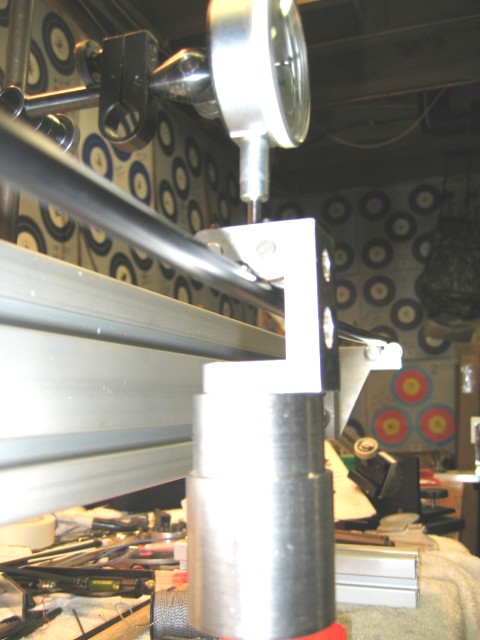
My spine tester is one I made myself. I posted this when I first built it couple of years ago:
JeffB had asked me a while ago if I ever got around to making a spine testing jig that I had mentioned I was
going to build, and if I had any pics. We all know how busy we get and things get put on the back burner. For a year (or more).

But I finally got around to making what I think is a damn nice spine tester, and extremely accurate as well. I'm sure it can't compare to the ultra precise laser type spine testers that Easton uses, but for a jig with a dial indicator I haven't seen any better.
Couple of things to think about when making a spine tester. I had seen several home-made versions similar to this one:
http://www.jamesmhill.com/Spine_Tester.html
Have a look at the pics in the link and note the way the dial indicator is mounted BELOW the weight. That is a key factor in this design. After looking at several designs like this I thought it would be easy enough to make with some scrap aluminum I had laying around at work. I got to thinking about the standard weight of 880grams and how I was going to get to that amount for the weight.
I had a 1" travel dial indicator that I could use and I started tinkering with that and then the light bulb went on. When you press the plunger of the indicator and get near the 1" of travel, what brings it back to its starting point? A SPRING inside! That spring has a force, and in the designs where the indicator is below the weight- it is OPPOSING your downward weight. And the spring force isn't linear. The force increases as you stretch that internal "return spring". So I wanted to know how much force I was dealing with. It surprised me when I got near the 1" of travel it was approaching 100grams!
So in the designs where the dial indicator is mounted below the weight, you have a variance of your final downward weight depending on the deflection you're measuring. That 880gram weight could be off by more than 12% (880 down, 100 up) if the deflection is around an inch (at least with my indicator)- I would assume that others indicators are similar in construction. I suppose it would be ok for arrow-to-arrow comparisons, but if you're trying to actually
measure the spine deflection amount it could be outta whack by quite bit I would imagine. The weaker the spine of the arrow your trying to meausure, the more the return spring is stretched as the deflection amount is greater and the more it would "help" the spine and it would seem stiffer than it really was. [:@]
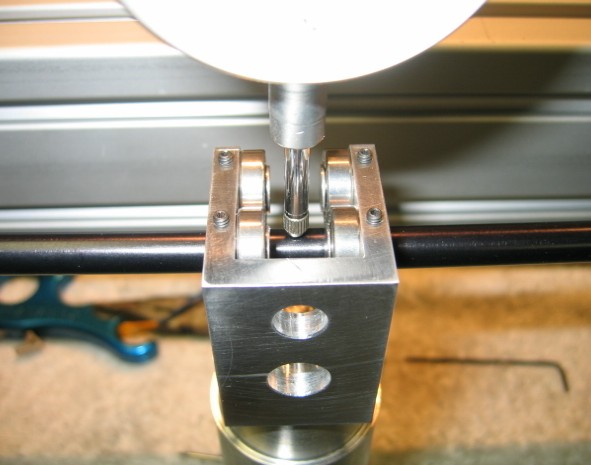
Wow, that was surprising to me. So what to do? If you remove the back cover of the dial indicator, you can simply unhook the return spring. So I need to mount it above the shaft. There is enough "dead weight" in the plunger that the indicator works just fine without the spring if mounted above the shaft. The dead weight of the plunger just rides on top of the shaft ADDING to our hanging weight. So I simply measure the dead weight of the plunger on a accurate scale and it came out to just about 29.0 grams. Cool- now I knew my final hanging weight should be 851.0 grams to equal the correct 880 for the industry standard.
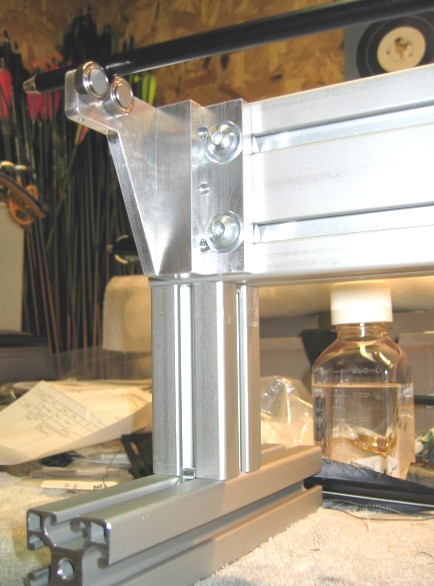
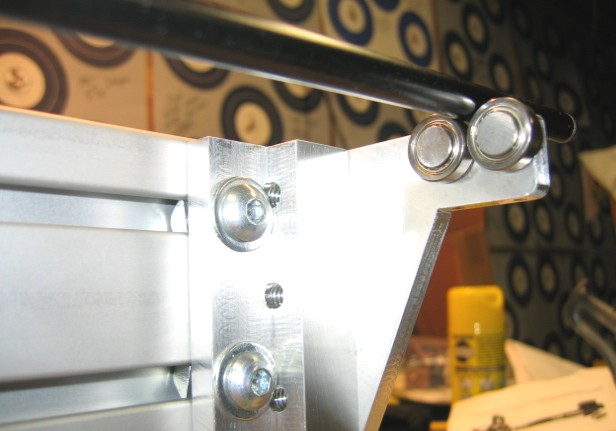
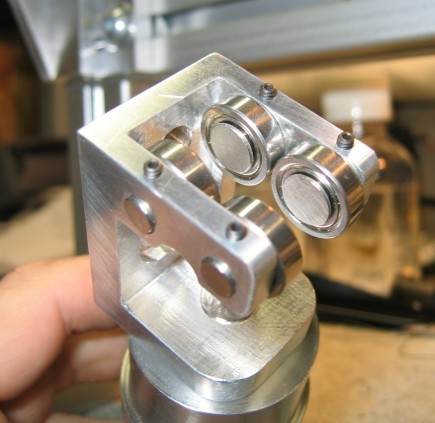
I have seen some weight "hooks" that hang on the shaft. I didn't want a hook that could possibly scratch into an expensive carbon arrow shaft, so I made a symmetrical hanging device that uses bearings on each side of the indicator. That way I know my indicator is measuring the lowest part of the deflection. If the hanging apparatus was off to one side of the indicator plunger (like only using two bearings) I could not be sure of getting the indicator in the correct spot for the full deflection amount. Thousandths of an inch make a difference. Having bearings also allows very accurate rotation of the shaft while the weight is haning in place. Fairly easy to find "spine runout" or a stiff side of a shaft this way.
The outside supports also use a couple of ball bearings. Currently at 28" span at the inside edges of the bearings, but I'll mill some more holes in one inch increments for spans of 26", 24", etc.... I have some 27.5" arrows with fletching on them, and while I couldn't measure the industry standard 28" span on them anymore, I could at least do arrow-to-arrow comparisons at 24".

I would estimate that I'm withing .010" of the span as I had a couple of thousandths of play in the bolt holes on each end bracket. Close enough for me!
Now I can exactly see how consistent my arrows are from advertised spine and from arrow to arrow. Thanks for prodding me along Jeff!