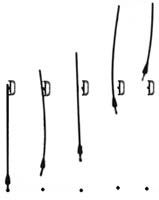
Bob, does that mean that the feathers do a pretty good job of folding away? Does that mean that a arrow with more grains per inch will fly better because of the minor disturbance to the feathers? If so what weight per inch is a good starting point? Or an I just being a duffus and who cares about feather contact?
Looking at the right set of drawings it looks like the shaft makes good contact with the bow (I'm guessing from the string rolling off the fingers), is that correct? This stuff is pretty interesting!
Yes, the feathers have to fold away if you are shooting off the riser. If you get a chance go to Foxfire Archery, Arrows by Kelly and read about their theoy of using four fletch arrows 60/120 and fletch contact. If you are using an elevated rest, you can get away using vanes. I'd imagine using a heavier arrow would be a little more stableconcerning fletching contact, however having the proper spined arrows will be the more important. If the arrow contacts the riser, you will have problems. I don't really think of grains per inch, rather I use total arrow weight. In general, I like to use at least 10 grains per pound. This would equate to a minimum 600 grain arrow for a 60 pound draw. The right set of drawings shows archers paradox. It is suppose to be an overhead representation of the arrow and the riser as the arrow is released. Below is another representation that may be helpful. It shows how a properly spined arrow reacts as it clears the riser.