
|
help...recovering/tracking deer
ok what do you guys do or use or whatever to retrieve deer you have shot with a rifle and a bow...do you use a blood detector...where do you look...what signs to look for...when to look
|
Number one tool is common sense. There are many recovery scenarios depending upon how the deer was shot, time of day, bullet vs. arrow, etc. Don't rush in and mess things up. Get yourself calmed down and engage your brain. There is a good recovery thread on the bowhunting forum.
|
I tried one of those blood lights and it didn't work IMHO. I use a good light and a roll of tissue paper, dropping a piece on the trail as I find something. Lots of times you can look back and figure where you missed the trail and will be able to pick it up a little further up.
|
First you need to mark the location of the deer well so that you are looking in the right spot. You're excited, so it's easy to misjudge where you saw the deer last.
Look for blood sign. Not necessarily on the ground. The blood will smeer off on tall grass and weeds, etc. Which side of the deer was the exit wound? It'll usually bleed more from that side. Stay off of the deer's trail while you are tracking, so if you lose the sign you can come back to the last known location. Mark the blood sign with bits of toilet paper. As you look back at the marked trail, you'll get a good idea of his route and which way he'll likely be going. If you're following good steady blood sign, and then.. nothing, you've lost the trail. Go back to the last known sign and try a different direction. Best of all, get your buddies to help. More eyes makes looking and finding easier. Also, keep this in mind: A deer well hit with a bow, (heart/lungs/liver) will only live for about 5-10 seconds. However far it runs in that time, is the distance you'll have to track it. Be patient, take your time. If you come across evidence that it's gut-shot. Stop immediately and come back in about 6 hours or overnight, The deer will be pretty close to where you kicked it up last. |
Take in all evidence, blood ,how much ? what color,pink .bright red. dark?
hair. length and color will help with where shot. act accordingly look for scuffs in leaves or dirt, broken twigs leaves or plants. check for spider webs that are broken or intact so you know which wat it didn't go go slow and mark the trail with paper |
If the blood is sparse go slow. Get on your hands and knees. Look for specks on the ground and on any weeds and grass. Don't get ahead of yourself. If you lose the trail always go to the last spot and start again. Deer don't always go the way you think they should. I've had tracking jobs that were nothing but very small specks and it takes a long time to do it right. Also always track your deer even if you see it fall. The more experience you get the better you will get at it.
|
what if i can find no blood
|
Originally Posted by syrupman
(Post 3673178)
what if i can find no blood
|
Best tool for tracking deer is TIME, you never want to push a deer. I dont use anything special to track deer. I can see blood pretty easy and I have always relied on my sight and common sense of how deer act when the are wounded. But if you have the chance and it is legal in your state, dogs can be a very affective tool.
|
Even when hit, sometimes, the sign won't show up for a few yards down the trail. The blood has to start leeking out. I guarantee, that, if you hit it, it's bleeding somewhere. If you hit it and you're not finding blood, you're looking in the wrong spot. You just have to find it. A good hit in the vitals will always preoduce lots of bleeding. If you aren't confident of a good hit, don't shoot.
|
Wingbone, sometimes if a deer is hit high, say a high liver shot, you will not find much if any blood, especially if there isn't a pass thru with either a bullet or arrow. They will bleed internally for a long time before they bleed outside. Main thing is don't give up on one if you are confident that the animal was hit. I agree that a dog is a big help.
|
If you can't find blood or lose the blood trail, get a couple of friends and do a grid search. I think that most fatally hit deer die within 200yds of the shot - check out to at least 400yds for added insurance.
A trained dog will beat all the lights, sprays, grid searches, and whatever else you have hands down. Dogs are useful even if it has rained (up to 0.5") or snowed on the trail. I just started using Ruby last season. ... Go to the UBT website(http://www.unitedbloodtrackers.org/) to find volunteer trackers. If dog trailing is not legal in your state, join UBT and start writing letters... -fsh 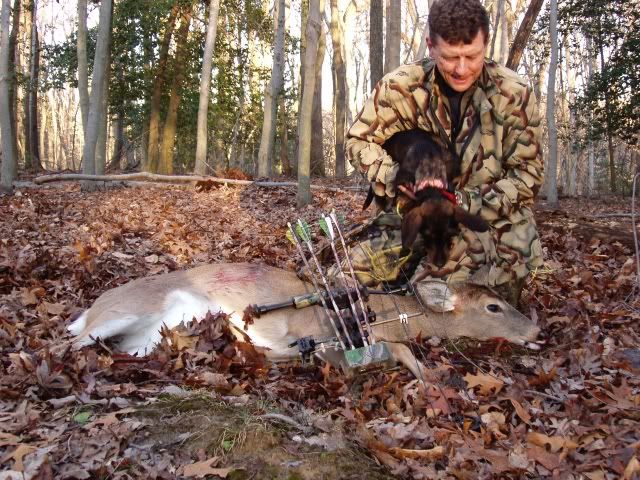 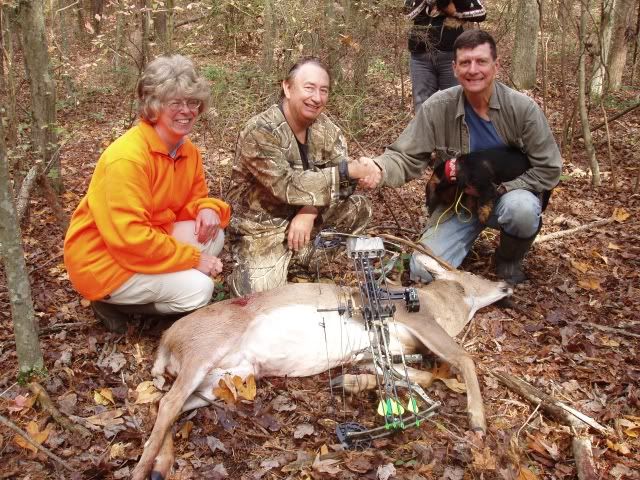 |
When I first started hunting someone recommended Finding Wounded Deer by John Trout Jr. I bought it and it is an excellent tracking tool. It has a section in the back that describes the hit based on the evidence (color of blood, hair, etc...) and what you should do (pick up the trail immediately, wait X amount of time, etc...). It stays in my backpack during hunting season.
|
There is alot of things you can look for when tracking a wounded deer or a deer that was shot with a well placed. Look for hair laying where the deer was hit. Look for blood ect as well. Keep in mind a well placed shot and a deer will run a long ways at times before falling over. Tracking in the rain proves to be a much harder job to do. But can be done if you look for other signs than just a blood trail. Look for hair on bushes where your deer went through. Look for toes to be spread wide a part. This is the way a badly wounded deer will travel in order to maintain balance when walking or running. Also as others have stated mark the spot where you last saw sign from your deer. Then gradually make circles going completely around the area you last marked.Expanding the circled with each complete pass until you either find more sign or your downed deer. Most importantly do not just give up because it showed only a little bit of blood. Sometimes it takes a while to see any blood at all.
Good luck with tracking it.. |
Most of it has already been mentioned and like someone already said I personally found out a long time ago one of the best tracking tool I had was giving the animal plenty of time to lay down after the shot. When I finally quit pushing wounded animals my recovery % went way up. It is OK when you know you smoked them to go after them as soon as a 1/2 hr but if there is any doubt in the location of the shot 4 hrs is as soon as I will go after them and if I know it was a bad shot I give them more time. One little trick I do for tracking a minimum blood trail is take some type of tissue and drop a piece at each location blood is found. Many times when I cannot find any more blood I can look back at the blood trail and see that I have gotten off the actual line that the blood trail is taking and can adjust back over in line with the existing blood trail and many times find more blood immediately. I have to go back and retrieve all of the tissue after the tracking is done but it is worth it. If you cannot find anymore blood then your woodsmanship has to take over. Be aware of everything. We once found a buck of mine that I hit poorly because the buck had ran into a chest high weed field that had multiple deer paths cutting through it (everyone knows these can be hard tracking without a lot of blood). Every deer path going through the field had spiderwebs with dew on them across the paths so they were shining in the morning sun. One of my buddies noticed that one of the paths had a freshly broken spider web on it so we took that one and found my buck. Be alert to your surroundings when tracking. If you bump the deer your tracking pull out immediately and give it "at least" 6 hours to lay back down
|
| All times are GMT -8. The time now is 07:26 AM. |
Copyright © 2026 MH Sub I, LLC dba Internet Brands. All rights reserved. Use of this site indicates your consent to the Terms of Use.