
|
JeffB, this spine's for you!
JeffB had asked me a while ago if I ever got around to making a spine testing jig that I had mentioned I was going to build, and if I had any pics. We all know how busy we get and things get put on the back burner. For a year (or more). :eek:
But I finally got around to making what I think is a damn nice spine tester, and extremely accurate as well. I'm sure it can't compare to the ultra precise laser type spine testers that Easton uses, but for a jig with a dial indicator I haven't seen any better. Couple of things to think about when making a spine tester. I had seen several home-made versions similar to this one: http://www.jamesmhill.com/Spine_Tester.html Have a look at the pics and note the way the dial indicator is mounted BELOW the weight. That is a key factor in this design. After looking at several designs like this I thought it would be easy enough to make with some scrap aluminum I had laying around at work. I got to thinking about the standard weight of 880grams and how I was going to get to that amount for the weight. I had a 1" travel dial indicator that I could use and I started tinkering with that and then the light bulb went on. When you press the plunger of the indicator and get near the 1" of travel, what brings it back to its starting point? A SPRING inside! That spring has a force, and in the designs where the indicator is below the weight- it is OPPOSING your downward weight. And the spring force isn't linear. The force increases as you stretch that internal "return spring". So I wanted to know how much force I was dealing with. It surprised me when I got near the 1" of travel it was approaching 100grams! So in the designs where the dial indicator is mounted below the weight, you have a variance of your final downward weight depending on the deflection you're measuring. That 880gram weight could be off by more than 12% (880 down, 100 up) if the deflection is around an inch (at least with my indicator)- I would assume that others indicators are similar in construction. I suppose it would be ok for arrow-to-arrow comparisons, but if you're trying to actually measure the spine deflection amount it could be outta whack by quite bit I would imagine. The weaker the spine of the arrow your trying to meausure, the more the return spring is stretched as the deflection amount is greater and the more it would "help" the spine and it would seem stiffer than it really was. [:@] Wow, that was surprising to me. So what to do? If you remove the back cover of the dial indicator, you can simply unhook the return spring. So I need to mount it above the shaft. There is enough "dead weight" in the plunger that the indicator works just fine without the spring if mounted above the shaft. The dead weight of the plunger just rides on top of the shaft ADDING to our hanging weight. So I simply measure the dead weight of the plunger on a accurate scale and it came out to just about 29.0 grams. Cool- now I knew my final hanging weight should be 851.0 grams to equal the correct 880 for the industry standard. I have seen some weight "hooks" that hang on the shaft. I didn't want a hook that could possibly scratch into an expensive carbon arrow shaft, so I made a symmetrical hanging device that uses bearings on each side of the indicator. That way I know my indicator is measuring the lowest part of the deflection. If the hanging apparatus was off to one side of the indicator plunger (like only using two bearings) I could not be sure of getting the indicator in the correct spot for the full deflection amount. Thousandths of an inch make a difference. The outside supports also use a couple of ball bearings. Currently at 28" span at the inside edges of the bearings, but I'll mill some more holes in one inch increments for spans of 26", 24", etc.... I have some 27.5" arrows with fletching on them, and while I couldn't measure the industry standard 28" span on them anymore, I could at least do arrow-to-arrow comparisons at 24". :) I would estimate that I'm withing .010" of the span as I had a couple of thousandths of play in the bolt holes on each end bracket. Close enough for me! Now I can exactly see how consistent my arrows are from advertised spine and from arrow to arrow. Thanks for prodding me along Jeff! 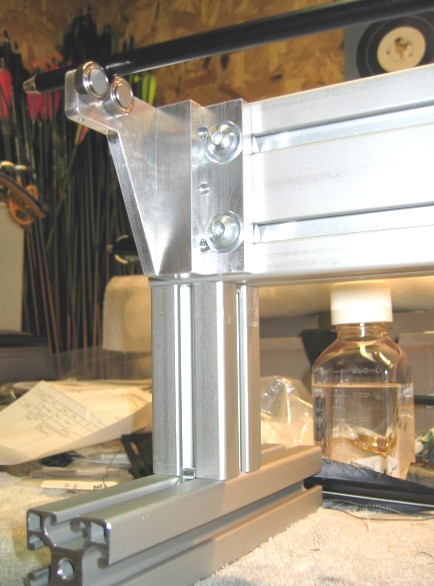 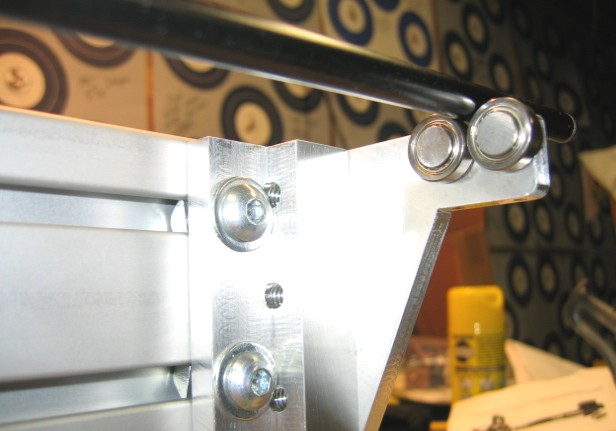 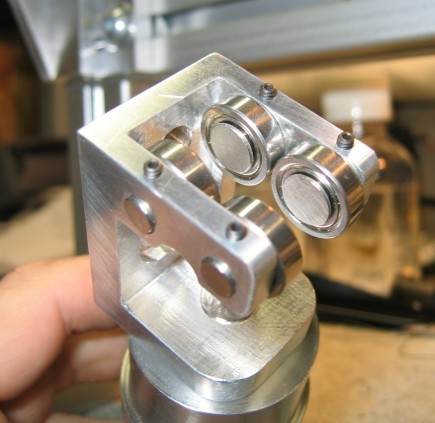 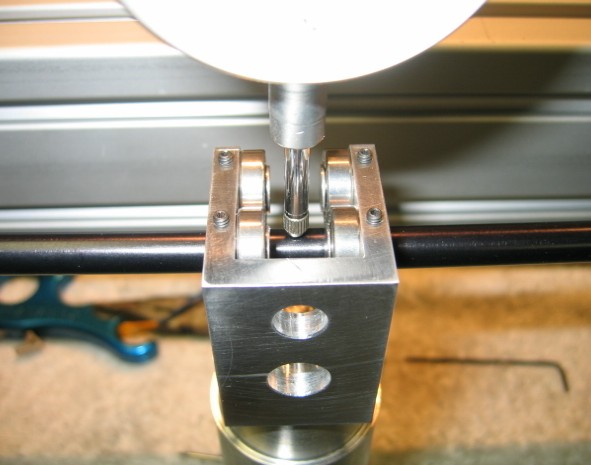 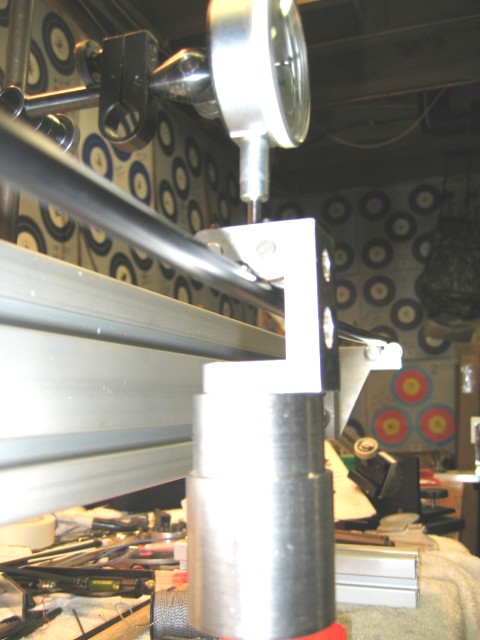 |
RE: JeffB, this spine's for you!
Thats a hell of a shop you got there. All kinds of cool toys!!
|
RE: JeffB, this spine's for you!
Jim, nice job!! I have a question. With aluminum shafts I have been told that the weld
area on the shaft is the stiffest and the heaviest spot on the shaft. This is were I try and put my cock vane to make my arrows group more consistant together. Somewhat simular to what I believe Tru-Flight arrow Co. does. I float my raw shaft arrows in my bath tub with some soap added to the water and the shafts do in deed rotate in the water to the same spot, which I assume is with the weld (or heavy portion) of the arrow downward in the water. My question here is with your spine tester, can you tell where the weld is on aluminum shafts by the deflection? |
RE: JeffB, this spine's for you!
Aluminum shafts are not welded, they are seemless and drawn through many dies from much larger tubing.
|
RE: JeffB, this spine's for you!
Black Frog, that is an amazing spine tester. Looks like you'd have to charge about $1000 if you wanted to sell one. :D
I love the design. When I was building mine, I did quite a bit of research and had read somewhere about removing the spring and mounting the dial indicator on the top. After thinking about it, I realized that I had no need to know the actual spine, that comparing arrows to each other was sufficient for my use, so I took the easier route. Mounting the weight below the arrow is a challenge and I wouldn't even want to try to make the gizmo you created. ;) I also tried to imagine the amount that little spring would affect a 2 lb weight. I don't think it's much - especially on the stiffer spines. After looking at a few dial indicators, I realized they don't all have the same spring tension. You can choose one with less pressure. I'm not sure how far mine is off, but most .034 arrows hover right around the .034 mark. I used 3/4" cabinet grade plywood with common hardware brackets. With the dial indicator it cost about $30 and an hour of my time. It works, but is no where near the tool you made. Wanna trade?  |
RE: JeffB, this spine's for you!
Nice Job! I am always in amazement at the devices that some of you have the skills to put together. That "shop" of yours is pretty impressive as well. I would feel quite a sense of accomplishment to have all of those excellent scoring targets surrounding me as I work.
|
RE: JeffB, this spine's for you!
Aluminum shafts are not welded, they are seemless and drawn through many dies from much larger tubing. SA, I agree on stiff spines you wouldn't notice much difference. But I was surprised on how much that spring force was as I approached the full travel. Since I deal with youth/light poundage bows and arrows I occasionally have to mess around with light spined arrows. Do I want to trade? ummmmm.... not just yet. ;) With the bearings on both ends and on the hanging weight, it's very smooth on the rotation of the arrow. I tinkered with my indoor arrows on the tester last night for the first time. They were all within .004" of each other for deflection, but the fun thing was seeing the stiff spot on a few of the shafts. Some had no stiff side that I could see, but a couple of the shafts did a .002-.003" wobble of the deflection as the shaft was rotated. I'll admit I'm very fortunate to have all the toys I do. My basement is better equipped than most any archery shop I've been in. ;) |
RE: JeffB, this spine's for you!
Very nice , It would be nice if sometime in the future you could post some variance results , of say an alluminum shaft, compared to an acc , compared to an all carbon . Bet the results would suprise , especialy if they had some useage on them .
|
RE: JeffB, this spine's for you!
Excellent project Black Frog--TECHNOLOGY well worth the time spent building. Congrats!!
|
RE: JeffB, this spine's for you!
Aluminum shafts are not welded, they are seemless |
RE: JeffB, this spine's for you!
Black Frog, you got me thinking. I could probably mount rollers on a piece of wood that hangs from underneath. Wood is real easy to adjust to an exact weight. I don't have much in the way of metal working tools , but I do have planers, sanders and an electronic scale to get the weight real close on a piece of wood.
This is what my arrows rest on now. I bet they'd work for hanging the weight and they only cost about 59 cents. I don't like the bolt for a weight because it has to be placed exactly the same way each time or the reading will vary a bit.  |
RE: JeffB, this spine's for you!
SA, Sure that would work! You could easily shape something out of wood to hang the weight on. If you got a hunk of lead for the weight, you can carve that down to what you need. Or if you're a fisherman you may have a lead pot to melt sinkers. Steel is tougher to work with, and aluminum was too light. I had a chunk of stainless steel that I used and just kept shaving off the bottom until the weight was correct. The "official" weight amount is 880grams. I think that is 1.94lbs. I'm lucky I have access to VERY accurate and calibrated scales here at work, but you could always take it to the Post Office and check the weight on their scales if yours doesn't go that high. My scale at home didn't.[:@]
I checked a Mitutoyo 1" dial indicator which is different than the one I used on my jig. The Mitutoyo also approached 100 grams of spring force near the 1" of travel! Just by pressing it with my finger I would not have guessed it to be that much.... I don't like the bolt for a weight because it has to be placed exactly the same way each time or the reading will vary a bit. |
RE: JeffB, this spine's for you!
Todd,
Beautiful workmanship ! Doesn't surprise me at all, since you're the guy who built it. ;) Sag. |
RE: JeffB, this spine's for you!
I've been thinking about the suspended weight and got to wondering if spreading the weight out over an inch or two would affect the way the arrow bends. It seems to me that pressing at two points would result in a different reading than pressing at one point. I'm wondering if it wouldn't be better to suspend the weight from an eye-screw that the arrow passes through. This would concentrate the pressure at one point, and yet the weight should hang the same way each time, since the roundness of the eye-screw should act much like a couple rollers. The plunger on the dial caliper would have to sit a fraction to the side, but I can't imagine that would affect the reading to a noticable degree.
Thanks for the lead idea. I no longer have my sinker-making gear, but I could easily drill a hole down the center of a piece of hardwood and then fill it with lead to the appropriate level. Then I'd put a lid on with the eye-screw attached to the lid and maybe it would work. . . And I'll have those cold beers after I finish making the weight.;) |
RE: JeffB, this spine's for you!
Todd,
VERY nice spine tester..very nice. Wish I had your skill at crafting things. It's really an eye opener when ya start testing all these carbon arrows. Some of the stuff manufacturers sell us is just complete crap..even higher dollar arrows. If I ever get the time and inclination to get back to shooting, I'll be shooting Carbon Tech, or good 'ol A/C/Cs. They spine magnificently. |
RE: JeffB, this spine's for you!
got to wondering if spreading the weight out over an inch or two would affect the way the arrow bends. It seems to me that pressing at two points would result in a different reading than pressing at one point. The plunger on the dial caliper would have to sit a fraction to the side, but I can't imagine that would affect the reading to a noticable degree. Jeff, I just threw some of my navigators on there and I was impressed with the consistency of the few I measured. I could detect no stiff or weak side on three I tried. I am giving up on some carbons that I had been using for hunting arrows the last few years and using ACC's this year. ACC's are a damn good arrow. |
RE: JeffB, this spine's for you!
BF, that tester is a work of art. I must say, the machining is great.
|
RE: JeffB, this spine's for you!
Black Frog
Fine work on your spine tester. It looks very well thought out and executed! We weigh, spine test and then bare shaft all shafts out of a shooting machine (glorified Hooter Shooter on steroids) for consistency of performance. We can often rotate the nocks on a shaft and get it shooting to the same hole as the rest of the bunch once we are at a very tight spine variance. We have found that the stiffer the spine relative to the bow weight, the less critical the spine match becomes. That being said, ACCs are pretty hard to beat in my book for an all around shaft. We don’t spend much time on carbons with the exception of some CTs once in a while. What has your carbon testing revealed? In other words whose carbons have you found to be close to ACC consistency if any, and what has been your experience among the different brands? If you don’t want to let it all hang out on the forum, a personal reply reply would be appreciated. Jeff, your input is always highly regarded as well. Black Frog, once again….very nice work. Best….Nubbb |
RE: JeffB, this spine's for you!
Nubbb,
I just got this tester assembled this past weekend, so my tinkerings with shafts are very preliminary. In fact I still need to finalize the indicator mount I'm milling that will place the indicator DIRECTLY above the centerline of the shaft, and perfectly verticle (at least within a thousandth of an inch or so...). Currently I just have an indicator holder rod assembly, and you can position that in just about any orientation. But as we get toward the outdoor field season and hunting season, I'll be trying a new batch of Navigators for field and ACC's for hunting. I do some work for other people and will be checking their arrows as they come through so I can get some idea of what's marketing advertising and what is for real.... |
RE: JeffB, this spine's for you!
ORIGINAL: Black Frog and will be checking their arrows as they come through so I can get some idea of what's marketing advertising and what is for real....  [&:] [&:] |
RE: JeffB, this spine's for you!
Black Frog,
How's the testing coming? What Brand of T-Slotted framing did you use? It doesn't look like 80/20. Thanks...Nubbb |
| All times are GMT -8. The time now is 12:11 PM. |
Copyright © 2026 MH Sub I, LLC dba Internet Brands. All rights reserved. Use of this site indicates your consent to the Terms of Use.