
|
Science project report (long)
A while back I posted about my son (8th gr) planning to do his science project on m/l bullet performance. I needed some advice on how to do it, and bullets to test...a bunch of folks here stepped up to help us out.
A HUGE thanks to sabotloader, hubby11, idahoron, an bronko22000! They graciously sent us a number of different bullets to test out, and asked nothing in return. I do appreciate it guys...hopefully someday I can return the favor. Semisane gave me the idea we ended up going with...I built a wood box 1'x1'x2'...filled it with damp play sand. I cut a hole in the front to shoot through, and used some posterboard to hold the sand in. This setup worked very well. Could have actually been about 6" shorter in reality. So my son and I built the box, set up the shooting bench, layed out our bullets and accessories, and away we went. He used one of my .50 cal MK-85's. Each shot was loaded with 80gr Pyrodex RS, and we used RWS #11 caps. The bench was set up 20yds out. He spit patch swabbed between each shot to keep the fouling down. He shot each of the bullets we had twice. (Would liked to have done more, but we didn't have enough bullets of every type to do more...and in reality it took us a LONG time to get through all the bullets as it was.) Thankfully it was a gorgeous day, took us about 8hrs total. Even with only shooting each bullet twice, the results from shot to shot were VERY similar in all aspects. It was pretty cool...he would shoot, and then we'd go dig through the sand and find the bullet...measure the penetration depth, and repack the sand back tight for the next shot, replacing the posterboard as needed. He recorded his info in his log book after every shot, then swabbed and realoaded for the next shot. Over the next few days, he took the shot bullets, weighed them to see how much weight retention they had, and measured how much they expanded. Later he took pictures of everything, and recorded all the data for his project. I thought it ended up great :happy0001: Keep in mind...this is shooting into damp sand, not a deer. BUT, since the playing field for all these bullets was exactly the same...I feel it gives a good representation of how they perform. Other than size differences, all other factors in the test were the same. I really enjoyed this project....and it was neat to be able to see & use so many different bullets. I've never shot alot of different bullets...I've always been a don't fix it if it ain't broke guy. Very interesting our findings. I was really impressed with some of the bullets, and really diappointed in others. I'm sure some healthy debate will arise...be interested to hear you guys thoughts/feedback. (I do have the spreadsheet he put together with all the data on it that I'll be glad to email to anyone who would like it. Just pm me your email addresss.) I'm gonna go ahead and post the pics of the project and results. There are quite a few, so bear with me. 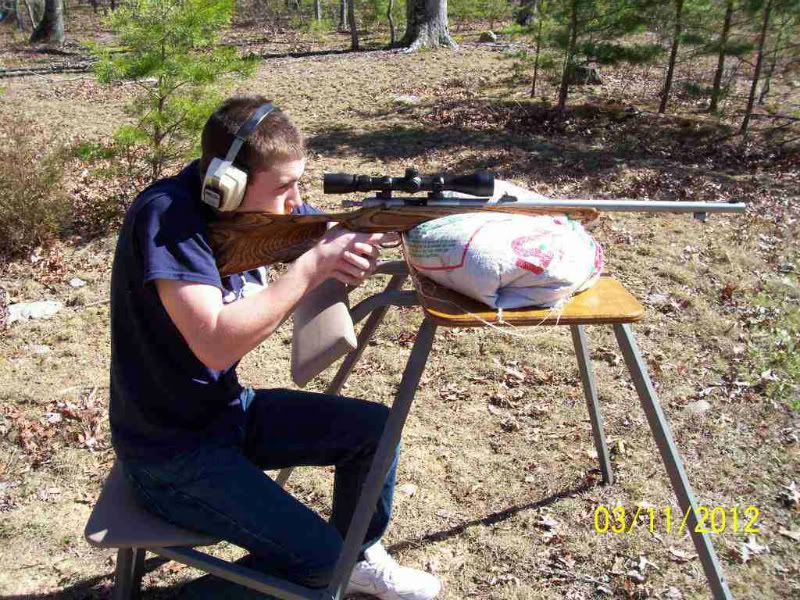 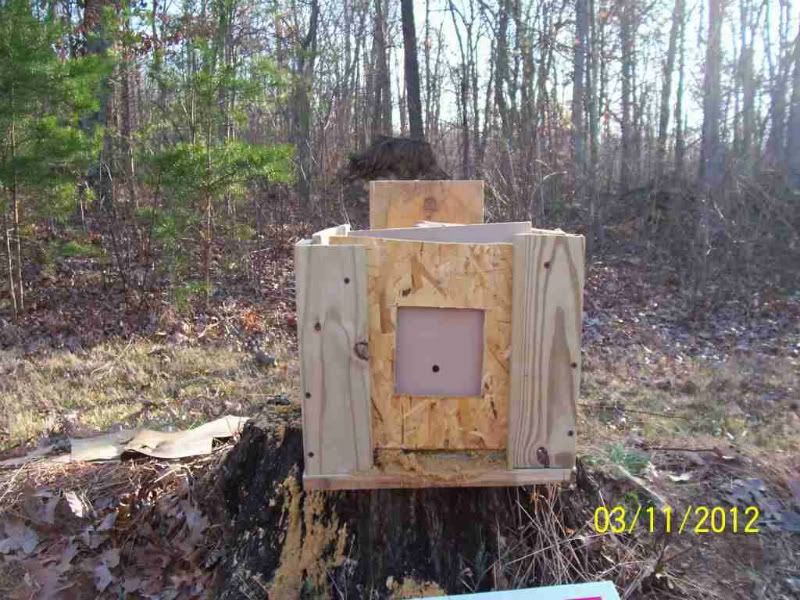 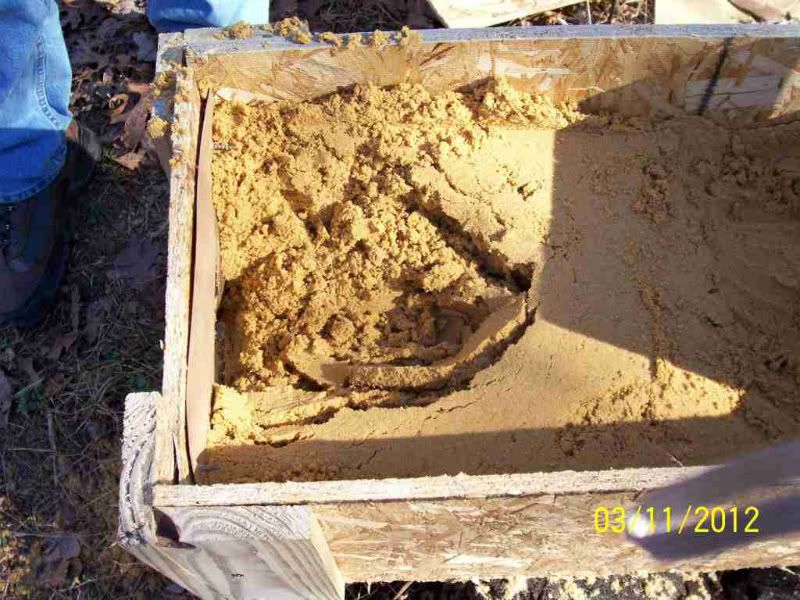 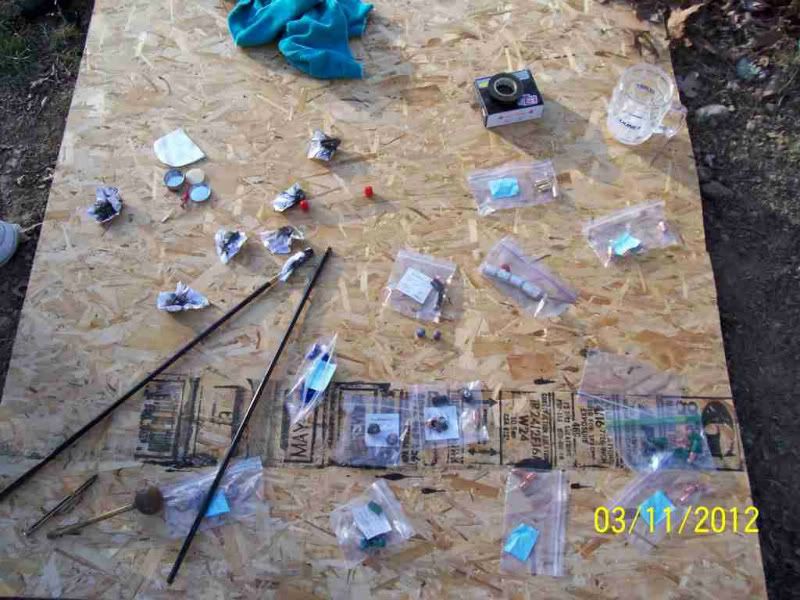 |
Looks like it was a great outing for son and father. Hope you ganined all the inforamation that was needed and more importantly I really hope your son gained personal information that he will be able to share with everyone.
I certainly would like to see the results in a spreadsheet... mike |
  |
Ok, I'm going to put the photos up in the order that my son ranked them based on his findings. Best to worst. The first 7 were catagorized as his BEST Performers.
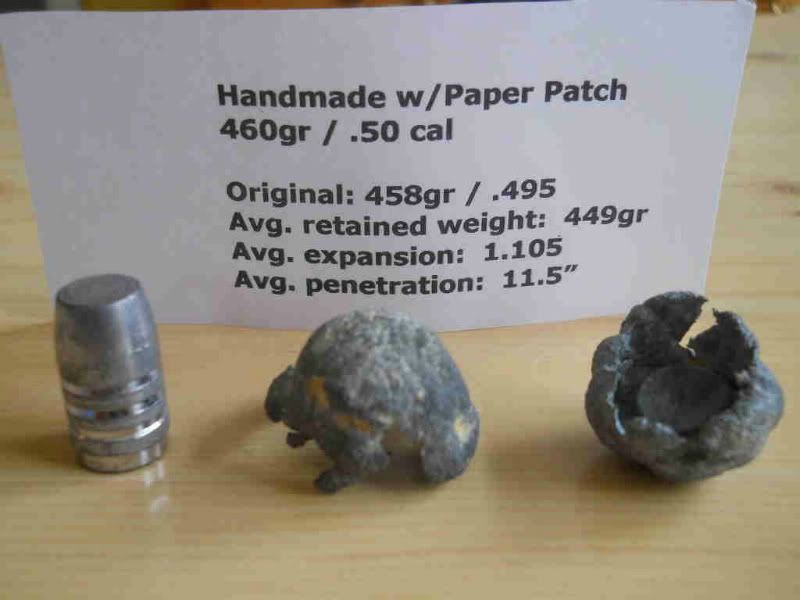 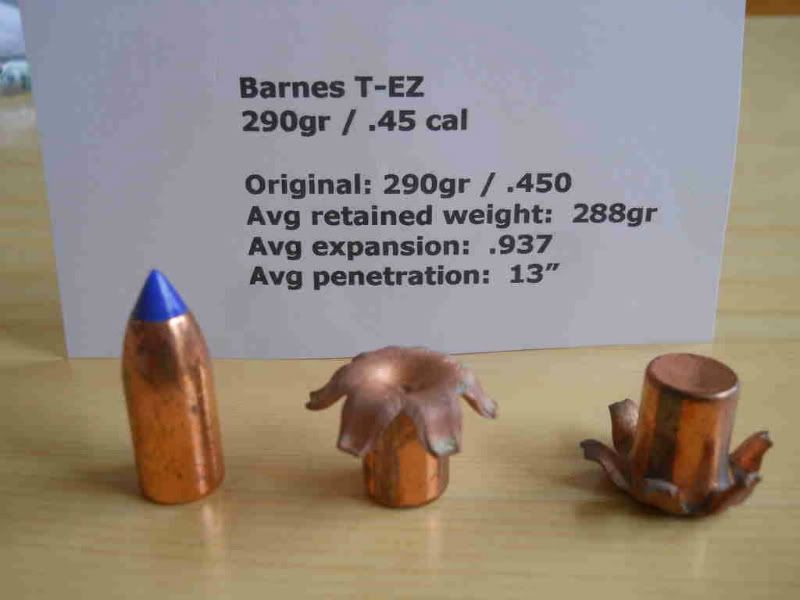 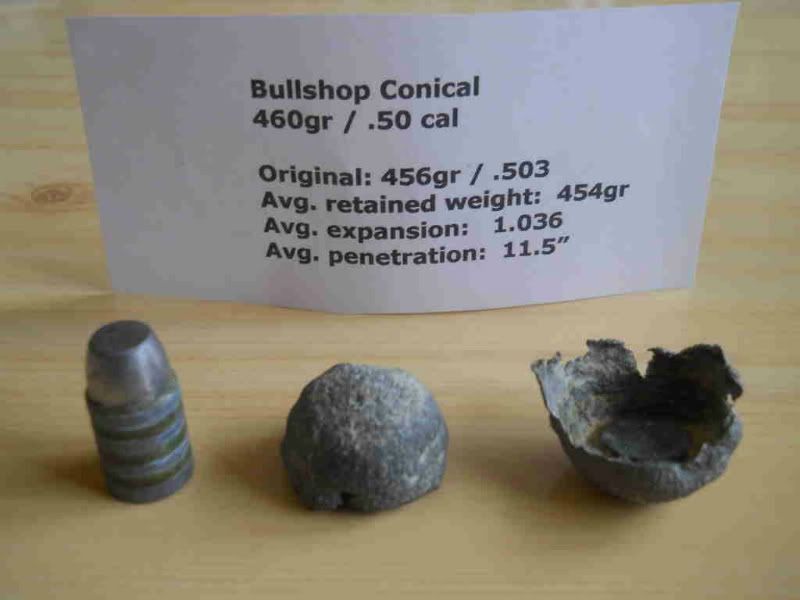 |
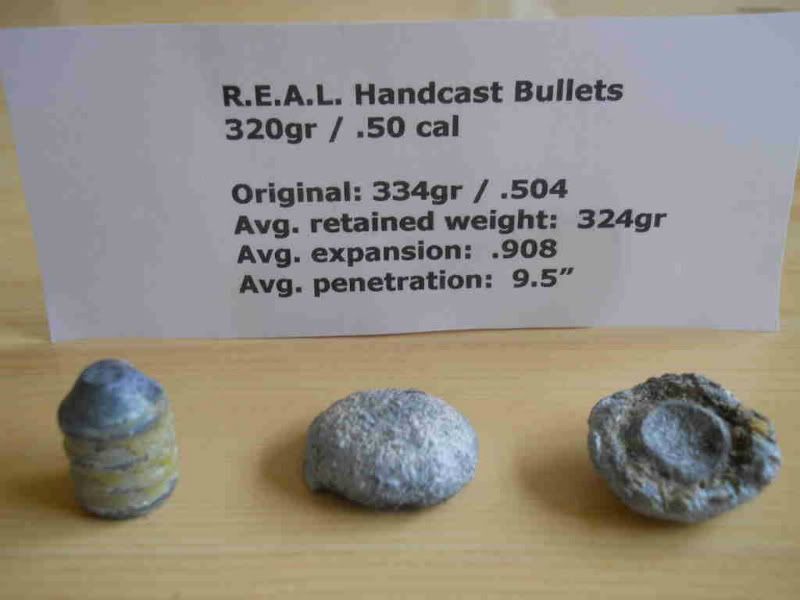 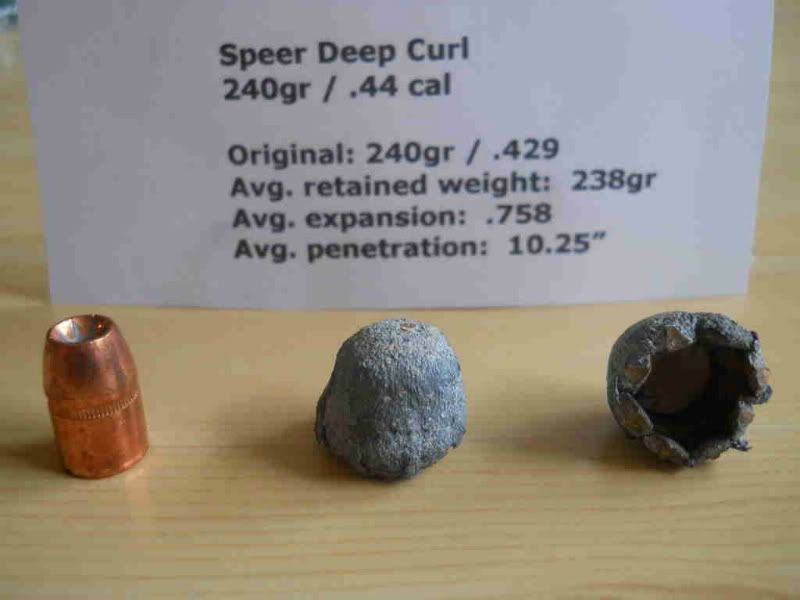 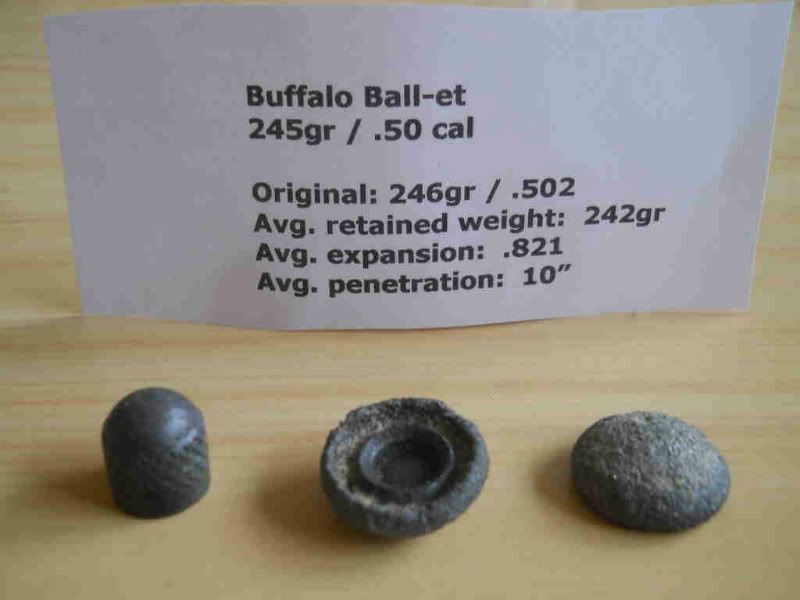 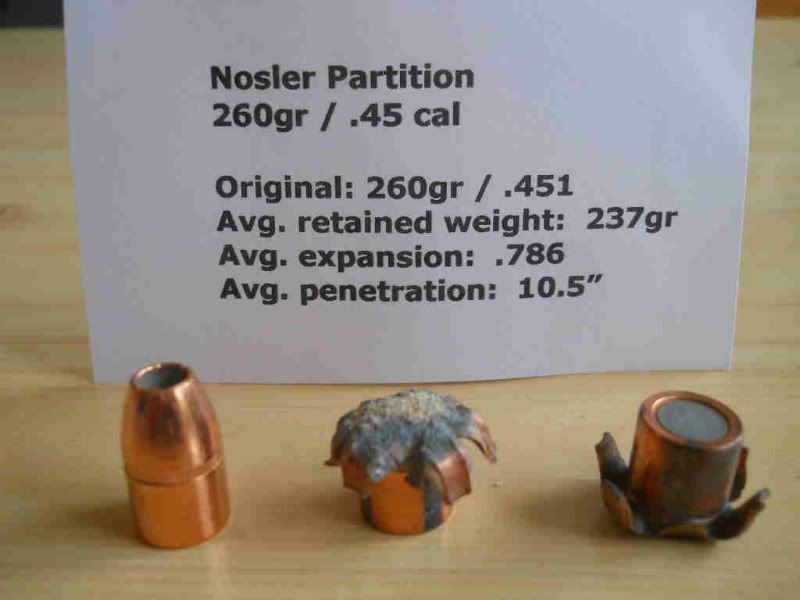 |
These next 6 are listed as his GOOD performers.
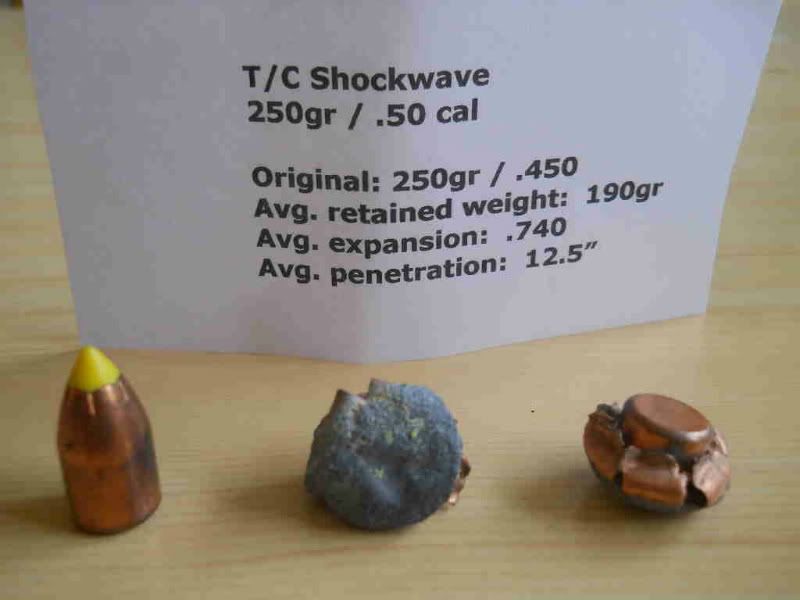 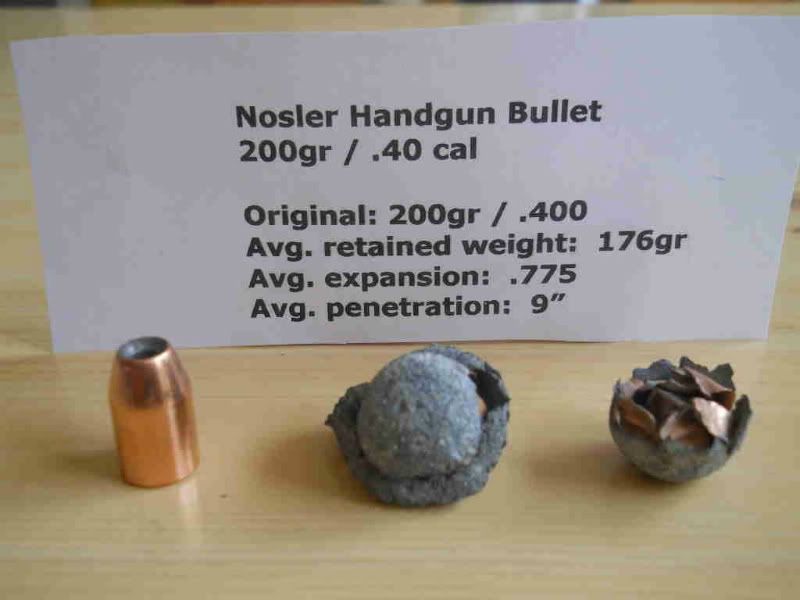 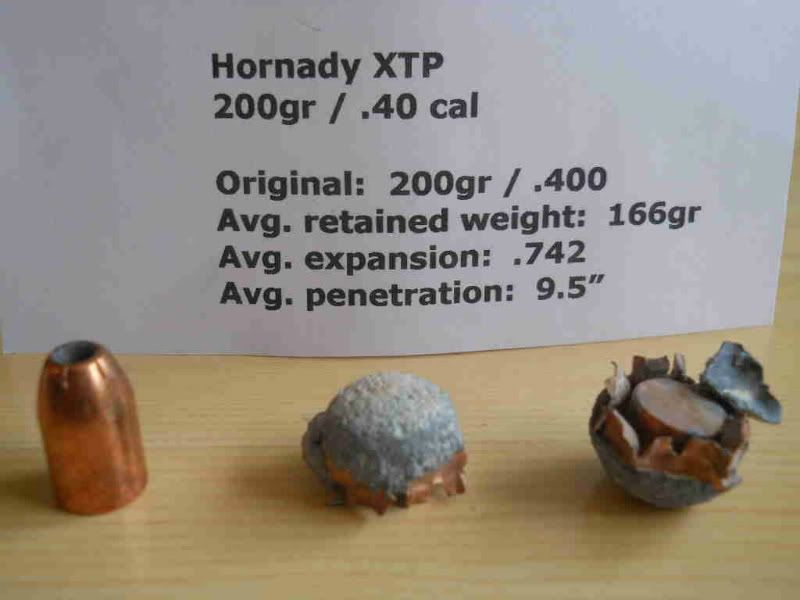 |
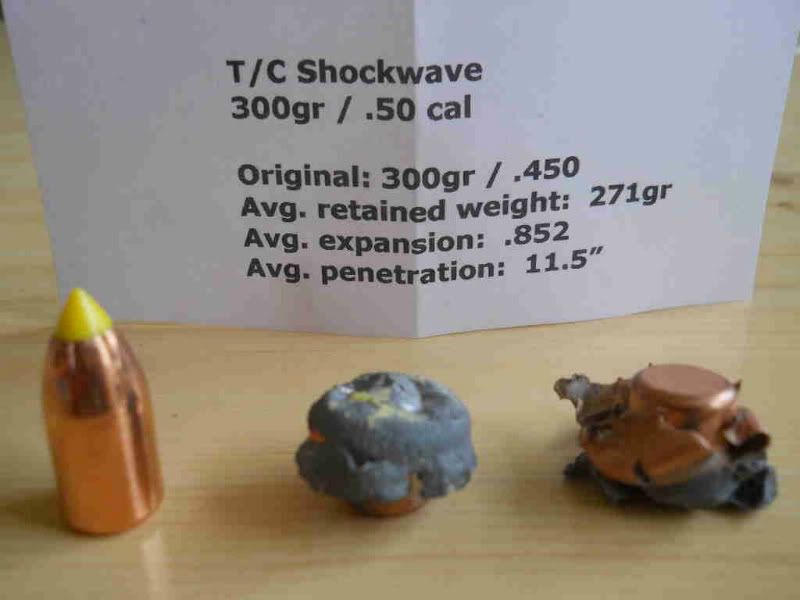 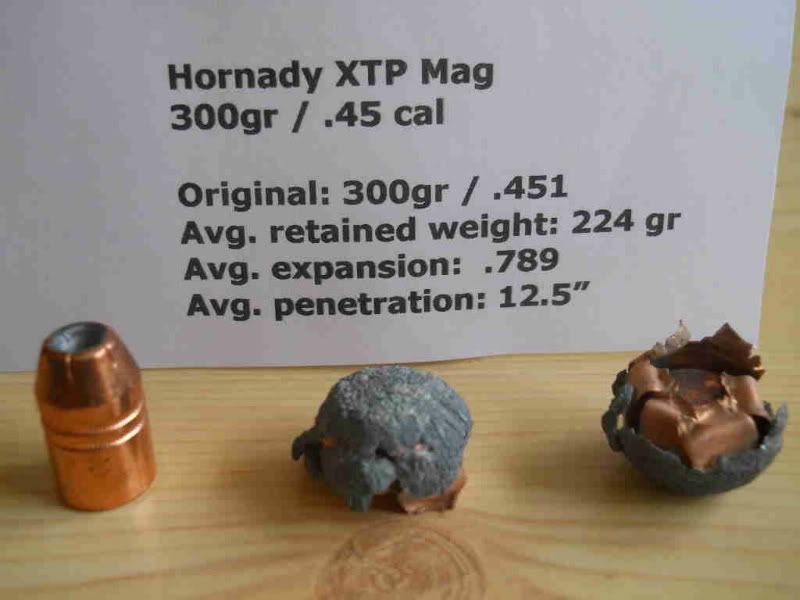  |
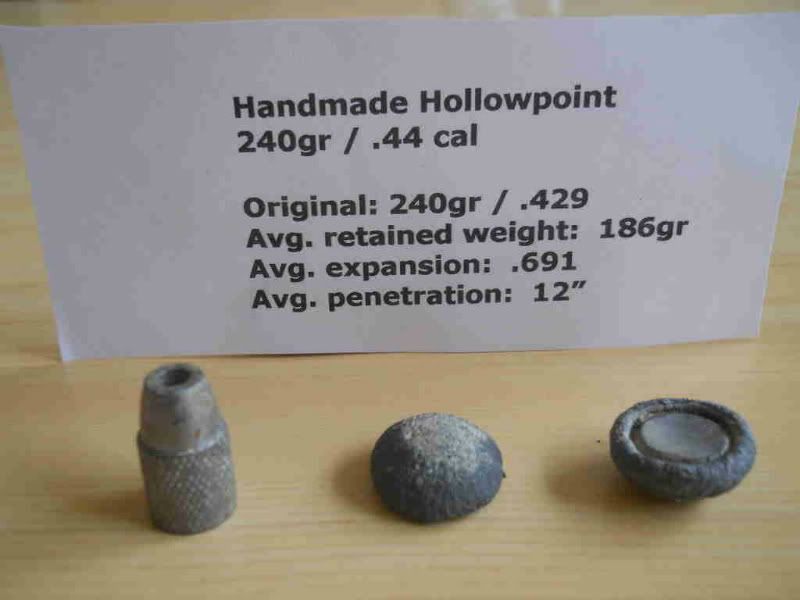
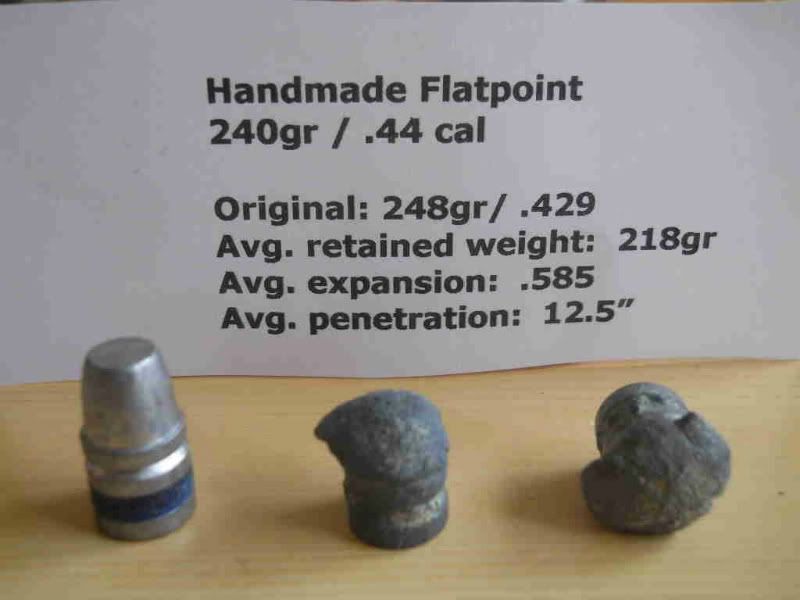
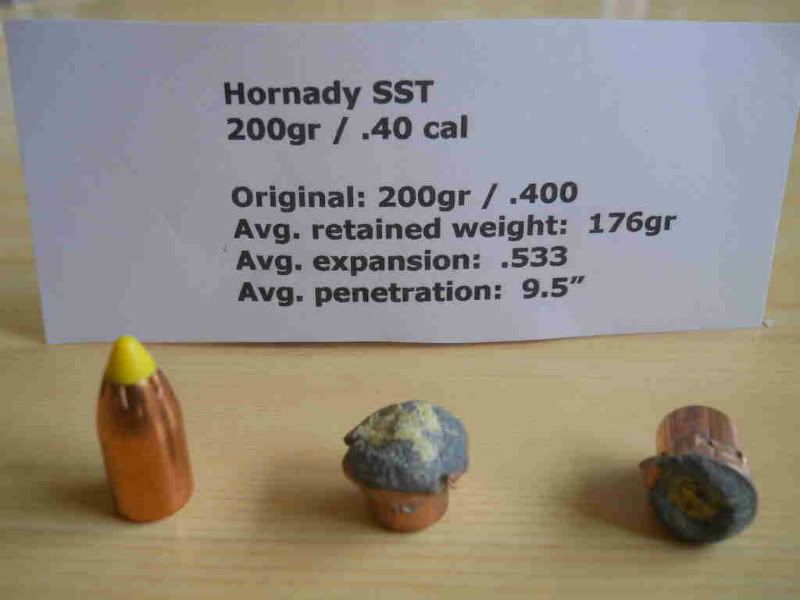
The next 3 he listed as FAIR perfomance.
   |
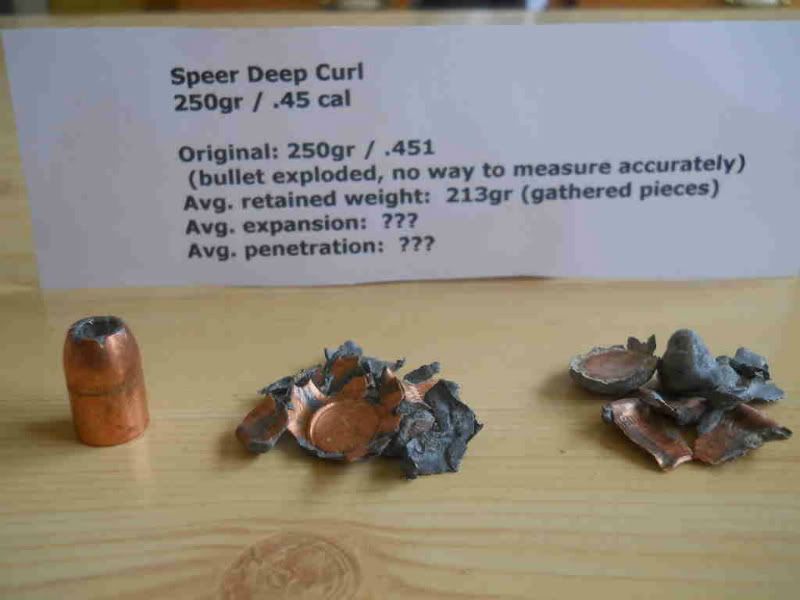
The last 5 he catagorized as POOR performers.
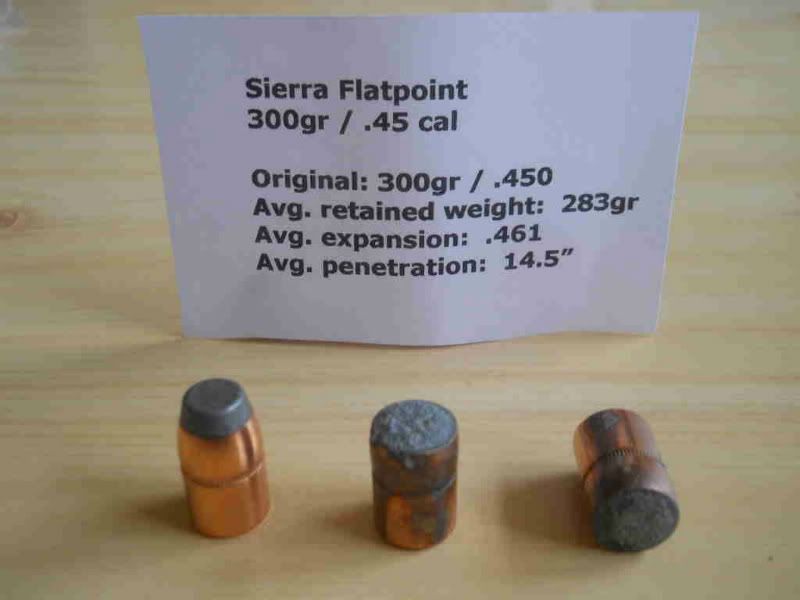 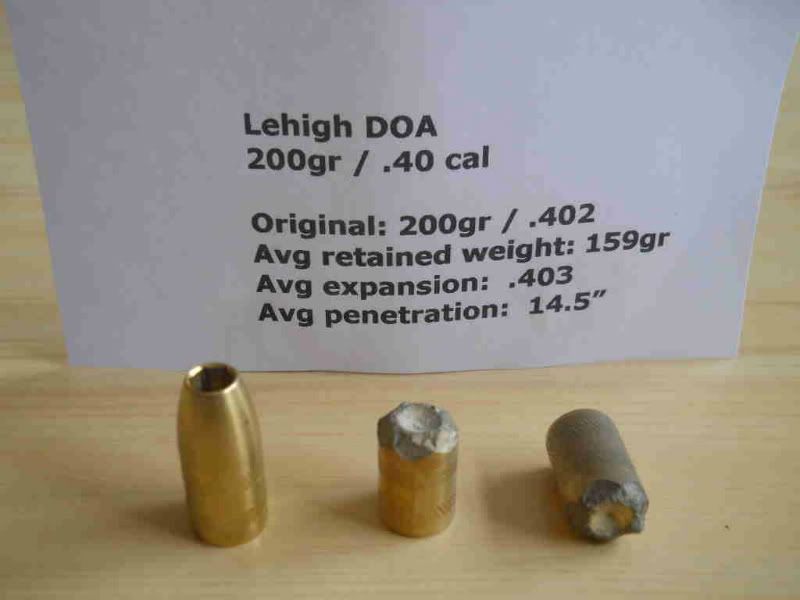 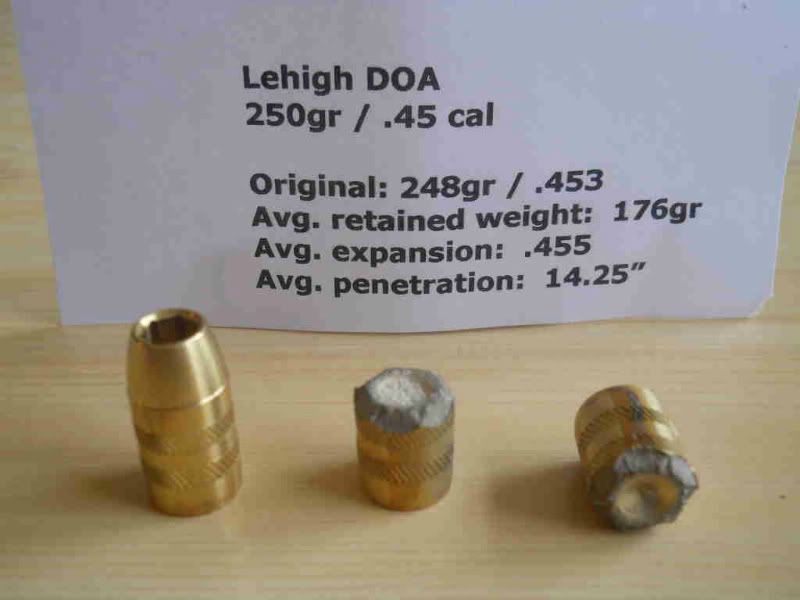 |
(these were bottom of the barrel... I found it REALLY interesting - and have a theory on it that I will discuss)
  |
Ok....there you have it. My thoughts...
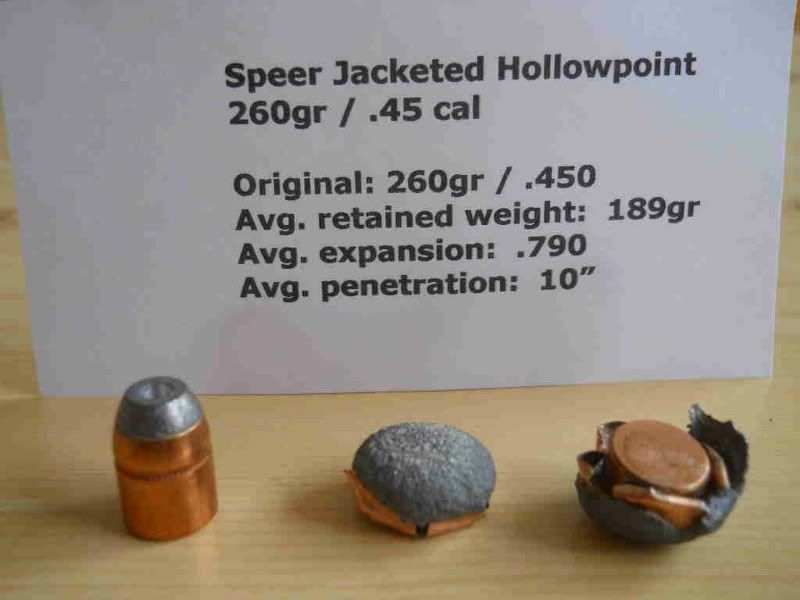
I was totally impressed with the Big all lead bullets...amazed actually. (in fact, ALL the all lead bullets did well) The Barnes and Nosler Partition did EXACTLY what they are designed to do. The XTP's & Shockwaves did great, which goes along with the overall reports on them. The Knight bullets, which I shoot personally (Speer 260's jacketed hp)...did well, which I knew they would. I've had excellent performance on live game with them over the years -- even though they are listed as "plinkers" on Speer's website, not as "hunting" rounds. Here is a pic of the only one I ever recovered, most blow right through. Never had one get away, most don't go far at all...some are DRT. I guess we should have listed the % expansion as 177% or 77% gain. You get the picture. 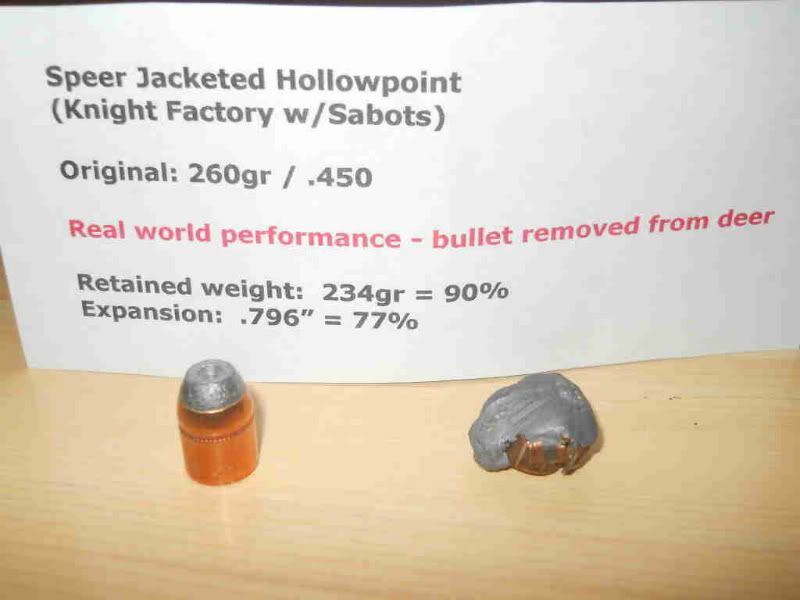 |
I was suprised at the poor performance of some of the bullets, including the Lehighs. Not sure why they are designed to perform like they do.
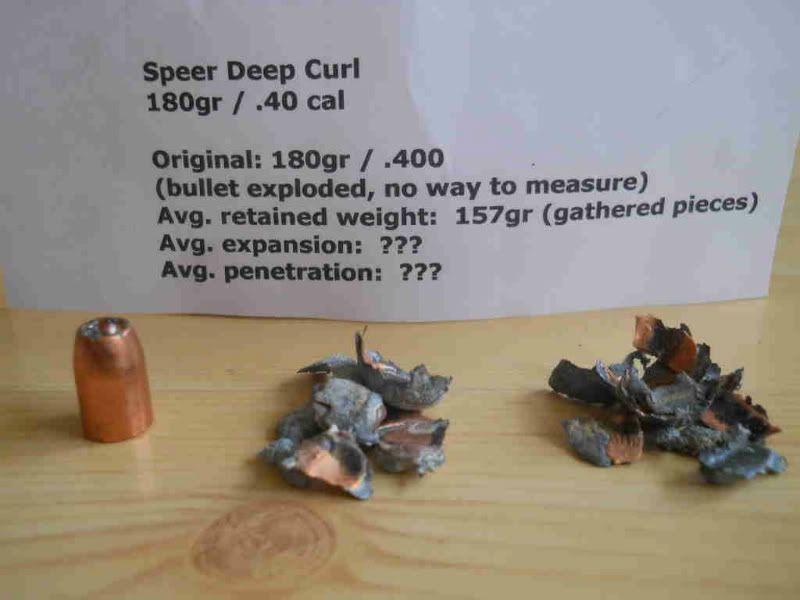
The Deep Curl's puzzled me big time. The 240's did AWESOME... the 250 & 180....wow. Interstingly...both the bad ones were exactly the same bullet design. On the 240, the copper jacket fully wrapped the hollow point...on the 250 & 180, it only partially folded over into the hp. You can see the difference. I was shocked actually. Really, imo....most of the bullets had satisfactory performance, obviously some better than others. With the exception of the last 5...I wouldn't hesitate to use any of them based on our test. Hope you guys enjoy....and thanks again for all the help! My son was amazed at how you guys stepped up to help out some kid you don't even know :D Funniest thing of the project...I didn't say anything when he went to shoot a bullshop. It walloped him, and he was like "what the heck!" From then on he knew what to expect from the big bullets :D (now for some healthy discussion...) |
Good report looks like you both had fun doing this
|
A lot of information there. Excellent job. And the Lehigh I believe did what they were designed to do. The loss in weight is the petals coming off. And the rest is intended to plow through which would account for the excellent penetration.
Like you, I love big lead. And the results did not surprise me. Its just hard to get past the fact that a lead conical bullet will put a world of hurt on something. You did a great job there doing the testing young man. The ones that just went to pieces, kind of surprised me at that distance and with that powder charge. An excellent job. The only thing I might have done different is used a chronograph right before the box. At 20 yards the chance of shooting a chronograph are slim although it could have happened. And a shield would have protected the machine from sabots. The reason I say this is.. some of the bullets are made to perform best at certain speeds. 80 grains of Pyrodex might not have "brought out the best" in some of the bullets or shown the worst in others. But believe me, I am not knocking the work put into this. Just a real good effort there. A great report!! |
Nice work boys!! Very much enjoyed your photos, and reading your conclusions!
|
Cayugad....yeah, I was trying to get a chrono for the test. My dad has one, but I couldn't get up with him in time, as he lives a few hours away. I wanted to see the speeds as well.
I think you are right, that the Lehighs did what they were designed to do...but personally, I don't like that. I'd rather have them expand and plow through, than poke a small hole through. They did penetrate very well, as they should have. My favorites were the two big lead 460's, and the 240 deep curl. Amazing how those peformed...and they shed almost no weight. That 240 DC dang near turned inside out. I was blown away at how it did, vs the other two deep curls that blew up. |
Originally Posted by ronlaughlin
(Post 3924143)
Nice work boys!! Very much enjoyed your photos, and reading your conclusions!
When you posted your jug blown to pieces the other day from the deep curl, I immediately thought you might have had a similar issue as we did. But, obviously after you shot again with clean holes...it had to have hit rocks. |
Originally Posted by WV Hunter
(Post 3924093)
The last 5 he catagorized as POOR performers.
The design and operation of the Lehigh/Bloodline is from Europe - Germany, I believe. Over there they hunt with rifles much smaller in caliber than we do and they need to have a very lethal bullet. The design features incorporated in the Lehigh/Bloodline offers that aspect. The petals are designed to come off in a liquid medium, then the petals rotate out and up creating tremendous damage to the internal organs. In your case the petals came off but did not probabably travel very far in your wet sand environment, which would be completely different in a liquid medium. Once the petals come off the boddy of the bullet continues penetrating with the ragged edges of the bullet tearing and cutting its way through tissue, at the same time the small cup in the nose of the bullet creates a large 'hydrostactic' shock within the animal. Theoretically this damage and shock will also overide the animals ability to start the flight response that is the natural response when an animal gets hurt. This picture shows how the petals operate in Ballist Jell. You can see how the petals move away from the primary wound channel to create more damage and shock to the animal. 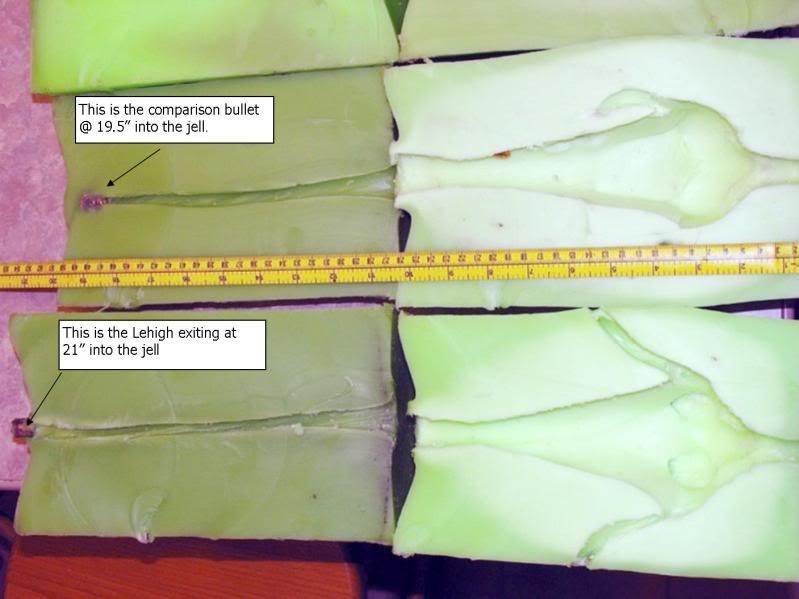 It really is a difficult operation for us Americans to buy into, but it does work. Here is Dave's explanation of the Bullet but it is a long read... Thankyou for the inquiry on why Lehigh Bullets uses brass instead of copper. I thought I would expand this to also include how the Lehigh bullets function. The design aspects of a good hunting bullet include: accuracy, initial penetration, expansion/energy transfer, organ destruction, and final penetration/perforation. Accuracy Accuracy is important for terminal performance as the bullet has to get to the intended location. Lehigh bullets are machined from barstock on cnc lathes. The bullets come off the machine complete with no secondary operations. The bullets are machined at around 8,000 rpm. Due to the bullet being formed while spinning, the concentricity of all the features is inherent in the process. The hollowpoint is centered on the outside diameter and the wall thickness is equal all around the bullet. This means the center of the geometry is equal to the axis of rotation which makes for an accurate bullet. A formed bullet, either a jacketed or formed solid copper bullet is made in a static process, it is not spinning. Manufacturing and tooling tolerances make it very difficult to keep the internal features like the hollowpoint at the true center axis. Most o these bullets are also produced on a press that may form 10-15 at a time. Each of those bullets have the potential for being slightly out of balance due to the different tooling each one sees. I am not stating you can not make an accurate bullet through the forming method; I am just stating it is easier to produce an accurate bullet by machining. The downside of machining bullets is the cycle time. Machining yields somewhere around 120 bullets per hour while forming can yield over 5,000 per hour. Initial Penetration The bullet must be stong enough to penetrate the animals hide and muscle boundary before expansion begins. Factors for consideration include the bullet weight, impact velocity, and the animals structure. Due to these variables, bullets have to be designed based on estimated averages which induces performance issues when game is taken at the extremes of where the bullet designers thought the bullet would be used. This effects all manufactures. Machining a bullet from brass enables us to very quickly change the design features like the hollowpoint and then test the result. Since the parameters are controlled by cnc code, it is very simple and fast to change from one design to another enabling the testing of many configurations in a single day to quickly arrive at an optimum design. This process takes much longer on formed bullets as changes are tooling dependent. New dies and punches must be produced for each trial and the equipment must be then setup and centered making it a long process to try to get to the optimum performance level. The investement in tooling is very large and that is why you may find a formed bullet manufacture producing a poorly performing bullet for sometime before changing the design. The tooling and machine may also limit the formed bullet manufacture on how strong they can make the nose for complete initial penetration. The forming machine may not have the power to form a jacket with sufficient wall thickness resulting with a bullet that begins expansion upon contact severly limiting the bullets terminal performance. Machining a brass bullet to any wall thickness is very simple. Exapnsion/Energy Transfer This phase of terminal performance is very similar in a Lehigh brass bullet and a copper or jacketed bullet. The process begins as the bullet contacts the animal and completes when the bullet is fully expanded. The nose or metplat, determines the initial energy transfer. Big, flat noses transfer an extreme amount of energy. Depending on the impact point, this energy may be sufficient to shut down the animals nervous system. While a large flat nose is the best design for intital energy transfer, it lowers the ballistic coefficient of the bullet resulting in velocity loss and making it more susceptable to wind conditions. Upon penetrating the hide and muscle layer, the bullet encounters tissue with a greater liquid content. This hydraulic pressure in the hollopoint cavity causes the nose to expand transfering additional energy to the animal. Expansion is complete when the upset growth stops which on a jacketed bullet could be a partial expansion or when the nose is completely folded back around the shank. Assuming a .500" diameter jacketed bullet, expansion may reach a frontal daimeter of 1.00". Lehigh bullets start expansion much in the same way. The bullets are designed to begin expansion upon the resulting hydraulic pressure. The nose petals are then designed to split the web of material between them. Once the petals achieve an angle of slightly less than 45 degrees, the petals separate from the base and radiate outward on independent trajectory paths. Remember all components of the bullet are still spinning. Organ Destruction In this phase there are some very distinct differences between a conventional formed/mushrooming bullet and a Lehigh brass bullet. As the Lehigh bullet's petals radiate outward, additional energy is transferred by each of the six petals. The petals have sharp cutting edges, and coupled with the spinning action, they are devastating to all tissue encountered leading to massive organ damage. The radial pattern will normally extend over 10". A customer recently tested the bullets on a bison and using a metal detector found petals 18" from the base path. Organ destruction was enormous. Often there is sufficient enrgy in the petals to penetrate the offside hide. A convetional mushrooming bullet can only effect tissue near its path through the animal. A 10" wide path of destruction has a greater terminal effect that a 1" path. Please note we are not advocating using the controlled fracturing feature for a hunter to take marginal shots, we are just exteding the killing performance of a well-placed shot. Final Penetration/Perforartion The increased frontal diameter of a mushroomed bullet severly impares additional penetration. The increase surface area slows the bullet down quickly and imperfect mushrooming where one side expands further than the other results in the bullet veering off the inteded course. A large radiused nose also tends to follow the path of least resistance which pulls the bullet off course. If you look at most African game solids, the nose has a large flat which punches through bone and keeps the bullet tracking straight. Once the controlled fractuing of the petals on the Lehigh bullet is complete, the bullet shank continues penetrating with a frontal diameter equal to the bullet diameter. The new nose of the bullet is flat, the best shape for straight line penetration and the cicumference edge around the face is sharp allowing the bullet to cut cleanly and to punch through bone without course variation. The Lehigh bullet shank is designed to retain sufficient energy to completely penetrate the offside hide providing an exit bloodtrail. In summary, the controlled fracturing of the Lehigh bullet is very different from what we have been conditioned to believe is the optimal performace. The terminal performance of the Lehigh's is devastating and much different than a mushrooming bullet. We are not going to get everyone to drink the Lehigh Koolaide, but I hope over time that people will see through experience that the Lehigh terminal performance is superior. As a bullet designer I have the responsibility to game of creating the most effective bullet possible - this is a responsibility I take very seriously. Thanks for your inquiry and I hope my explanation was clear. Dave Fricke |
Thanks Sabotloader. That makes alot of sense....and their testing is obviously better than an 8th graders :D
I understand better now how they are designed, honestly I never knew that. Explains why so many folks like & use them. |
A very interesting report and I can appreciate all of the work that went into it.
But I'm more impressed by the result of the Sierra 300 grain FP's that weighed 283 grains after being fired as shown in post #9. http://www.huntingnet.com/forum/3924093-post9.html As the Bloodline article explains, Big, flat noses transfer an extreme amount of energy. |
Great post WV Hunter. Like most of the guys here I've seen my fair share of school science fair projects. The effort you son put into conducting and documenting that experiment is way above most anything I've seen. If the HNI forum guys could be on the judging panel he would get the gold for sure.
|
WV Hunter,
Very nice test. It's nice to see that your sons school let him do a gun related project. Here is a .400 200gr SST which left the muzzle around 2500fps. I recovered it on the offside shoulder on a Maryland whitetail shot at around 130yds. It either weighed 140 or 160gr recovered.   Might want to tell the teacher to look here for positive feedback. :D |
Originally Posted by arcticap
(Post 3924216)
A very interesting report and I can appreciate all of the work that went into it.
But I'm more impressed by the result of the Sierra 300 grain FP's that weighed 283 grains after being fired as shown in post #9. http://www.huntingnet.com/forum/3924093-post9.html As the Bloodline article explains, That result could be beneficial for penetrating a very large thick skinned animal like a big bear or buffalo. |
Originally Posted by arcticap
(Post 3924216)
A very interesting report and I can appreciate all of the work that went into it.
But I'm more impressed by the result of the Sierra 300 grain FP's that weighed 283 grains after being fired as shown in post #9. http://www.huntingnet.com/forum/3924093-post9.html As the Bloodline article explains, That result could be beneficial for penetrating a very large thick skinned animal like a big bear or buffalo. On 'regular' game, I personally would not choose the Sierra's...I'd rather have a bullet with a little more expansion. |
Originally Posted by Omega45
(Post 3924242)
WV Hunter,
Very nice test. It's nice to see that your sons school let him do a gun related project. Here is a .400 200gr SST which left the muzzle around 2500fps. I recovered it on the offside shoulder on a Maryland whitetail shot at around 130yds. It either weighed 140 or 160gr recovered. Might want to tell the teacher to look here for positive feedback. :D |
Originally Posted by bronko22000
(Post 3924255)
I was impressed that my cast 320 gr REALs performed so well. I might have to work up an accurate hunting load for them in one of my .50s.
|
Originally Posted by Semisane
(Post 3924227)
Great post WV Hunter. Like most of the guys here I've seen my fair share of school science fair projects. The effort you son put into conducting and documenting that experiment is way above most anything I've seen. If the HNI forum guys could be on the judging panel he would get the gold for sure.
|
Great report! Very interesting, and I can see a lot of work went into it. It must have been a lot of fun to do as well. Tests like this are a good way to have some sort of "baseline" for comparing different bullets. Bullet performance on live game however, may vary....
I was also impressed by the performance of the big lead bullets. I think with any of those options you will have no trouble with any sort of game in the lower 48.... |
Great report WV! I'm happy to see how the Speer .44cal/240gr bullets performed. Dollar for performance value can't be beat.
Not too surprised at the .50cal/250gr Speer. That crazy deep hollow point has always concerned me a bit. You could do shots out of it. |
Originally Posted by hubby11
(Post 3924507)
Great report WV! I'm happy to see how the Speer .44cal/240gr bullets performed. Dollar for performance value can't be beat.
Not too surprised at the .50cal/250gr Speer. That crazy deep hollow point has always concerned me a bit. You could do shots out of it. Thanks again for sending some to test, appreciate it! :happy0001: |
Originally Posted by oldsmellhound
(Post 3924410)
Great report! Very interesting, and I can see a lot of work went into it. It must have been a lot of fun to do as well. Tests like this are a good way to have some sort of "baseline" for comparing different bullets. Bullet performance on live game however, may vary....
I was also impressed by the performance of the big lead bullets. I think with any of those options you will have no trouble with any sort of game in the lower 48.... The way my son catagorized the bullets was based on what HE decided was best to worst, based on his findings. As sabotloader pointed out...some that appeared worse in his findings, actually did exactly what they were supposed to. So I guess we have to come to our own conclusions on each one. Or better yet, lets go test some out on game and see what happens :happy0001: I know I want to try out some big lead...can't wait to whop something with one of them! |
That was an interesting project. If I am reading this right he chose my paper patched "moose maulers" as his top pick?
I have shot, and I have seen animals shot with these bullets and I have never found one in an animal. They plow through no matter what angle. I saw my buddy shoot a buck in the right rear hip and it exited out his front shoulder. How did you guys like the paper patched bullets as a whole. Did they go down the rifle ok? They were sized for my gun so I wondered how they worked. Did you use the same powder charge for all bullets? Ron |
Originally Posted by WV Hunter
(Post 3924651)
I agree that this gives a baseline to see how these bullets performed in this test. I would like to think they would have similar or better performance on game...but who knows. It appears from the two bullets recovered from game, this appears to be the case.
If anything I would expect better performance on game, at least from the bullets you tested that I have used on game. Though it is an interesting test and provides a good baseline, I wouldn't jump to any major conclusions from it. For example, I have shot a fair number of deer with the 200 XTP and the 200 SST. In your son's test, they both penetrated 9.5". When shooting live deer however, I found that the 200 SST/Shockwave always out-penetrated the 200 XTP, usually by a large margin.(this is with similar powder charges and ranges) In general, I always recovered the 200 XTP in the deer, usually under the off-side hide. With the 200 SST/Shockwave, I only every recovered one bullet, the rest being pass-thrus. The only bullet recovered was on a deer facing me head on- bullet was found in one of the rear hams after penetrating almost the entire length of the deer. So real-world results may vary.... However, thank you (and your son) again for doing this, I found it very interesting. |
Originally Posted by idahoron
(Post 3924816)
That was an interesting project. If I am reading this right he chose my paper patched "moose maulers" as his top pick?
I have shot, and I have seen animals shot with these bullets and I have never found one in an animal. They plow through no matter what angle. I saw my buddy shoot a buck in the right rear hip and it exited out his front shoulder. How did you guys like the paper patched bullets as a whole. Did they go down the rifle ok? They were sized for my gun so I wondered how they worked. Did you use the same powder charge for all bullets? Ron They fit right down the barrel fine, and other than punishing my son when he shot them (LOL) were amazing. I really liked them and personally wouldn't hesitate using them on anything I would ever hunt. We did use the same 80gr load of pyrodex every time, for all bullets. If you (or anyone else) want me to email you the spreadsheet, shoot me your email address via pm. It has all the data in one place. |
Originally Posted by oldsmellhound
(Post 3924877)
If anything I would expect better performance on game, at least from the bullets you tested that I have used on game. Though it is an interesting test and provides a good baseline, I wouldn't jump to any major conclusions from it.
For example, I have shot a fair number of deer with the 200 XTP and the 200 SST. In your son's test, they both penetrated 9.5". When shooting live deer however, I found that the 200 SST/Shockwave always out-penetrated the 200 XTP, usually by a large margin.(this is with similar powder charges and ranges) In general, I always recovered the 200 XTP in the deer, usually under the off-side hide. With the 200 SST/Shockwave, I only every recovered one bullet, the rest being pass-thrus. The only bullet recovered was on a deer facing me head on- bullet was found in one of the rear hams after penetrating almost the entire length of the deer. So real-world results may vary.... However, thank you (and your son) again for doing this, I found it very interesting. We got to see how much weight they retained, and how well they expanded....which to me (in this test) was more important than penetration. Since they varied so much in size & weight, I knew penetration was gonna vary alot. The fact that several bullets expanded to over twice their size, while retaining almost all their weight was extremely impressive. In your shockwave / xtp example...even that can be analized as to which did better. Some believe that the best a bullet can do is to penetrate 99% of the way through (stopping just under the skin) thereby using up all of its energy on the animal, vs. blowing through and still having 'unused' energy that is wasted. I personally choose to have a passthrough...two holes is a good thing, imo. :D Bottom line, it all comes down to shot placement anyhow most of the time..so the vast majority of these bullets would kill just fine most likely. |
Originally Posted by WV Hunter
(Post 3924930)
Yesir Ron....those bad boys were awesome! Thanks for sending them to test! They were his top performer :D
They fit right down the barrel fine, and other than punishing my son when he shot them (LOL) were amazing. I really liked them and personally wouldn't hesitate using them on anything I would ever hunt. We did use the same 80gr load of pyrodex every time, for all bullets. If you (or anyone else) want me to email you the spreadsheet, shoot me your email address via pm. It has all the data in one place. There isn't anything on this side of the world I wouldn't shoot with them. Too bad you didn't get a chance to so a accuracy test with them. You would have been impressed. Ron |
Well...he took 1st place with his project last night :D
He was proud...lots of the parents and teachers really liked it. |
I'm not the least bit surprised WV Hunter. :groupwave:
Please extend the congratulations of all members of the HNI Black Powder forum to the young man. He made us all proud.:party0005:  |
Congrats to your son! Great job!
|
Hooray!! From what we read here, he certainly deserved first place!
|
| All times are GMT -8. The time now is 05:38 AM. |
Copyright © 2026 MH Sub I, LLC dba Internet Brands. All rights reserved. Use of this site indicates your consent to the Terms of Use.