
|
This Combination Seems to Work
This didn't turn out the way i hoped it would. This past week has seen me trying to find a load and rifle that i could use for next early prairie rifle doe season. What i wanted was a long range shooter using a lot of powder. Two rifles were tried in this endeaver. 130g of BH resulted in an incomplete burn with powder all over the snow. I had high hopes for a 120g load, and tried it for 3 days, but it just wasn't what i had hoped for. Today, i tried 115g BH pushing the 270g Gold Dot, and it worked pretty good.
The top target was the aim, and the first 3 shots were from 203 yard. The fourth shot i made from 101 yard. The shots were the 16th, 17th, 18th, and 19th shots from a rifle-breech plug-oring, after they were clean 2 day ago.  Then 5 shots were put through the clock placed at 15 yard. They averaged out to 1941 fps. The Shooter Program calculated muzzle velocity at 2000 fps, and when i used it to calculate today's trajectory, here is what it came up with.  The temperature during the shoot was about 25, and the shooting was at about 4600 feet elevation. When i sight the rifle in for the hunt, i will go by the following calculation.  The breech plug utilizes a home made stainless steel vent liner which started out with a 0.029" flash hole about 100 shots ago; today it has a 0.029" flash hole. The vent liner is used to replace the OEM flash hole that was destroyed by drilling it out to create powder chamber. The flame channel is 1/8". The primer seat of the breech plug i managed to ruin earlier this week. This i did by continuing to shoot, when the breech plug was near plugged up, and it resulted in a flame cut seat, that would no longer seal. In order to continue using the plug, i drilled out the primer pocket to remove the flame cut, and this requires the use of an o-ring. Pictures of the rifle, innards, and primers follow.    There was no soot evident on the threads of the breech plug after 24 shots were taken; no grease or tape was used. The primers are about 0.002" or 0.003" longer than unfired primers. To me this indicates that the o-ring not only makes a seal, but also holds the primer so that it can't grow. The OEM head space of CVA rifles does allow the anvil to come out of the cup. One doesn't see that in this rifle-breech plug. One other thing; the o-ring could be used for more shots, but won't be. |
very interesting report. And good shooting too.
|
ronlaughlin
130g of BH resulted in an incomplete burn with powder all over the snow. I had high hopes for a 120g load, and tried it for 3 days, but it just wasn't what i had hoped for. Today, i tried 115g BH pushing the 270g Gold Dot, and it worked pretty good. Another reason I believe it is residue, is that I shot 90 thru 130 grains of BH and saw a substantial velocity increase with each different load. The next thing is I was shooting a 300 grain bullet. Now here is the flip side.... shooting a light weight bullet with BH you might be shooting powder out the barrel as the light bullet gets out the barrel so fast BH does not have enought time to burn. If you look at this chart, i was using a light 200 grain bullet and you can see that BH did not hold its own until I got way up in the powder load. Then it appears that it was shooting or burning, progressive burning, was about in time with the exit of the bullet from the barrel. 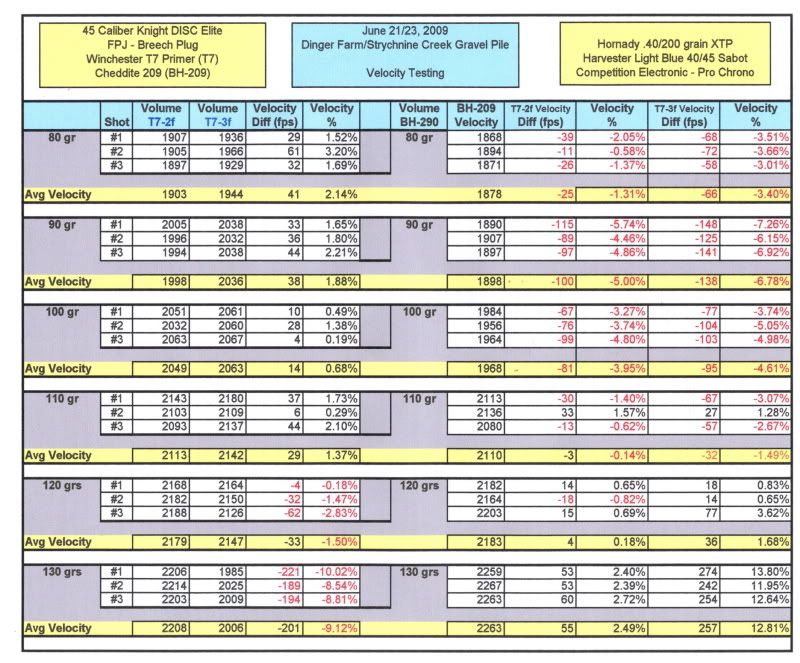 Guess it all come down to you will have to make your own judgement... |
So far ive only found 2 ways to get a really good burn with max amounts of BH209 and i prefer using both. A fairly tight sabot and a 300gr or larger .45X bullet if its in a 50cal. I haven't had any luck with 44x50 yet and heavier charges, They have either been inaccurate or blew the sabot although i havent used the Smooth Green yet.
100-115gr has given me the best results over the widest range of calibers, sabots and weights. Only 2 max load combos have really been impressive and those were in my 54cal with a 300gr+ and really tight but loadable sabots. Ive got some semi heavy 458s coming to try in the 52cal and was planning on trying them with upto 130gr in the slightly longer LRH barrel. I will try to layout a old sheet or tarp and see what residue is left also. The muzzle flash has also appeared normal to me with all loads but its worth the effort just to see what happens. |
sabotloader
The reason i came to the conclusion, it was unburnt powder on the snow, is because when i clocked the loads, the 120g load gave faster bullet speeds than the 130g load. |
Congratulations on the vent-liners. 100 shots and know sign of wear is excellent in my opinion.
The breech plug you show pictures of looks terrible. That primer pocket around the o ring looks plugged very bad. Not something i would use/trust that's for sure. I guess that's why you do testing. |
|
Originally Posted by Grouse45
(Post 3765815)
Congratulations on the vent-liners. 100 shots and know sign of wear is excellent in my opinion.
The breech plug you show pictures of looks terrible. That primer pocket around the o ring looks plugged very bad. Not something i would use/trust that's for sure. I guess that's why you do testing. You're the one that writes that one needs at least a 5/32 flame channel, and a 0.032" flash hole. The appearance of the plug after 24 shots, more or less verify what you write. I haven't cleaned the rifle or plug yet, but i did test to see what size drill, would fit into the remaining opening........1/16". It is also conceivable to me that the primer seat in this breech plug wouldn't have been ruined, had the flame channel been 5/32", and the flash hole been 0.032". What ever; the breech plug as it is, ignites BH in sub zero weather, and when it is nearly plugged up with carbon. Another thing i wonder is, would i get better results with 130g BH, if i had a larger flame channel, and a larger flash hole. |
Is it possible that a mag primer might help with max and slightly over max load data? A slightly larger flash hole to bring that mag primer fire to the powder maybe? Just some random thoughts since i normally shoot milder primers and have poor results with max loads in general.
How did sabots look from the different loads? The Harvester smooth green is pretty strong but did you get a chance to compare them? The lower velocity is just kind of strange considering some guys get good results with that much powder and a 200gr in a 40x50. I havent but.... :D |
Originally Posted by ronlaughlin
(Post 3765850)
Myself, i am curious about which is harder. The heat treated Lehigh vent liner, or the stainless steel of these cap screws that i made into vent liner.
You're the one that writes that one needs at least a 5/32 flame channel, and a 0.032" flash hole. The appearance of the plug after 24 shots, more or less verify what you write. I haven't cleaned the rifle or plug yet, but i did test to see what size drill, would fit into the remaining opening........1/16". It is also conceivable to me that the primer seat in this breech plug wouldn't have been ruined, had the flame channel been 5/32", and the flash hole been 0.032". What ever; the breech plug as it is, ignites BH in sub zero weather, and when it is nearly plugged up with carbon. Another thing i wonder is, would i get better results with 130g BH, if i had a larger flame channel, and a larger flash hole. As far as the breech plug, not sure if that would help. I would say no, clean plug against clean plug. The more you shoot my theory and others would be more consistent i believe. |
Originally Posted by Grouse45
(Post 3765919)
The Lehigh vent-liners go threw a process that keeps them from wearing out from the heat as well as hardened. I'm pretty sure it's not all about hardness. You stated you got 100 shots and no wear at all????? That's dam good in my opinion. Are they cheap or expensive?.............................
So far i have learned to use cobalt drills not high speed steel drills. Cobalt drills cost me about $3 each instead of $.85 each. The cobalt drills can drill more than one hole, but they don't last forever. Stainless seems to be fussy about what one uses for lubricant, and has led me to invest in 2 different brands supposedly good for drilling stainless. Both of these lubricants work better than the mineral oil i tried initially. It turns out, if i hold my mouth right, and have enough of the correct lubricant, and use expensive drills, i can make a vent liner for a few cents. It also turns out that one could ruin several cap screws, and break several drills, and not have made one good vent liner. Making vent liners seems quite silly to me. In my possession are several Lehigh vent liners, a few PR vent liners, and some home made stainless steel vent liners with 0.028", 0.029", and 0.032" flash holes. |
| All times are GMT -8. The time now is 07:39 AM. |
Copyright © 2026 MH Sub I, LLC dba Internet Brands. All rights reserved. Use of this site indicates your consent to the Terms of Use.